
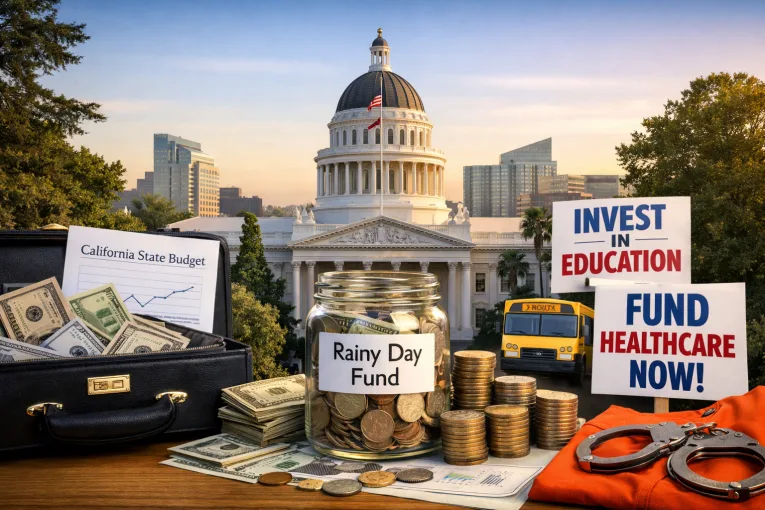
SACRAMENTO, Calif. — Progressive advocacy organizations across California responded to Gov. Gavin Newsom’s proposed 2026–27 state budget with cautious praise, pointing to stronger-than-expected revenues, a markedly smaller projected deficit than many analysts had feared, and renewed deposits into the state’s Rainy Day Fund, while urging lawmakers to expand investments in anti-poverty programs, health care and community services as the budget process moves forward.
Newsom submitted a $348.9 billion spending plan to the Legislature that reflects what his administration described as California’s underlying economic strength, higher-than-projected revenues and disciplined spending.
The proposal includes total deposits of $23 billion into state reserves and projects a $2.9 billion deficit for the upcoming fiscal year, a figure significantly lower than earlier estimates that had raised concern about deep and prolonged budget shortfalls.
Administration officials attributed the improved outlook to stronger cash receipts, resilient financial markets and a better-than-expected economic trajectory over the three-year budget window.
The governor’s office said December revenues alone exceeded projections by nearly $3 billion, revenue that was not yet incorporated into the January proposal, further underscoring the extent to which the deficit had narrowed.
Despite the improved revenue picture, Newsom framed the budget as deliberately cautious, limiting new ongoing spending and prioritizing long-term fiscal stability amid uncertainty driven by federal policy changes, global economic volatility, tariffs and immigration actions that could affect inflation, labor markets and state revenues.
“This budget reflects both confidence and caution,” Newsom said in a statement accompanying the proposal. “California’s economy is strong, revenues are outperforming expectations, and our fiscal position is stable because of years of prudent fiscal management — but we remain disciplined and focused on sustaining progress, not overextending it.”
Progressive groups said the stronger fiscal footing reinforced their argument that California can protect existing social investments while addressing urgent unmet needs.
The Prosper California Coalition, a cross-sector partnership of more than 50 community, faith, direct service and labor organizations, welcomed the governor’s decision to protect the California Earned Income Tax Credit, the Young Child Tax Credit and the Foster Youth Tax Credit, programs the coalition said have delivered more than $8.8 billion to families since their creation.
The coalition said those refundable tax credits have proven effective at reducing poverty and helping families with low incomes meet basic needs such as food, rent and child care.
While praising the preservation of the credits, the coalition called on legislators to expand CalEITC education and outreach, invest additional funding in free tax preparation assistance, expand eligibility for the Young Child Tax Credit and restore cuts affecting families and immigrants enacted in the prior budget year.
Advocates warned that economic pressures on low-income Californians are likely to intensify as federal policy shifts under H.R.1 take effect over time, increasing the importance of state-level protections.
Shimica Gaskins, president and CEO of End Child Poverty California powered by GRACE, said the proposed budget continues the governor’s long-standing focus on combating child poverty even amid fiscal uncertainty.
“As the state grapples with federal attacks and economic uncertainties, we are glad to see Governor Newsom continue to invest in programs that support families and combat poverty,” Gaskins said. “His legacy as a champion to end child poverty is clear in the success of California’s three refundable tax credits — the CalEITC, YCTC, and FYTC — delivering $8.8B to families since their creation.”
The governor’s budget also emphasizes rebuilding fiscal reserves and paying down long-term obligations, moves that progressive groups acknowledged as important safeguards against future downturns.
The proposal includes a $3 billion deposit into California’s Rainy Day Fund, bringing total reserves to $23 billion, and commits $11.8 billion over four years toward reducing pension liabilities, including $3 billion in the upcoming fiscal year.
Administration officials said those steps are intended to strengthen California’s fiscal resilience and protect core programs from revenue volatility, a concern heightened by the state’s reliance on capital gains income and the prospect of economic disruption tied to federal policy shifts.
Pete Manzo, president and CEO of United Ways of California, said he was encouraged that the budget avoided further significant cuts to core safety-net programs. “We are encouraged that the Governor highlighted effective anti-poverty programs like the CalEITC, Young Child Tax Credit, and Foster Youth Tax Credit in his list of major achievements,” Manzo said. “With over one in three households living below the Real Cost Measure, maintaining state investments in essential services matters.”
Education emerged as a central pillar of the proposal, with record per-pupil funding and continued investments in universal transitional kindergarten, universal school meals, before- and after-school programs and the community schools model.
The administration said those investments have already shown measurable results, including reductions in chronic absenteeism and improved academic outcomes for historically underserved students.
The budget also maintains substantial funding for higher education, with billions allocated to the University of California, California State University and the California Community Colleges.
The administration highlighted data showing that a majority of UC and CSU students graduated without student loan debt in recent years, outcomes it attributed in part to sustained state investment.
While acknowledging the scale of those commitments, progressive advocates argued that the improved revenue outlook strengthens the case for rejecting proposed cuts in other areas. Health advocates were particularly critical of the governor’s proposal to reduce Medi-Cal Dental funding for children, warning that eliminating an estimated $144 million in state funding would trigger the loss of approximately $182 million in federal matching funds and result in long-term cost increases.
“Cutting Medi-Cal Dental for kids is shortsighted and dangerous,” said Dr. Jeff Jacobson, a Sacramento-based dentist. “These reductions will force providers out of the system, leave children without preventive care, and push more families into emergency rooms.”
Advocates cited state data showing that dental pain remains one of the leading causes of missed school days and that untreated tooth decay is widespread among California children, particularly in low-income communities. They warned that previous eliminations of dental benefits led to sharp increases in emergency room visits, driving up state costs before coverage was eventually restored.
Criminal justice reform organizations also weighed in, pointing to the budget’s acknowledgment that California’s incarcerated population continues to decline.
The California Department of Corrections and Rehabilitation estimates that prison and facility closures, deactivations and contract terminations will generate approximately $4.9 billion in cumulative savings by 2027–28, with annual savings approaching $600 million.
Despite those trends, the budget does not identify additional prisons for closure beyond the planned shutdown of the California Rehabilitation Center in Norco in 2026. Advocates said the state is missing an opportunity to reduce incarceration costs further and redirect savings to community-based services.
“Abysmally low elder parole grant rates and extreme sentencing have turned prisons into expensive nursing homes,” said Dax Proctor, statewide coordinator for Californians United for a Responsible Budget. “That’s an inhumane, fiscally reckless policy choice. It doesn’t improve public safety.”
Advocates noted that the budget projects relatively modest increases in the prison population associated with Proposition 36, far below earlier estimates, and argued that those revised projections undermine the case for maintaining excess prison capacity.
The budget also reflects growing pressure from federal policy changes. The administration estimates that recent federal actions will impose $1.4 billion in additional costs on California, including $1.1 billion in Medi-Cal and nearly $300 million in CalFresh. Progressive groups said those added costs heighten the need for state action to protect health care and food assistance programs.
End Child Poverty California urged state leaders to defend CalFresh and Medi-Cal, eliminate enrollment freezes and premium requirements that disproportionately affect immigrant communities and adopt progressive revenue solutions to offset federal rollbacks.
“As Washington targets immigrant communities and vulnerable populations while handing out massive tax breaks to the wealthy, we must refuse to balance our budget on the backs of our poorest families,” Gaskins said.
While Newsom’s budget proposes new investments in housing, reproductive health care grants, wildfire resilience and public safety, progressive advocates said the broader fiscal context should encourage lawmakers to be bolder.
They pointed to the narrowing deficit, replenished reserves and continued revenue strength as evidence that California has more capacity to invest than previously assumed.
At the same time, advocates acknowledged the governor’s emphasis on accountability and efficiency, including reductions in state operations spending and the elimination of long-vacant positions, moves the administration says will generate billions in savings without cutting services.
As the Legislature begins hearings and negotiations, progressive groups said the debate over the 2026–27 budget will test competing visions of fiscal prudence and social investment.
While praising the governor for stabilizing the state’s finances and avoiding worst-case deficit scenarios, advocates argued that the budget process must now focus on translating improved fiscal conditions into tangible protections for children, families, elders and vulnerable communities.
They said the coming months will determine whether California uses its strengthened fiscal position to deepen equity and resilience or allows federal volatility and caution to erode hard-won gains.
Follow the Vanguard on Social Media – X, Instagram and Facebook. Subscribe the Vanguard News letters. To make a tax-deductible donation, please visit davisvanguard.org/donate or give directly through ActBlue. Your support will ensure that the vital work of the Vanguard continues.

“As it stands, California’s state and local governments have the most public pension debt in the country, with total unfunded pension liabilities of more than $265 billion, according to a new report from the Reason Foundation. That’s over $6,000 in pension debt for every state resident.”
https://reason.org/commentary/californias-state-and-local-pension-plans-have-over-265-billion-in-debt/#:~:text=As%20it%20stands%2C%20California's%20state,debt%20for%20every%20state%20resident.
California’s total pension debt is “the most” for the obvious reason that California has 12% of the US population. The per capita pension debt in California is not “the most,” it is about 10th in the country, at least as of 2022.
State
Public Employee Benefit Debt per Capita
Total Public Employee Benefit Debt
1
New Jersey
$17.65K
$163.93B
2
Connecticut
$15.82K
$57.05B
3
Illinois
$14.55K
$186.46B
4
Delaware
$8.58K
$8.5B
5
Vermont
$8.17K
$5.25B
6
Hawaii
$8.07K
$11.74B
7
Massachusetts
$7.12K
$50.02B
8
Kentucky
$6.17K
$27.8B
9
Maryland
$4.34K
$26.8B
10
California
$3.75K
$148.45B
https://reason.org/commentary/public-pension-debt-rankings-for-state-and-local-governments/
That’s… over… $6,000… in… pension… debt… for… every… state… resident.”
Let that sink in.
While per-capita is a better measure, it doesn’t negate the basic fact/argument that we are all per-capita screwed.
“PROGRESSIVES PRAISE REVENUE GAINS IN NEWSOM BUDGET, PRESS FOR DEEPER INVESTMENTS”
Good, I want to open a Childcare Learing Center?