
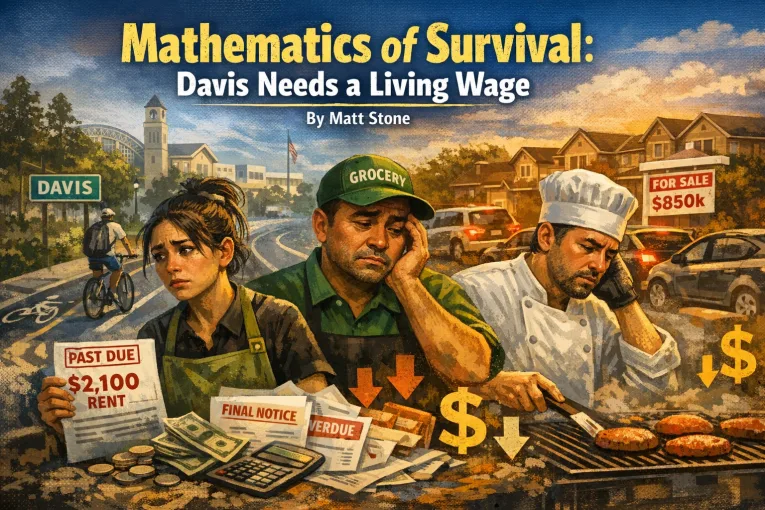
We love to talk about Davis. We love to talk about the bike lanes, the farmers market, the intellectual vibrancy, and the “quality of life.” We wrap the city in an identity of progress and education, proudly displaying it as a beacon of the future.
But there is a bill for that identity, and right now, it is being paid by the people who can least afford to cover it.
We need to talk about the math.
Generally, based on available data, the average rent for a one-bedroom apartment in Davis is roughly $2,100 a month. To afford that without being rent-burdened, meaning you spend more than 30% of your income just to keep a roof over your head, you need to earn roughly $84,000 a year. That breaks down to a wage of roughly $40 an hour.
The average mortgage is even more unforgiving. With a median home price generally around $850,000, the monthly cost is roughly $5,100. That requires an income of nearly $205,000 a year. To buy into the “Davis dream,” you generally need to earn almost $100 an hour.
Now, look at what is paid.
The projected California minimum wage for 2026 is estimated to be around $17 an hour. That yields an annual income of roughly $35,000.
Is the town happy paying poverty wages? Does your heart feel good knowing that the person who made the coffee, stocked the shelves, or cleaned the university lab is generally short $50,000 a year just to have a roof over their head?
This is not a theoretical problem. It is a structural choice. A $17 wage in a $2,000 rental market is not a safety net; it is a guarantee of overcrowding, commuting, and financial precarity. It forces the very people who make Davis function to live elsewhere, draining the vitality from the community they serve.
Consider the human cost. Think about the single parent working full-time at a local grocery store. Think about the line cook working the lunch rush who can’t afford to live in the city where he cooks. Think about the barista who knows every regular’s order but can’t afford a one-bedroom within the city limits. These are not statistics. They are neighbors. They are the invisible backbone of a town that likes to preach inclusion while practicing exclusion.
Look around. You see the teachers who drive in from out of town because they can’t afford the rent. You see the police officers who commute hours to protect a community they can’t afford to join. You see the service workers who are exhausted before the day begins because they are working two jobs just to survive.
You see the traffic congestion caused not by too many cars, but by the displacement of the workforce.
You see the high cost of living. You see the inflation. You see everything but the root cause: the wage.
This is where the “University Town” narrative bumps up against reality. Davis is a hub of intellect, research, and progress. It prides itself on being smarter than the average municipality. Yet, it runs the local economy on a mathematically impossible model. It relies on a class of service workers who are effectively subsidizing the lifestyle of the affluent with their own survival. The prosperity of the few is built on the poverty of the many.
Franklin D. Roosevelt famously said, “No business which depends for existence on paying less than living wages to its workers has any right to continue in this country.” By that standard, much of the Davis service sector is currently on probation, tolerating a model that fails to meet the basic test of human dignity.
Davis can do better. It has the resources to do better.
If we look at other municipalities, we see that raising the floor is not economic suicide. Emeryville and Berkeley, (progressive enclaves that house major universities) have already paved the way. They have implemented tiered wage structures that protect small businesses while requiring large corporations to pay a living wage. They proved that a high-wage economy is sustainable.
We even have a mirror in Flagstaff, Arizona. Flagstaff is a university town. It relies heavily on tourism and students. It currently boasts a minimum wage of $17.40. Even then, a single adult generally needs about $22.50 to afford the basics there. The gap remains, but they are doing more to close it than Davis is.
The critics will scream about tradeoffs. They will warn that businesses will flee. But the math is already screaming the opposite. Davis is currently subsidizing low-wage businesses with public services. When a worker cannot afford to live in the town they serve, their tax dollars go elsewhere. When they cannot afford food, they rely on safety nets.
It is time to shift the burden. Raising the wage is not just about charity; it is an investment in the local economy. When workers earn a living wage, they spend that money in the community. When they are forced to commute, they spend it where they live.
The community has to decide what kind of town it wants to be. If it believes in the dignity of work, it must pay the cost of that dignity. If it believes in a “progressive” future, it has to pay for it. We have the data. We have the examples. The only thing missing is the courage to act.

California is expensive. No argument there. But the conclusion you’re drawing is backwards.
Minimum wage hikes don’t hit “the economy.” They hit restaurants, cafés, retail, childcare, gyms, small grocers, auto shops, salons, and other small services. These businesses survive on thin profit, volatile demand, and constant fixed costs. When wages jump, owners raise prices, cut hours, cut staff, cut benefits, automate, or shut down. I know, I ran a small business for awhile. Walk through downtowns in San Francisco, Oakland, Berkeley, Sacramento, parts of Los Angeles and you see fewer independent shops, more vacancies, more “For Lease” signs, and what remains tends toward high-margin luxury, corporate chains, or “hobby businesses” subsidized by wealth.
A Starbucks spreads labor costs across huge volume, standardized workflows, and corporate financing. A local café can’t. A big retailer leans on scale, automation, and supplier leverage. A family-run shop can’t. Minimum wage hikes punish the exact kind of local ownership everyone claims to want, independent, quirky, community-rooted businesses. Look at how Davis is changing, all you have to do is look downtown, then look at the Davis Collection: all thriving chains.
And the “just pay more” argument always skips the real-world mechanics. Labor cost increases don’t stay neatly contained to the lowest-paid worker. The ladder compresses, shift leads want more, experienced workers want more, assistant managers want more, payroll balloons without a matching increase in customers. The result shows up fast, fewer shifts, fewer hires, fewer entry-level opportunities, more closures, “closed Mondays,” “kitchen closes at 8,” self-checkout, QR ordering, one exhausted manager doing three jobs. And once those patterns start, closure is almost certain to follow, and then those people don’t have those jobs at all. I’ve seen it hundreds of times. And now Ding How is closing, and other independent businesses, many in the very towns you mentioned, are teetering.
People who need a true “living wage” also aren’t the long-term workforce for minimum-wage jobs anyway. Minimum wage work has a market because it’s part-time, entry-level, flexible, seasonal, student-friendly, second-income supplemental, short-term “bridge” employment. A lot of these jobs get filled by students, roommates doubling up, retirees staying active, and people using the job to get experience and move up. Turning entry-level jobs into “career wages” sounds compassionate, but the market response becomes fewer jobs, fewer hours, more automation, and more corporate dominance.
And look at the numbers. California’s minimum wage keeps climbing, but the “living wage” advocates cite keeps climbing too. Even if you pushed the minimum wage to $22, $25, even $30, the same activists would come back and say it still isn’t enough. So what’s the plan, $40/hour minimum wage, $60, $100 for everyone to meet Davis’ dream? That’s a never ending ladder, not a serious policy, and of course the price of housing will climb upward with this mass inflow of cash. Money is just trade, nothing more, and you can’t hide from the reaper of the economic reality of what things really cost and what the demand really is.
California already has a clear pattern: mandates go up, small businesses get squeezed, and the winners end up being the biggest players who can absorb the hit.
If you want higher pay, the sustainable path comes from productivity, competition for labor, lower regulatory drag, and more business formation, not wage laws that turn small employers into the enforcement arm of a political talking point. Minimum wage hikes feel good on paper, then you watch the real-world outcomes, higher prices, fewer entry-level jobs, fewer local businesses, more chains, and the same people who pushed the policy acting shocked when the neighborhood gets hollowed out and the price of everything goes up to match.
Yes Alan, Davis already has enough empty storefronts. Raising the minimum wage in Davis to $40/hour will make Pole Line Road even more crowded with the outflow of shoppers to Woodland.
A quick A.I. search revealed the fallout from local higher minimum wage laws:
Examples of Cities and Reported Impacts:
West Hollywood, CA: Experienced business closures, staff cuts, and reduced hours following steep minimum wage increases, prompting council delays.
Los Angeles, CA: Faced job losses in the full-service restaurant sector and potential hotel conversions due to high wage mandates.
Seattle, WA: The $15 minimum wage correlated with restaurant closures and increased tuition at childcare centers.
New York City, NY: Lost thousands of restaurant jobs and saw significant closures, especially in areas like Times Square.
Emeryville, CA: A study linked job losses and closures to the city’s minimum wage hikes, leading to temporary halts in increases.
San Francisco, CA: Faced significant restaurant job losses amid annual wage hikes and regulatory pressures.
California’s Statewide Fast Food Wage:
The $20 minimum wage for fast-food workers in California has been linked to widespread job losses (around 16,000), reduced hours for employees, and menu price increases, with many restaurants closing.
What studies were relied upon?
Your “perspective” highlights the challenges that small businesses face in a high-cost environment like California. However, let’s cut through the noise and address the core issue head-on: your idea that people should live in poverty to support businesses is not just shortsighted; it’s downright exploitative and unethical.
The notion that workers should live in poverty to keep business costs low is a twisted logic that benefits no one in the long run. Paying poverty wages creates a cycle of dependence on public assistance and a less stable workforce. It’s a band-aid solution that masks deeper economic issues. The plan is to pay an actual living wage and to keep it current with the cost of living. This ensures that workers can afford basic necessities AND contribute to the LOCAL economy.
While it’s true that large corporations have advantages, this doesn’t justify keeping workers in poverty. The idea that small businesses can’t compete is a cop-out. Many independent businesses thrive by offering unique products and personalized service. Supporting these businesses requires a multi-faceted approach, including fair wages, affordable housing, and policies that reduce regulatory burdens. The shift towards corporate chains is influenced by multiple factors, not just wage increases.
While it’s true that labor cost increases can have ripple effects, this doesn’t negate the need for fair wages. The idea that turning entry-level jobs into “career wages” will lead to fewer jobs is a scare tactic. Many businesses can adapt by increasing prices slightly, improving productivity, and benefiting from a more prosperous local economy. Additionally, the argument that minimum wage jobs are meant to be entry-level overlooks the reality that many workers rely on these jobs as their primary source of income.
This argument is a convenient way to dismiss the needs of workers. Many workers, especially in high-cost areas, rely on these jobs as their primary source of income. Turning these jobs into “career wages” can provide a pathway to economic stability and mobility for workers who might otherwise struggle to make ends meet. The idea that the “living wage” is a moving target is valid, but it doesn’t negate the need for fair compensation.
While these factors are important, they are influenced by a range of policies, including education, infrastructure, and regulatory environments. Minimum wage increases can be part of a broader strategy to support workers and promote economic growth. It’s also worth noting that many successful economies have implemented high minimum wages and strong social safety nets with positive outcomes for both workers and businesses.
Then… the most insidious part of your argument. The idea that people should live in poverty to support businesses is fundamentally flawed and unethical. Workers deserve fair compensation for their labor, and businesses should strive to create sustainable models that support both their employees and their bottom line. Paying poverty wages may keep business costs low in the short term, but it creates a range of social and economic problems that ultimately harm both workers and the broader economy. It’s a twisted logic that benefits no one in the long run.
These tired arguments have been around for 50 years, and the numbers disprove them many times over. Study after study has shown that modest increases in the minimum wage do not lead to significant job losses or business closures. Instead, they lead to increased worker productivity, reduced turnover, and a more stable workforce. The idea that minimum wage hikes are bad for the economy is a myth that has been debunked by countless economic studies. It’s time to move beyond these outdated arguments and focus on creating a more just and equitable society for everyone.
Overall, while your concerns about the impact of minimum wage hikes on small businesses are minimally valid, they don’t tell the whole story. A more nuanced approach that considers the broader economic context, the needs of workers, and the potential benefits of fair wages is necessary. By supporting policies that promote economic mobility, fair compensation, and a thriving local economy, we can create a more just and equitable society for everyone. People living in poverty to support businesses is not just a bad idea; it’s an exploitative one that we should all reject. The “plan” is to pay an actual living wage and to keep it current with the cost of living, ensuring that workers can afford basic necessities and contribute to the local economy.
I’m curious why the focus on Davis raising the minimum wage and not let’s say Winters? Is it because Davis is a university town? Why should university towns pay higher minimum wages than it’s neighbors?
Does Winters not have a housing affordability problem? Not according to this A.I. search:
“Average rent in Winters, CA, varies but expect rates generally starting around $1,800-$2,000 for smaller units, with a recent listing showing a studio at $1,850 and a one-bedroom at $1,900.”
Yes… the disparities between different communities are factors that influence housing affordability and cost of living.
Firstly, the focus on Davis is not arbitrary. Davis is a university town with a significant student population, which means it has unique economic dynamics. The presence of the University brings in a large number of students, faculty, and staff, which can drive up the cost of living, including housing. This is a common phenomenon in university towns, where the demand for housing and services is high due to the influx of people associated with the university.
However, the argument for raising the minimum wage in Davis is not solely based on its status as a university town. The cost of living in Davis is high for everyone, not just students. According to recent data, the average rent for a one-bedroom apartment in Davis is roughly $2,100 a month. To afford this without being rent-burdened, one needs to earn roughly $84,000 a year, or about $40 an hour. This high cost of living affects all residents, including service workers, retail employees, and other low-wage earners. $40/hr to be OUT OF POVERTY.
Now, let’s address Winters. You’re right that Winters also has a housing affordability problem. The average rent in Winters, as you mentioned, starts around $1,800-$2,000 for smaller units. While this is slightly lower than Davis, it’s still a significant burden for low-wage workers. The cost of living in Winters is influenced by its proximity to Sacramento and other Bay Area cities, which drives up housing prices.
The argument for raising the minimum wage is not about pitting one community against another but about ensuring that all workers can afford to live in the communities where they work. The cost of living in both Davis and Winters is high, and workers in both towns deserve fair compensation for their labor.
Moreover, the idea that university towns should pay higher minimum wages than their neighbors overlooks the fact that the cost of living is influenced by a range of factors, including housing market dynamics, local economic conditions, regional disparities, AND the University itself. University towns often have higher costs of living due to the concentration of wealth and the demand for services, but this does not mean that workers in these towns should be paid less.
Additionally, Davis has the unique ability to set an example that can trickle down to surrounding communities. As a prominent university town with a strong economic base, Davis can lead the way in demonstrating that paying a living wage is not only feasible but also beneficial for the local economy. When Davis raises the minimum wage, it sends a clear message to neighboring communities that fair compensation for workers is a priority. This can inspire other towns, like Winters, to follow suit and adopt similar policies, creating a ripple effect of improved economic conditions and quality of life for workers across the region.
The focus on Davis is not about singling out university towns but about addressing the high cost of living that affects all residents. The argument for raising the minimum wage is about ensuring that workers can afford to live in the communities where they work, regardless of whether those communities are university towns or not. Winters, like Davis, has a housing affordability problem, and workers in both towns deserve fair compensation for their labor. The goal is to create a more just and equitable society where all workers can afford basic necessities and contribute to their local economies. By setting an example, Davis can lead the way in creating positive change for surrounding communities.
Robots don’t require a wage, don’t get sick or go on strike, nor do they require a place to live (though they do need a dry closet, I guess).
I was going to say that they also don’t have a bad attitude, but then remembered some sci-fi movies which prove otherwise.
Yup, it’s hard getting service at a McDonald’s front counter anymore.
You know what’s worse than $20/hour (CA’s minimum wage for fast food workers), is no job at all.
“When Davis raises the minimum wage, it sends a clear message to neighboring communities that fair compensation for workers is a priority. This can inspire other towns, like Winters, to follow suit and adopt similar policies, creating a ripple effect of improved economic conditions and quality of life for workers across the region.”
And if those other towns don’t follow suit, that would lead to more low-wage workers attempting to get jobs in Davis (more inbound commuters).
If anything, Davis’ wages should probably be “lower” than other towns, so that those mofos get jobs in their OWN towns. (Can’t help but think of teachers in this scenario, who insist on working for an oversized school district. Though they may be motivated by factors other than wages.)
Actually, other factors might also be at play regarding reasons why a police officer, for example, might prefer to work in Davis, vs. some higher-crime community. But police are in an entirely different category compared to some flunky who decides to make “barista” a permanent career. (Actually don’t know of anyone who attempts that, other than someone with Down’s Syndrome for example – who require support regardless.)
Can some of the Davis business owners weigh in on this?
How would they feel about paying their employees $40/hour?
I know we have some Vanguard commenters who run small businesses and/or non-profits.
“I know we have some Vanguard commenters who run small businesses and/or non-profits.”
Gee, I wonder who that might be . . . (though at least one of them might provide some compensation in the form of educational credits/internships – especially in regard to future attorneys who might be suing cities/police departments for insufficient equity).
:-)
“MATHEMATICS OF SURVIVAL”
Small business owners also have to have a sense of “MATHEMATICS OF SURVIVAL” or they go out of business.
Why don’t some of the Davis business owners comment and explain this?