
For the past six years—since my release from incarceration—I have searched for inner peace: a salve for a shattered soul, a sense of calm after years of upheaval. That search has not always been easy. But it has also led me to clarity.
I am not trying to erase the nearly five years I spent incarcerated. I am not trying to return to the person I once was. And I am certainly not trying to forget the women I met or the experiences I witnessed behind prison walls. The answer to all of those questions is no.
I have forgiven. I have accepted. But I will never forget—and I shouldn’t. Those years fuel the work I do today. They reshaped my life’s trajectory and gave me purpose. I can now say, with complete sincerity, “I get it.” Not as a slogan or a talking point, but as a lived truth.
This understanding goes beyond sympathy or even compassion. It is empathy—the ability to recognize pain before it is spoken, to hear the weight carried by certain words. It is known that what may be an ordinary day for one person can be a life-altering anniversary for another: the day of arrest, sentencing, incarceration, or release. These dates are etched into memory as permanently as birthdays or weddings. They define lives.
For nearly six years, reentry work became my salve. I worked alongside extraordinary colleagues and clients who became family. Together, we helped people navigate the rocky and unforgiving road of reentry. For the first time, I was doing work that felt right—work I could dedicate my life to. This wasn’t just a job. It was healing.
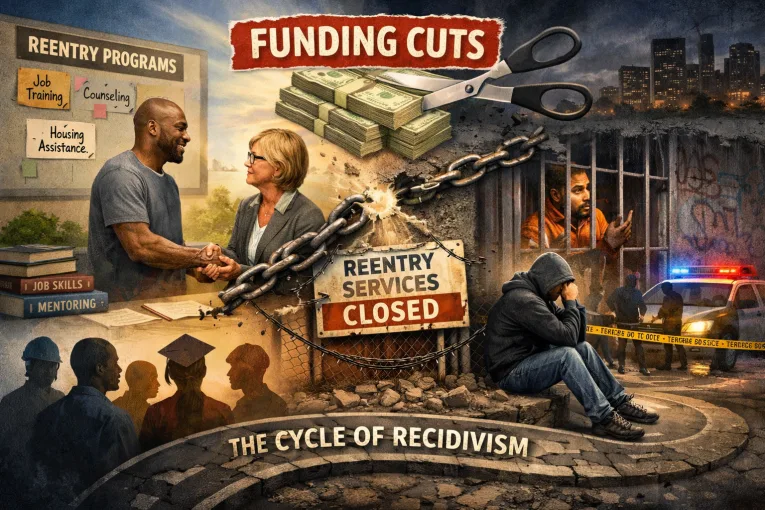
Yet despite clear evidence that reentry programs work—despite proven outcomes and measurable success—funding for these services is being slashed or eliminated altogether. This is the true crime: the systemic neglect of people returning to our communities.
The scale of the issue demands attention. Nearly 2 million people are incarcerated in the United States today, with tens of millions more directly affected by the criminal legal system through probation, parole, or a criminal record that follows them long after release.
When reentry services disappear, so do the basics: temporary housing, hot meals, clean clothes, safe places to land. Without support, the cycle continues. Someone once sober relapses. Someone who fought to resolve court cases and rebuild their life finds no safety net and returns to what they know—another offense, another sentence, another loss.
Do policymakers and funders truly understand what is at stake? We know incarceration remains a massive part of our social landscape, and yet we are stripping away the very services that help people successfully reintegrate. This contradiction is not just illogical; it is dangerous.
Reentry services are not charity. They are public safety. They are a community investment. They are proof that transformation is possible when people are given support instead of abandonment.
As I look toward my future, I ask myself what comes next—how I can continue serving a population that deserves more than survival? I don’t yet have all the answers. But I know this much: cutting reentry services doesn’t save money, reduce crime, or strengthen communities. It only guarantees that the cycle will continue.
And we will all pay the price.
Kathy Morse is an advocate for incarcerated and formerly incarcerated individuals, and for justice reform.

Thank you for your voice ☮️💚