
“When political actors begin defending state violence based on who it targets rather than how it is exercised, the republic is already in peril.” – Representative Marjorie Taylor Greene
“The administration is urging Americans to reject the evidence of their eyes and ears.” – New York Times editorial board
It is not a sign of health in a democracy when a figure best known for political extremism sounds, even briefly, like a custodian of constitutional restraint. It is a warning.
Representative Marjorie Taylor Greene is not a credible avatar of civil liberties. Her political career has been built on division, provocation, and grievance.
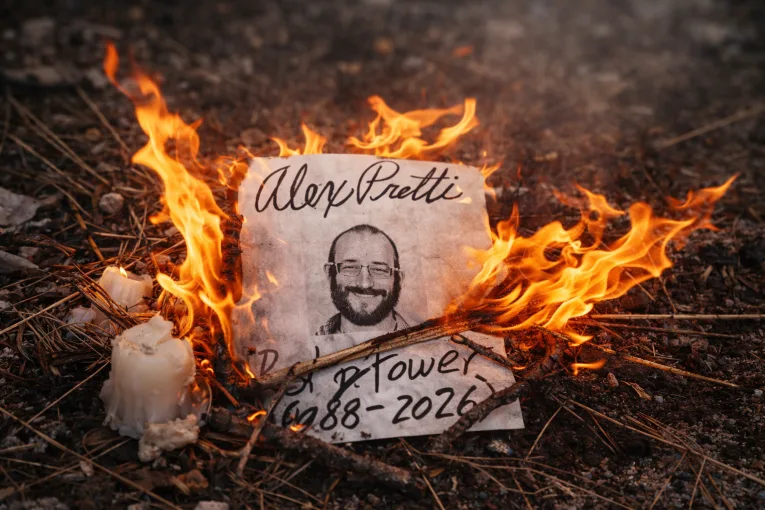
Yet her recent statement responding to the killing of Alex Jeffrey Pretti in Minneapolis deserves attention—not because it redeems her record, but because it inadvertently illuminates how far the country has drifted toward a more dangerous political condition.
Greene’s remarks are notable less for what they advocate than for whom they are addressed to. Speaking directly to her own supporters, she reaffirmed her long-standing positions on border enforcement and law enforcement, writing, “I unapologetically believe in border security and deporting criminal illegal aliens and I support law enforcement.”
But she then pivoted to a language that has grown disturbingly rare in today’s political discourse: a defense of constitutional process and restraint.
“I also unapologetically support the 2nd Amendment,” she wrote. “Legally carrying a firearm is not the same as brandishing a firearm. I support American’s 1st and 4th Amendment rights. There is nothing wrong with legally peacefully protesting and videoing.”
Greene then posed a hypothetical meant to pierce partisan loyalty by asking her readers to imagine the same sequence of events—federal agents shoving a woman to the ground, deploying bear spray, beating a man, disarming him, and then killing him—occurring not to someone viewed as a political enemy, but to a supporter of the MAGA movement.
“What would have been our reaction?” she asked.
Her conclusion was blunt: “Both sides need to take off their political blinders. You are all being incited into civil war, yet none of it solves any of the real problems that we all face, and tragically people are dying.”
I don’t agree with the both sides framing here as though equal culpability, and for sure Greene’s warning does not make her a moral authority.
But it does underscore a profound civic truth: when political actors begin defending state violence based on whom it targets rather than how it is exercised, the republic is already in peril.
What Greene’s statement reveals—perhaps unintentionally—is that the machinery of coercive power is starting to feel indiscriminate, unmoored from shared rules, and therefore threatening even to those who once applauded its use.
That assessment is echoed, more soberly and with greater institutional weight, by the New York Times editorial board.
Responding to the killing of Mr. Pretti, the board wrote that “when the government kills, it has an obligation to demonstrate that it has acted in the public interest.”
It concluded that the Trump administration has instead engaged in “a perversion of justice,” citing official statements made “without offering evidence” and characterizing them as “unfounded and inflammatory judgments” that “pre-empt the outcome of an investigation.”
The editorial board’s gravest charge was not merely that officials spoke too soon, but that they sought to impose a false narrative in defiance of visible facts.
“The administration is urging Americans to reject the evidence of their eyes and ears,” the board wrote. “Ms. Noem and Mr. Bovino are lying in defiance of obvious truths. They are lying in the manner of authoritarian regimes that require people to accept lies as a demonstration of power.”
That phrase—a demonstration of power—captures the heart of the danger facing the country. Democracies are not only systems of elections and laws; they are systems of belief.
They depend on a shared understanding that truth matters, that force is bounded by rules, and that the state must account for itself when it takes a life.
When those assumptions erode, the political order does not simply become more polarized, it becomes unstable. This is something out of 1984.
Long-form reporting from Minneapolis shows what that instability looks like on the ground.
The New York Times described a city transformed by the federal immigration crackdown into what one correspondent called “a giant eyeball,” where “every exercised citizen’s smartphone” functioned as a form of community surveillance.
The reporting documented how “the lines between documentation and confrontation had grown blurry,” and how the presence of heavily armed federal agents did not calm the city but instead intensified fear and confusion.
In one of the most revealing passages, the reporter observed that the agents’ presence “was a vector of chaos,” noting that they appeared to have “no capacity to maintain order or much apparent interest in doing so.”
What held crowds back, the reporter wrote, was not confidence in law enforcement, but fear born of recent killings.
The conclusion drawn by many residents was stark: “Nobody could help them. They were on their own.”
That sense of abandonment—of being governed by spectacle and force rather than law—is corrosive, because when people no longer believe institutions will protect them they retreat into tribe, neighborhood, and mutual defense, a turn that may resemble resilience but more often signals the early stages of fragmentation.
The constitutional stakes of this moment are further clarified by the historical analysis offered by WIRED.
Garrett M. Graff situates the Minneapolis deployment within a long American tradition of federal intervention, from the enforcement of desegregation orders to the protection of civil rights marchers.
But he draws a sharp distinction between those episodes and the present one.
“Trump today is attempting something unprecedented that stands in contravention of all historical tradition in the United States,” Graff writes, describing “the brutal application of federal forces against a state and region with no apparent reason beyond its being led by members of the political opposition.”
Graff also argues that the character of the deployed forces matters.
“The agents from Customs and Border Protection (CBP) and ICE are different,” he writes. “They are not trained to normal federal law enforcement standards of dealing with the public and are meant to operate with severely limited authority to enforce immigration matters, not general federal laws.” He adds that CBP agents are “less a regular law enforcement agency, grounded in due process, and more a paramilitary force meant to operate on the border regions.”
These distinctions are not academic; they go to the heart of what kind of power the state is exercising and against whom, because a democracy that deploys paramilitary-style forces at home, blurs lines of authority, and treats dissent or documentation as provocation is not merely enforcing the law but fundamentally reshaping the relationship between the state and its citizens.
That is the deeper significance of Greene’s intervention: her warning lands not because it is principled, but because it recognizes—perhaps for the first time—the boomerang effect of normalized excess.
Once the logic of “order at any cost” is accepted, once evidence becomes subordinate to official narrative, and once force is justified by affiliation rather than conduct, no faction retains control over where that power will land next.
History suggests that democracies rarely collapse through sudden coups.
More often, they hollow out gradually through repeated episodes in which exceptions become precedents and precedents become norms, each justification seeming temporary and each outrage absorbed until what was once unthinkable becomes merely controversial and then routine.
This is why the present moment should not be understood primarily as a partisan crisis or even as a policy dispute over immigration, but as a crisis of democratic restraint, one that turns on whether truth remains a constraint on power, whether accountability is still possible, and whether constitutional rights are enforced universally or only selectively.
Greene is right about one thing: political blinders are dangerous.
But the danger is not symmetrical because power is not symmetrical, and the obligation therefore falls most heavily on those who wield state force—and on the institutions meant to check it—to pull the country back from a precipice where violence becomes policy, denial becomes doctrine, and loyalty replaces law.
The question now is whether Congress, the courts, and the public will insist on that restraint, or whether the United States will continue to drift toward a politics defined by domination and fear.
More than a century ago, confronted with a world sliding toward catastrophe, W. B. Yeats wrote: “Things fall apart; the centre cannot hold.”
He ended with a question that still resonates today: “And what rough beast, its hour come round at last, slouches towards Bethlehem to be born?”
Follow the Vanguard on Social Media – X, Instagram and Facebook. Subscribe the Vanguard News letters. To make a tax-deductible donation, please visit davisvanguard.org/donate or give directly through ActBlue. Your support will ensure that the vital work of the Vanguard continues.

This really cracks me up that the left is now hanging on MTG’s every word.
You clearly didn’t read the article carefully if that is your Takeaway
It’s not just you citing MTG in your article, it’s everywhere on all of the left leaning news outlets.
Where the left once hated MTG they now love her because of her conflict with Trump.
I don’t love her, I merely pointed out she’s being more reasonable on this than say… you.
That’s what people say when someone doesn’t agree with their side of the argument, that the other side is being unreasonable.
So we must defer to the left’s new expert, MTG. LMAO
MTG pointed out a real problem, you haven’t said anything.
It’s a man bites dog story, for sure. But MTG isn’t the only one. Even the Minnesota Gun Owners Caucus is asking for a full investigation. The only people who think the murder of a citizen engaged in legally sanctioned activity are those who have voluntarily chosen to ossify their minds, close their hearts and turn their backs on living a moral life.
I’m not hanging on her every word, so that excuses me from the left. After all, she asserted that Ashli Babbitt was innocent as the woman climbed through a broken window inside the Capitol and was shot by a Capitol police officer. Who would believe MTG?
Ashli Babbitt didn’t bring a pistol to a protest and still got killed.
She was warned in advance that they were going to shoot. Nobody held her down and shot her. She was part of a mob who were moving en masse, out numbering the Capitol Police and threatening violence. Alex Pretti was engaged in helping a woman the goons had knocked down, he was not part of a mob and was held down and gunned down from behind. Nothing similar at all except that MTG was incorrect that Ashli Babbit was some innocent bystander. So, help me understand what point it was you were trying to make when someone as hyperbolic as MTG is outraged by an actual murder.
“I don’t agree with the both sides framing here as though equal culpability, and for sure Greene’s warning does not make her a moral authority.”
Yes you do, or you wouldn’t have quoted her in this context. You just can’t handle ‘both sides-ing’ as an argument, or you are catering to you base. Greene, you has been Bat-S crazy in almost everything she has ever said, has said several surprisingly sane things, since just about the day she stepped down. Something major happened there, and one thing Greene keeps turning to is a condemnation of political violence. Hopefully she’ll denounce the existence Jewish space lasers — although Israel just announced a new iron dome laser technology, it is ground based.
But seriously DG, she’s talking to her political base. How is she supposed to get through to them with her message of the harm of escalating rhetoric and political violence. By becoming left wing? No, if she’s going to reach the right, this message of comparing the two sides with a similar scenario is going to ring true for many. In fact, I was listening this morning to many conservatives condemning Trump’s policies and rhetoric after the 2nd shooting.
Walz seems like Mr. Peace, but he shows his colors when he calls ICE the Gestapo, when these are federal law enforcement member doing what they are told, just like they did under the ‘Deporter-in-Chief’ Obama, but they weren’t faced with hostile to violent activists willing to take them on as combatants. The evocation of Godwin’s law is no longer laughable, it is today absurdly dangerous and politicians shouldn’t be evoking Nazi images of ICE agents.
I don’t condone either of these shootings from what I’ve seen so far. However, taking on ICE agents in the street isn’t the answer. The answer is a mass movement to change the laws. And I would start with a blanket amnesty of all immigrants who are not citizens and already here and without violent criminal records. I heard of one such law being considered, with some conservative support. Use your energy to protest outside the legislature and put massive pressure on your representatives who are sitting on their arses echoing extremist rhetoric on both sides while Minneapolis burns.
And the Vanguards’ new favorite word: “brink”.
Be interesting to see if general strike discussions actually come to fruition.
I agree it is mischaracterizing ICE like the Gestapo. They are much more like the Central American death squads. Masked, operating out of unofficial vehicles, acting with impunity, disappearing people.
Also like mischaracterizing much of the protesters as peaceful.
Here is what you’ve posted today on this subject:
Keith Olsen — January 26, 2026 at 8:53 am
“This really cracks me up that the left is now hanging on MTG’s every word.”
Keith Olsen — January 26, 2026 at 9:04 am
“It’s not just you citing MTG in your article, it’s everywhere on all of the left leaning news outlets. Where the left once hated MTG they now love her because of her conflict with Trump.”
Keith Olsen — January 26, 2026 at 9:13 am
“That’s what people say when someone doesn’t agree with their side of the argument, that the other side is being unreasonable. So we must defer to the left’s new expert, MTG. LMAO”
Keith Olsen — January 26, 2026 at 12:16 pm
“Ashli Babbitt didn’t bring a pistol to a protest and still got killed.”
I don’t think any of your comments are substantive – so here’s what you didn’t address..
Greene reaffirms her long-standing positions on border security, law enforcement support, and conservative constitutional values (Second, First, and Fourth Amendments).
She distinguishes legally peaceful protest and lawful gun ownership from wrongdoing or provocation, emphasizing that documentation of events (e.g., videoing) is legitimate civic engagement.
Greene poses a rhetorical challenge: if the same sequence of federal force occurred against someone perceived as aligned with her political base (e.g., a MAGA supporter), how would reactions differ?
She explicitly frames the situation as a danger of reciprocal escalation and political blindness, warning that both sides are being pulled toward deeper conflict that does not address actual systemic issues.
So let’s be more productive… here are my questions for you…
Do you believe First, Second, and Fourth Amendment protections should apply universally, regardless of political affiliation?
When Greene asks how reactions would differ if the same incident involved a MAGA supporter, do you believe the response should or would differ?
Greene argues that political blinders on all sides are accelerating conflict and normalizing violence. Do you agree that escalation is occurring?
Are you engaging with Greene’s argument about constitutional limits and restraint, or reacting primarily to her identity and past record?
Do you believe her argument about constitutional limits and restrain tis flawed, and if where specifically does it fail on constitutional, factual, or ethical grounds?
Do you believe this incident sets a precedent that should concern people across the political spectrum?
If it is a precedent, what limits should exist on federal power to prevent further normalization of lethal force in politically charged contexts?
“I don’t think any of your comments are substantive – so here’s what you didn’t address..”
KO made his point and was entertaining . . . that’s what I want from my commenters. Judgements of substantiveness, not so much . . .
“So let’s be more productive… here are my questions for you…” [followed by seven questions]
Are you going to subject all commenters to your seven-question “write me an essay” test ? Seems an odd new twist. You sure made a lot of effort to come up with a large quantity detailed questions. I guess we can expect more of this as the future of the comment section, for those who aren’t over there using Facebook like all the cool kids.
David Greenwald said … “ Yet her recent statement responding to the killing of Alex Jeffrey Pretti in Minneapolis deserves attention—not because it redeems her record, but because it inadvertently illuminates how far the country has drifted toward a more dangerous political condition.”
I respectfully disagree David with your assessment that MTG was inadvertent in her remarks. While I do not agree either the content of her customary remarks, I have always felt that she was acutely aware of the impact and implications of virtually all her remarks. She is very very good (in my opinion) in delivering her remarks with forethought .., which is the opposite of inadvertent.
JMO