
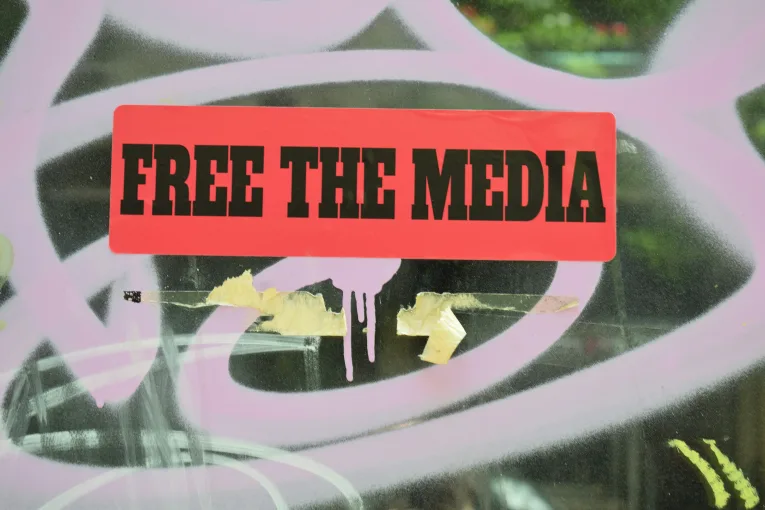
U.S. — The arrests of two journalists last month while covering a protest have intensified concerns about the use of federal civil rights statutes against members of the press, raising broader questions about press freedom and democratic accountability.
Last month, federal agents arrested journalists Georgia Fort and Don Lemon while they were covering a protest at a Minneapolis-area church, according to the Wren Collective, a nonprofit team of lawyers who focus on systemic issues across the legal field. However, they were not accused of inciting violence or damaging property; instead, their alleged offenses were their presence and documenting the events as they unfolded.
Prosecutors did not rely on ordinary charges such as trespass or disorderly conduct. According to the Wren Collective, federal prosecutors invoked the Freedom of Access to Clinic Entrances Act, or FACE Act, and a federal civil rights conspiracy statute originally enacted in the Reconstruction era to protect constitutional rights from coordinated interference.
Laws designed to safeguard civil rights are now being deployed against members of the press. The Wren Collective describes these implications as extending far beyond two arrests, signaling a willingness to reinterpret civil rights enforcement as a tool not only for protection but also for deterrence.
These arrests do not stand alone. The Wren Collective explains that they reflect a broader escalation during President Donald Trump’s second term, in which criticism of the press has increasingly translated into administrative and legal action.
In 2025, Attorney General Pam Bondi reversed prior Justice Department restrictions on subpoenaing reporters’ materials in leak investigations. The White House assumed direct control over press briefing access, replacing the historical role of the White House Correspondents’ Association. Furthermore, the FBI searched the home of Hannah Natanson as part of a federal leak inquiry, seizing devices in a move that press advocates described as extraordinary.
Additionally, litigation has become a recurring instrument, with a $10 billion defamation lawsuit filed against The Wall Street Journal over reporting related to Jeffrey Epstein. Furthermore, Federal Communications Commission Commissioner Anna Gomez publicly accused the administration of weaponizing regulatory authority after television host Jimmy Kimmel was pulled off the air amid scrutiny over political commentary.
The pattern is cumulative, with each action defensible in isolation, but together forming a system in which scrutiny of power carries escalating risk.
Federal actions are unfolding within a broader climate in which state and local officials have tested the boundaries of press retaliation. In one instance, former Mississippi Gov. Phil Bryant filed a defamation lawsuit against Mississippi Today following its Pulitzer-winning reporting on a welfare embezzlement scandal.
Another incident occurred in Texas, where journalist Priscilla Villarreal was arrested after requesting a comment from police. In Alabama, District Attorney Steve Bill indicted Atmore News reporter Don Fletcher for allegedly revealing grand jury information. Additionally, in California, Los Angeles County authorities sought criminal prosecution of journalist Maya Lau after she reported on misconduct within the sheriff’s department; a federal judge later ruled that a reasonable jury could find the referral chilled protected speech.
The Wren Collective explains that criminalizing journalism does not just affect reporters but alters the information ecosystem on which democratic governance depends.
Furthermore, as the Wren Collective writes, the press functions as an intermediary between power and the public. When journalists face increased risks in documenting state action, fewer stories are told, leading to a narrowed public understanding and eroding accountability.
The arrests of Fort and Lemon represent more than an isolated prosecution strategy; they reflect an inversion of civil rights statutes.
Furthermore, the Wren Collective argues that in a constitutional system built on separation of powers and protected speech, the question is not simply whether journalists can defend themselves in court. It is whether the structure of accountability can withstand a climate in which the act of bearing witness is reframed as unlawful.
Follow the Vanguard on Social Media – X, Instagram and Facebook. Subscribe the Vanguard News letters. To make a tax-deductible donation, please visit davisvanguard.org/donate or give directly through ActBlue. Your support will ensure that the vital work of the Vanguard continues.
