
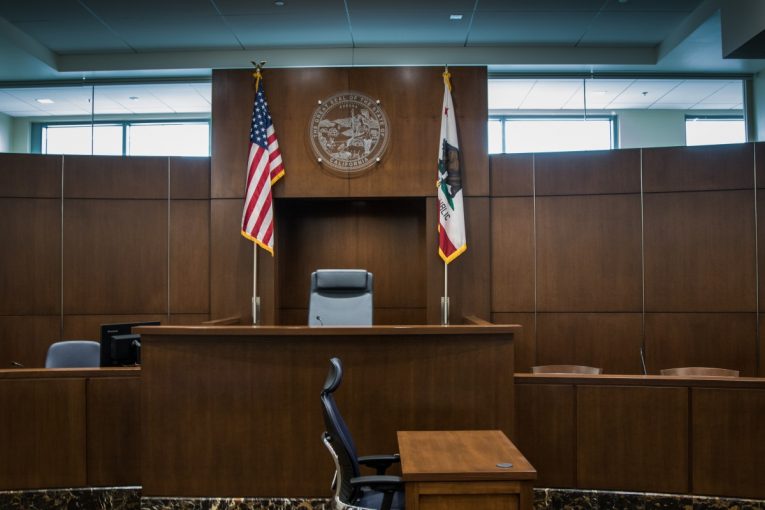
Woodland, Calif. — A Yolo County Superior Court judge on Wednesday questioned the evidentiary basis for a prosecutor’s request to terminate a woman’s mental health diversion, raising concerns about whether the legal standard for ending diversion had been met.
The case involves a woman accused of failing to consistently attend court-ordered psychotherapy despite previously being granted diversion. She was initially arrested on two driving infractions — improper display of license plates and driving without the proper license classification — as well as a misdemeanor count of evading a peace officer. The accused later obtained diversion after it was determined she suffered from post-traumatic stress disorder and was taking medication.
According to Deputy District Attorney Candance Guth Miller, the accused failed to comply with the court order on most prior review dates, despite repeated warnings that attendance was required. On that basis, Guth Miller argued the diversion should be terminated.
Although records showed the accused attended peer therapy sessions in December and January, Judge David Rosenberg said she had “missed a fair amount of sessions.” He noted that Aven Armstrong, the program’s director, had submitted a letter explaining he had been away for a month and was therefore unable to verify the accuracy of the accused’s reports.
“There’s a part of the People’s argument that has merit,” Rosenberg said, adding that he “[didn’t] have much of a yardstick” to evaluate the situation.
Deputy Public Defender Roberto Villa, representing the accused, argued that “recovery is not linear” and cited Penal Code section 1001.36, which governs mental health diversion. The statute specifies that four conditions must be met for diversion to be terminated, modified or for an individual to be conserved.
Penal Code § 1001.36(g): If any of the following circumstances exists, the court shall, after notice to the defendant, defense counsel, and the prosecution, hold a hearing to determine whether the criminal proceedings should be reinstated, whether the treatment should be modified, or whether the defendant should be conserved and referred to the conservatorship investigator of the county of commitment to initiate conservatorship proceedings for the defendant pursuant to Chapter 3 (commencing with Section 5350) of Part 1 of Division 5 of the Welfare and Institutions Code:
(1) The defendant is charged with an additional misdemeanor allegedly committed during the pretrial diversion that reflects the defendant’s propensity for violence.
(2) The defendant is charged with an additional felony allegedly committed during the pretrial diversion.
(3) The defendant is engaged in criminal conduct rendering the defendant unsuitable for diversion.
(4) Based on the opinion of a qualified mental health expert whom the court may deem appropriate, either of the following circumstances exists:
(A) The defendant is performing unsatisfactorily in the assigned program.
(B) The defendant is gravely disabled, as defined in subparagraph (B) of paragraph (1) of subdivision (h) of Section 5008 of the Welfare and Institutions Code. A defendant shall only be conserved and referred to the conservatorship investigator pursuant to this finding.
Villa argued that Guth Miller had “only given her opinion” and failed to satisfy Penal Code section 1001.36(g)(4)(A), which requires the opinion of a qualified mental health expert. He also noted that Rosenberg had warned the accused in November that she had “one last chance.”
The accused first appeared in court on Feb. 28, 2024, and was granted diversion on July 25, 2025. Despite the absence of any violent conduct and her prior qualification for diversion, Guth Miller continued to press for termination.
Villa, who reiterated there was no legal basis to revoke the diversion, was asked by the court to provide additional proof that the accused had attended her therapy sessions. Rather than requiring the prosecution to submit evidence supporting termination — such as documentation from a mental health professional — Rosenberg asked Villa how much time he would need, to which he responded four to six weeks.
The court set the next hearing for Feb. 28, 2026, four weeks later.
Regardless of the accused’s inconsistent attendance, the defense emphasized that the district attorney lacked legal grounds to seek termination without a mental health professional’s opinion or evidence of any qualifying statutory condition. Rosenberg’s decision to require proof from the defense, rather than from the prosecution, underscored broader concerns about the court’s ability to provide adequate legal support for individuals experiencing mental health crises.
Follow the Vanguard on Social Media – X, Instagram and Facebook. Subscribe the Vanguard News letters. To make a tax-deductible donation, please visit davisvanguard.org/donate or give directly through ActBlue. Your support will ensure that the vital work of the Vanguard continues.
