
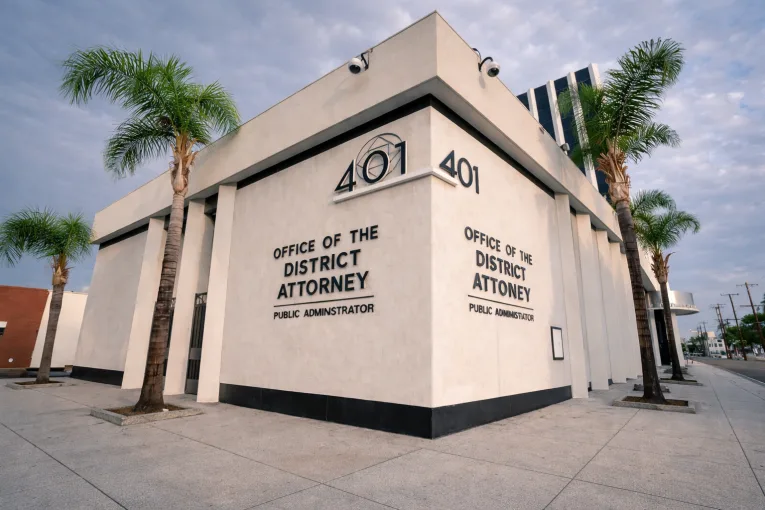
Bethel Cope-Vega wins $3.5 million harassment lawsuit against Orange County District Attorney’s Office.
SAN DIEGO — On most days, Bethel Cope-Vega stands in court representing one of the largest prosecution offices in the State of California, arguing for accountability in cases involving serious violence and harm. For years, she built a reputation inside the Orange County District Attorney’s Office as a formidable prosecutor, someone trusted with complex cases and high-stakes decisions.
Then she sued her employer.
This week, a San Diego jury awarded Cope-Vega $3.5 million in damages after finding sexual harassment and failure to prevent workplace misconduct in violation of California’s Fair Employment and Housing Act. The verdict follows years of litigation and places renewed scrutiny on the internal culture of the Orange County District Attorney’s Office.
For Cope-Vega, the path to that courtroom began in 2019.
“Well, in 2019, I was still a new young DA and about two months after Todd was sworn in, I was sent to the North Justice Center to work under his best friend Gary LoGalbo, who it was his first assignment as a boss,” she said in an interview . “And there were a handful of US misdemeanor DA’s. And he, as you know, sort of proceeded to just barrage us constantly with comments, looks inappropriate, behavior nonstop.”
The supervisor she was referring to was Gary LoGalbo, who at the time had just taken on a leadership role. According to Cope-Vega, what followed was not a single inappropriate comment, but a pattern.
“We would spend a lot of time trying to figure out how to handle this,” she said . “It’s not like we were young. It’s not like we were idiots and didn’t know what to do.”
In her complaint and in testimony, Cope-Vega described repeated sexually explicit comments. She recounted late-night calls allegedly asking what she was wearing, remarks that she was the subject of her supervisor’s dreams, and explicit statements in his office.
Among them: “You know, you don’t have to stand back there. Are you afraid? I’m not going to just bend you over that chair and take you from behind,” and, “I’m not going to bite unless you ask me to.”
The language, she said, was humiliating. But the professional calculus was complicated.
At the time, she was early in her career. The felony panel — a coveted assignment — was within reach. Advancement depended, in large part, on the support of her direct supervisor.
“Gary was my direct supervisor, the only person who would advocate for me to get there,” she said . “And so I had to keep him happy in order to have him advocate for that move. And so that’s what I decided to do.”
She said she sought advice.
“When we were evaluating our options, I reached out to several mentors in the office and talked with them about some hypothetical situations,” she said . “It was they who told me that you can’t go to HR because there will be a mark on you.”
Reporting internally, she was told, could be “career suicide.” She described fear that complaining could become personal.
Because of the way LoGalbo spoke about his relationship with District Attorney Todd Spitzer, she said, “we were fearful that it would become personal if we reported to HR.”
For a time, she said, the strategy was survival.
“We were all scared. I mean, we were terrified,” she said .
The reckoning came two years later. In 2021, a report was released detailing workplace harassment allegations within the office. Cope-Vega said she realized then that her anonymity — and her experience — had become public knowledge.
“It was when the report was released in 2021, and I realized that my anonymity and my experience was now public knowledge to everybody I worked with, and worse I think, to defense attorneys, to the bench, to really the entire legal community,” she said . “That’s when I decided to hire an attorney.”
Multiple employees initially filed complaints. In August 2021, several agreed to settle for six-figure amounts, but the Orange County Board of Supervisors rejected the proposed settlement. Two later resolved their lawsuits for a combined $1.3 million. Four additional cases remain pending.
Cope-Vega pressed forward.
Her case unfolded against the backdrop of earlier litigation by former senior prosecutor Tracy Miller, who secured a $3 million jury verdict that was later increased by more than $1.5 million in court-awarded attorneys’ fees.
Jurors in that case found that District Attorney Todd Spitzer and then-Chief Deputy Shawn Nelson engaged in harassment and retaliation after Miller raised concerns about how younger female prosecutors were treated, including Cope-Vega.
Together, the verdicts now expose the county to more than $8 million in financial consequences, with more cases still unresolved.
Throughout her lawsuit, Cope-Vega continued to work inside the office she was suing.
“I absolutely feel like I’ve had to work five times as hard as any of my colleagues in order to define myself as anything other than a Jane Doe,” she said .
She described the pressure to prove resilience in a profession that prizes toughness.
“You have to prove that you’re not weak. You have to prove that you aren’t a squeaky wheel, that you are not whiny,” she said . “I do feel like, yes, I am still here. I am tough. And I’ve worked really, really hard to prove that.”
Her record reflects that effort. In 2024, she was named California’s Outstanding Prosecutor of the Year — an award voted on by elected district attorneys across the state. Her attorney, Aaron Brock of Brock & Gonzales LLP, emphasized that distinction in a statement following the verdict.
“My client is a devoted public servant whose only goal has ever been to serve her community with integrity,” Brock said. “Being named California’s Outstanding Prosecutor of the Year in 2024 — an honor voted on by elected District Attorneys across the state — speaks volumes about her character and professionalism.”
If the award underscored her professional strength, the trial tested her endurance.
“I feel like I have crawled to hell and back on my knees. I feel like my clothes are on fire, my teeth are broken,” she said . “It has been rough. It has been miserable to see my success used against me to be in a position where the county entrusts me with some of the most serious cases in the county and then questioned every decision I made regarding this event. It was hard.”
LoGalbo died in late 2021 and did not testify, but District Attorney Spitzer did.
She described watching him take the stand as emotionally charged.
“Todd is the ultimate work dad,” she said . “And it was very emotional for me to see him have to come in to hear the nice things that he said about me. It was just a juxtaposition of, or cognitive dissonance, sort of everything I know to have him in there.”
In a public statement after the verdict, Cope-Vega said, “Having to sue the job I continue to love has been heartbreaking. This was never about money for me or the other victims — it has always been about standing up to injustice and doing what is right.”
She said the jury’s reaction was meaningful.
“When it is incredibly validating to have yet another jury, see what we went through and be absolutely, they were unanimous and they stuck around and talked to me afterwards and they were incredibly validating and that’s why we did it,” she said .
Yet she expressed concern that the litigation may not end with this verdict.
“Orange County Board of Supervisor Don Wagner made statements this morning that they were going to appeal this,” she said. “I think that the county’s intent is to drag this out for as long as they can to make it as expensive as possible.”
She described a dual frustration — as a litigant and as a public servant.
“It’s maddening as the individual who has to be dragged along for that ride,” she said . “But it’s also, it’s heartbreaking as a person who is actually working for the community of Orange County, I don’t think it’s in the county’s best interest to continue to make this as expensive as possible and to drag it out. And so it’s really disheartening.”
Beyond the personal and financial ramifications, the case exposed gaps in reporting systems.
“One of the things that the county tried to argue in the trial was that there was an anonymous reporting system back in 2019,” she said. “Matt Credit, who was the director of HR in 2019, came in and testify and stated very clearly, there was no avenue for anonymous reporting. There was no way to be anonymous.”
In a politically sensitive office, she suggested, anonymity matters.
“The lack of anonymity has, I think, probably made it very difficult for people in a highly political environment to be able to report things that are happening to them by their coworkers,” she said .
Asked what advice she would give to a young woman in a similar position, she paused.
“I think now, I think you can never go wrong betting on yourself and no one is going to come to your defense,” she said . “So you have to learn how to come to your own defense. But it’s not easy, it’s not pleasant, it’s, it’s hard.”
Then she added: “Get your support system in place.”
For now, she remains in the same office where the misconduct allegedly occurred, still prosecuting cases on behalf of Orange County.
The verdict is decisive. The aftermath, she suggests, is not.
Follow the Vanguard on Social Media – X, Instagram and Facebook. Subscribe the Vanguard News letters. To make a tax-deductible donation, please visit davisvanguard.org/donate or give directly through ActBlue. Your support will ensure that the vital work of the Vanguard continues.
