
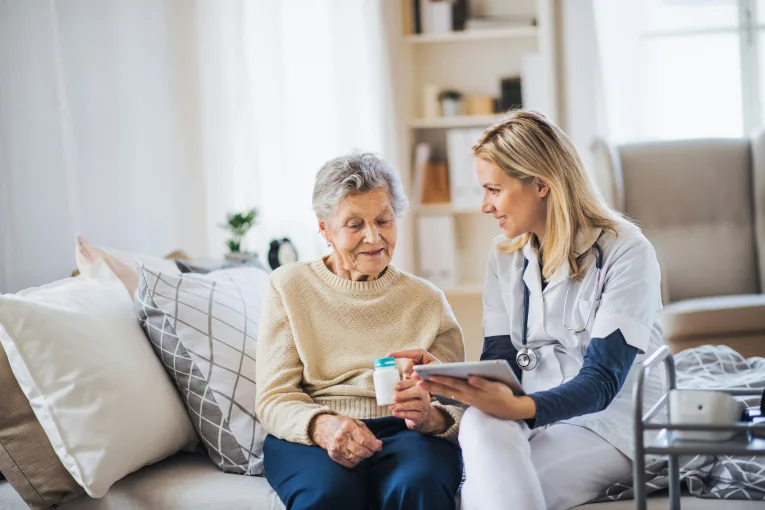
I am on an adventure caregiving for my parents while living here in Davis.
One thing I’ve noticed is that, sadly, the experience of caregiving for older adults is often overlooked by others.
I myself thought little about it until I was called upon to provide care.
Through caregiving, I’ve expanded my sense of spirituality, connected with my roots, and come to a deeper understanding of myself and what I am about.
I’ve also become curious about the experiences of other caregivers and developed a desire to share our experiences with others.
I am trained as a sociologist, so I conducted interviews with six caregivers for older adults in Davis—both family caregivers and professionals—to ask questions about what caregiving really looks like and its role in our society.
Their responses were insightful and echoed many of the topics that had developed in my own thoughts.
According to a 2025 report by AARP and the National Alliance for Caregiving, 59 million American adults—slightly more than 1 in 5 adults in the United States—are caregivers for another adult with a complex medical condition or disability.
That’s a lot of people.
Sixty-one percent are women.
With an aging population, there is an increased need for caregiving.
The number of caregivers has risen by 45% since 2015.
The length of time care is provided and the intensity of caregiving have also increased.
Care recipients are mostly older adults, with nearly half age 75 or older.
All of the caregivers who participated in my interviews were aware of the importance of caregiving for older adults.
One woman who had cared for her mother for many years explained that her favorite part of caregiving is feeling like you’re really making a difference in somebody’s life.
She expressed the satisfaction she found in seeing her mother happy.
All of the interview participants also described the significance of meaningfully connecting with the people for whom they were caring.
According to Michele Browne, a professional caregiver who said that the connections she makes are her favorite part of caregiving, “If you can make a connection with older people, they have a lot to give.”
Another caregiver recounted his clinical rotation during his certified nursing assistant training by saying, “Even the people who couldn’t talk were definitely worth talking to.”
“Everyone that could talk had something interesting to say.”
“The social interaction and the cross-generational communication were pretty keen.”
Some interview participants explained that the strength of their connection to the people they care for had the potential to be not just enjoyable but vital to that person’s health.
They said, for example, that they may notice things that doctors are not in a position to notice and might miss.
I have found this very important as well in my own experience.
Several of the caregivers explained that it is valuable to them to care for the whole person and to foster that person’s agency and autonomy, rather than simply focusing on activities of daily living.
Berkeley Neblett, who runs a caregiving agency, said that she works to help clients rediscover or maintain their sense of purpose and meaning.
She mentioned that a whole-person approach to care makes the job more interesting for the caregiver in addition to benefiting the person receiving care.
A woman caring for a family member with dementia described a whole-person approach by saying, “When there is a good day, when she’s there, treasure those moments—because she’s still there.”
“You’re not just helping a human body.”
“She’s still her.”
“Somewhere in there, she’s still there… Hold on to those good days.”
Not everything the interview participants expressed was upbeat.
Several stated that they believe caregiving is marginalized in our society because it has traditionally been considered “women’s work.”
I share this belief and think that the problem is deeply impactful.
Half acknowledged, in descriptions that deeply resonated with me, the difficulties that they experience from performing emotion work or emotional labor.
These concepts were introduced by the sociologist Arlie Hochschild to describe managing one’s feelings and expressions to carry out one’s role in private or professional life.
One participant mentioned the strain of being part of the “sandwich generation,” or adults who are caring for both their children and their aging parents.
Half of the participants discussed caregiving’s marginalization in terms of its often low pay.
Almost all mentioned how other countries undertake caregiving better than America does.
This ranged from considering caring for older relatives a standard practice, to having better care systems in place, to culturally marginalizing caregiving less.
One point a caregiver made stuck with me.
He brought up the epidemic of loneliness that we have in our society.
He described a breakdown of community that leads to a breakdown in empathy.
Caregiving, as he described it, alleviates these problems.
It builds stronger communities, reduces loneliness, and expands empathy.
“Know your elder neighbors,” he said.
That suggestion was repeated by another interview participant.
On a personal note, I have always found the experience of life’s interconnectedness important.
I have seen that one can experience it deeply in caregiving.
The Zen master and peace activist Thich Nhat Hanh called this interconnectedness “interbeing.”
As he wrote in his book The Art of Living, “We can observe emptiness and interbeing everywhere in our daily life… Looking into the child, we can be in touch with her parents and ancestors, but equally, looking into the parent, we can see the child.”
“We do not exist independently.”
“We inter-are.”
I hope, through this article, you have experienced some “interbeing” with us caregivers for older adults.
Melynda Moseley is a Davis-based caregiver and lifelong resident who draws on her background in sociology, including a master’s degree in Modern Society and Global Transformations from the University of Cambridge, to explore the experiences of those caring for older adults. She recently interviewed six local caregivers to better understand and share the realities of caregiving in her community.
Follow the Vanguard on Social Media – X, Instagram and Facebook. Subscribe the Vanguard News letters. To make a tax-deductible donation, please visit davisvanguard.org/donate or give directly through ActBlue. Your support will ensure that the vital work of the Vanguard continues.
