
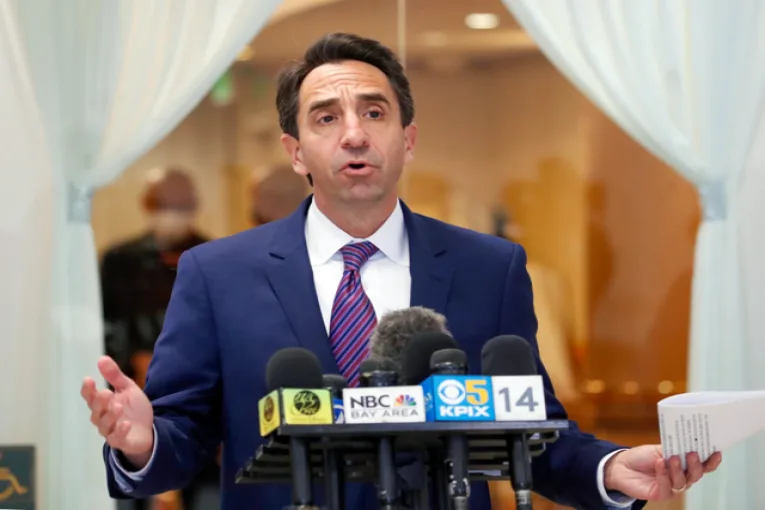
SAN JOSE, Calif. — A complaint filed with the State Bar of California is raising new questions about the conduct of Santa Clara County District Attorney Jeff Rosen, as a judge has ordered the production of records in a separate, high-profile Stanford protest case involving allegations of conflict of interest.
Jermaine A. Hopkins announced he filed the complaint against Rosen, citing concerns about alleged misuse of prosecutorial power for political benefit, the appearance of conflicts of interest, and what he described as a broader pattern of insider-protection dynamics that have undermined public trust in the county’s justice system.
The filing is separate from an existing State Bar matter, identified as 25-O-23629, which has been under review since August 2025.
The complaint comes as courts are addressing issues in an unrelated case stemming from a 2024 pro-Palestinian protest at Stanford University. According to Bay Area News Group reporting cited in the filing, Santa Clara County Superior Court Judge Kelley Paul ordered the District Attorney’s Office to turn over records sought by defense attorneys attempting to disqualify Rosen from retrying a felony vandalism case.
The judge ruled that the defense is entitled to records needed to pursue a conflict-of-interest claim and allowed subpoenas for materials beyond those held by the DA’s office. A follow-up hearing to review the records is expected by April 20, with a ruling on recusal scheduled for April 27, according to the reporting referenced in the complaint.
The case involves five individuals—German Gonzalez, Maya Burke, Taylor McCann, Hunter Taylor-Black and Amy Zhai—collectively referred to as the “Stanford 5.” A mistrial was previously declared after a split jury.
Separate reporting cited in the complaint indicates that defense counsel has sought to recuse the District Attorney’s Office, alleging in part that Rosen used a campaign webpage focused on “fighting antisemitism” that solicits donations while highlighting the prosecution of the Stanford defendants.
Hopkins’ complaint points to that campaign page as raising concerns about the boundary between public office and political fundraising. The page includes campaign navigation, a donation prompt reading “DONATE TO JEFF,” and embedded media content referencing charging decisions related to the Stanford protest case.
The complaint does not challenge the seriousness of hate crimes or the need to combat antisemitism, but instead focuses on the integrity of prosecutorial decision-making and whether charging decisions are being leveraged, directly or indirectly, for political advantage.
Beyond the Stanford case, Hopkins situates his complaint within what he describes as a broader pattern in Santa Clara County’s legal system. He alleges a long-running “insider network” culture and the retaliatory misuse of legal processes that he contends have affected public confidence in the courts.
Hopkins cites his own litigation history, including school district-initiated restraining order proceedings and related court-access disputes, as examples of systemic issues. He references an appellate decision in Sixth District Court of Appeal Case No. H050701, which reversed a workplace violence restraining order due to defective service and lack of jurisdiction, arguing that it illustrates how procedural shortcuts can result in orders that should not have been issued.
He further alleges that some judicial officers and court staff have enabled or insulated these patterns through record irregularities and by framing protected speech as criminal conduct.
The complaint also references the historical Bench-Bar-Media-Police committee culture in Santa Clara County, which Hopkins describes as emblematic of a “closed loop” of influence. While the committee is widely regarded as defunct, Hopkins contends that similar informal relationships and power structures remain active.
As part of his filing, Hopkins is calling for several reforms, including a clear and transparent separation between a district attorney’s prosecutorial actions and campaign operations, particularly in high-profile cases. He also calls for stronger disclosure and accountability mechanisms when conflicts of interest are alleged, independent review of restraining order practices used against public critics and whistleblowers, and a broader cultural shift away from insider protectionism toward consistent, rules-based administration of justice.
Hopkins said he is making materials available to oversight bodies and the media, including the State Bar complaint reference, reporting related to the Stanford case and Rosen’s campaign website, and documentation from his own legal matters.
Follow the Vanguard on Social Media – X, Instagram and Facebook. Subscribe the Vanguard News letters. To make a tax-deductible donation, please visit davisvanguard.org/donate or give directly through ActBlue. Your support will ensure that the vital work of the Vanguard continues.
