
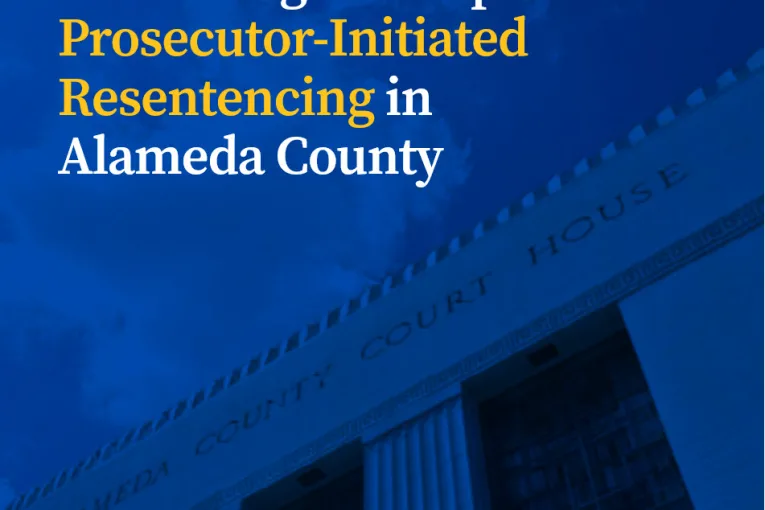
A recent report from the UC Berkeley School of Law Criminal Law and Justice Center concludes that prosecutor-initiated resentencing in Alameda County has reduced thousands of years of incarceration and generated tens to hundreds of millions of dollars in projected savings to the State of California, while presenting a low risk to public safety.
The study, Measuring the Impact of Prosecutor-Initiated Resentencing in Alameda County, examines 165 cases in which individuals were resentenced under Penal Code section 1172.1 between 2019 and early 2025.
That statute allows district attorneys and other authorized officials to refer incarcerated individuals back to court for possible sentence reductions based on pre- and post-conviction factors. It establishes “a strong presumption favoring resentencing that can only be overcome if the court finds an unreasonable risk of danger to public safety.”
Using incarceration cost estimates from the Legislative Analyst’s Office, the analysis calculates that resentencings in Alameda County resulted in approximately $42,584,000 in savings based on annual marginal incarceration costs, and roughly $287,370,000 when measured against the state’s annual average incarceration costs. The researchers relied on data from the Legislative Analyst’s Office and measurement tools developed by the Office of the State Public Defender.
Beyond the fiscal impact, the resentencings reduced an estimated 2,792 years of incarceration across the reviewed cases. On average, the 165 individuals had served about 21.8 years in prison prior to resentencing.
The report places Alameda County’s experience within the broader context of statewide sentencing reforms. In recent years, California expanded discretionary resentencing authority through AB 2942, which granted district attorneys the power to initiate resentencing referrals, and AB 1540, which clarified procedures and reinforced the presumption in favor of resentencing.
Although Alameda County did not participate in the formal California County Resentencing Pilot Program, the District Attorney’s Office began making resentencing referrals in October 2020 under then-District Attorney Nancy O’Malley. Data provided by the current administration indicates that 72 individuals were resentenced during O’Malley’s tenure.
After O’Malley chose not to seek reelection, Pamela Price was sworn in as district attorney in January 2023 and established a formal Resentencing Unit. During her administration, 93 additional individuals were resentenced, bringing the countywide total to 165.
Under Price, the office developed written criteria identifying priority categories for review. These included people sentenced to life without the possibility of parole, individuals sentenced under California’s third-strikes law, and those who were minors at the time of the commitment offense but sentenced as adults.
In 2024, following a mandate by U.S. District Court Judge Vince Chhabria requiring review of all of the county’s death penalty convictions for potential prosecutorial misconduct, Price initiated a special review of death sentence cases. She ultimately recommended resentencing in 30 such cases, and 17 individuals were successfully resentenced.
In November 2024, Alameda County voters recalled Price. The Board of Supervisors appointed Ursula Jones Dickson as district attorney in January 2025. According to the report, Dickson disbanded the Resentencing Unit and began filing motions to withdraw certain pending resentencing recommendations, “including for at least some of the remaining death-sentenced individuals,” marking what the authors describe as “a major policy shift.”
The demographic breakdown of the resentenced population underscores the report’s public safety analysis. Of the 165 individuals resentenced, 109 — or 66% — were age 50 or older at the time of resentencing. Twenty-one percent were 65 or older. The study cites research showing that age is a significant predictor of reoffending, with arrest rates for people ages 50 to 65 dropping to just over 2%, and for those over 65 the rate falling to “almost zero percent.”
Nearly all of those resentenced had been convicted of serious or violent felonies. Ninety-eight were originally convicted of first- or second-degree murder, 53 of robbery, and others of offenses such as assault with a deadly weapon, burglary and manslaughter.
Seventeen individuals initially sentenced to death were resentenced. Thirty-three people originally sentenced to life without the possibility of parole also received new sentences. Some were resentenced to indeterminate terms requiring review by the Board of Parole Hearings, while others received determinate terms and were eligible for release based on credit for time served.
The authors sought recidivism data specific to the 165 individuals resentenced in Alameda County but wrote that the current administration “does not make this data publicly available.” Even so, the report draws on state and national research indicating extremely low recidivism rates among individuals resentenced after serving long prison terms.
Citing research from the California Policy Lab, the study notes that among people resentenced and released under several major California “second look” policies, 3% to 8% were convicted of any new offense within one year, and fewer than 1% were convicted of a serious or violent felony during that period.
It also references research examining 368 convicted murderers granted parole in New York between 1999 and 2003, in which “six [people], or 1.6% percent were returned to prison within three years for a new felony conviction–none of them a violent offense.”
The authors contend that prosecutor-initiated resentencing “fills a gap in sentencing policies by focusing on crimes against persons” and provides a structured mechanism to reconsider lengthy sentences in light of rehabilitation, aging and changes in the law.
The authors conclude that prosecutor-initiated resentencing in Alameda County “promotes public safety, impacts those individuals whose sentences are no longer in the interest of justice and provides them with an opportunity to reenter and positively contribute to society, and meaningfully reduces costs to the State of California.”
The authors recommend that the Alameda County District Attorney’s Office reestablish a robust resentencing unit with sufficient legal and investigative support, develop clear eligibility criteria, track recidivism outcomes, engage victims early in the process and collaborate with state and local government to reinvest cost savings into reentry services and community-based public safety programs.
Follow the Vanguard on Social Media – X, Instagram and Facebook. Subscribe the Vanguard News letters. To make a tax-deductible donation, please visit davisvanguard.org/donate or give directly through ActBlue. Your support will ensure that the vital work of the Vanguard continues.

This shows that if the corrections system focuses on rehabilitation rather than retribution and punishment, we will see much better outcomes.