
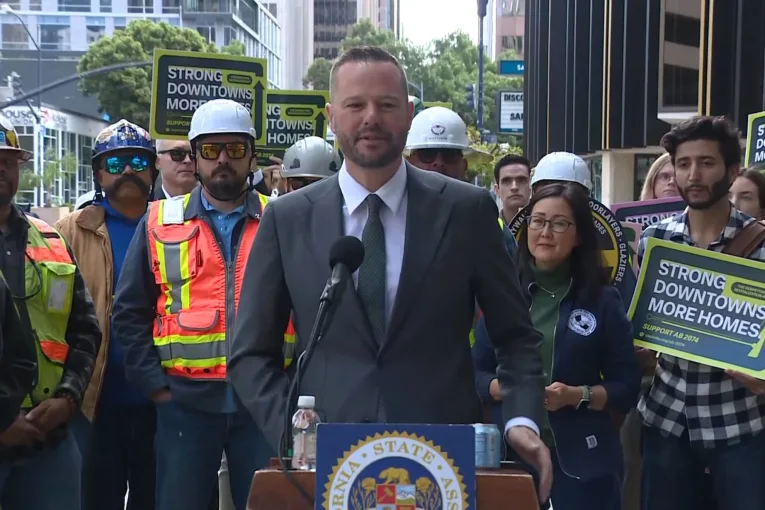
SAN DIEGO, Calif. — A new California housing proposal unveiled in San Diego this week would seek to accelerate high-rise residential development in the state’s largest and most transit-rich cities, combining faster approvals, clearer zoning standards and a new state-backed financing tool designed to help projects that have struggled to move forward.
AB 2074, authored by Matt Haney and backed by California YIMBY and the State Building and Construction Trades Council of California, is aimed at one of the most persistent problems in California housing policy: even where cities allow dense housing, many towers still fail to get built because construction costs, permitting delays and financing gaps make projects financially unworkable.
Supporters say the bill could reshape underused downtown corridors in cities such as San Diego, San Francisco, San Jose and Long Beach by steering housing growth toward existing transit systems, job centers and infrastructure already paid for by taxpayers.
“For too long, the economics of building high-rise housing in California’s downtowns simply haven’t worked. AB 2074 changes that,” said Brian Hanlon, chief executive officer of California YIMBY. “It’s time to build up.”
The proposal comes at a moment when many California downtowns are still adjusting to the long-term effects of remote work. Office vacancy remains elevated in several major cities, pedestrian traffic has not fully recovered and many business districts continue searching for a post-pandemic identity.
At the San Diego press conference, Haney framed the bill as both a housing measure and a downtown recovery strategy.
“We’re here with a very simple message, which is that downtowns need housing. Downtowns want housing. Downtowns are an incredible place to build more housing,” Haney said. “Our state can do more to support cities like San Diego in getting that housing approved and built fast.”
Haney pointed to San Diego as a model for what residential growth can do for urban cores.
“San Diego has proven that there is another way,” he said. “While other cities are still trying to figure it out, San Diego has doubled down, tripled down on building housing in their downtowns. And it’s working.”
According to supporters, AB 2074 is structured around four major components. It would increase allowable density in designated downtown transit zones, establish clearer geographic areas where high-rise growth is expected, streamline approvals for projects that meet labor standards, and create a revolving state loan fund to close financing gaps that often stall approved developments.
That financing piece may be the most significant. Housing advocates and developers alike have increasingly argued that entitlement reform alone is not enough when interest rates, insurance costs and construction pricing have made many multifamily projects impossible to finance.
Haney emphasized that point directly.
“You can upzone, you can streamline, but if the financing isn’t there to get these projects built, they don’t happen,” he said. “The state can step in by providing some of these additional loan dollars that will be repaid to the state.”
Under the proposal described at the event, the state would seed a $500 million revolving loan program. Supporters argue the structure would allow funds to be lent, repaid and recycled into future projects rather than spent once.
Nolan Gray of California YIMBY called that mechanism essential in the current market.
“It’s really, really hard to make projects pencil today,” Gray said. “This is a small amount of money to catalyze many tens of thousands of units that otherwise will not pencil.”
Backers also tied the measure to California’s broader affordability crisis. The state continues to face some of the nation’s highest rents, severe barriers to homeownership and the country’s largest unhoused population.
Gray said the shortage remains central to all three problems.
“We have a shortage in the order of millions of homes,” he said. “This is a crisis, and it’s a crisis where we know the solutions. AB 2074 is a big part of that solution.”
Local officials in San Diego used the announcement to argue that concentrated housing growth near transit can strengthen city finances, reduce commute emissions and revive struggling districts.
Todd Gloria said San Diego’s recent development pipeline shows what is possible when local land-use rules align with housing production.
“As you look around, literally every direction you can see brand new housing that is popping up,” Gloria said. “Buildings that were once offices that are converting to residential.”
He added that locating new housing near existing transit and infrastructure can answer one of the most common objections to growth.
“When you co-locate it with existing infrastructure, assets the taxpayers have already paid for, we can make sure that they’re being used, being put to their best and highest use,” Gloria said.
Gloria also highlighted San Diego’s own local financing initiative, Bridge to Home, saying it had helped move 23 projects and more than 2,000 homes through six rounds of funding over five years. Supporters of AB 2074 say the state proposal would scale a similar concept statewide.
Labor groups, often wary of streamlining proposals that weaken wage or workforce standards, appeared alongside pro-housing advocates in a notable coalition backing the bill.
Chris Hannan, president of the State Building and Construction Trades Council of California, said the measure attempts to combine housing production with high-quality union jobs.
“We agree wholeheartedly that we need to build more housing,” Hannan said. “We agree wholeheartedly that housing needs to be appropriately located near transit.”
He added, “Our membership is ready to roll up our sleeves, ready to go out and get to work building.”
That alliance between labor and pro-housing groups has become increasingly important in Sacramento, where some past housing bills have fractured over prevailing wage rules, environmental review or local control concerns. AB 2074’s backers presented the measure as evidence that those coalitions can be built when both production and worker protections are included.
“Housing advocates and the folks who build the housing should be on the same side,” Haney said. “And there’s so much room for agreement and so many opportunities for us to work together to actually get this housing built quicker.”
The bill now enters what is likely to be a closely watched legislative process. Questions remain over cost, implementation, city eligibility, environmental review interactions and whether communities resistant to added height and density will support state intervention in downtown zoning.
But the measure also reflects a larger shift in California housing politics. The debate is no longer only whether more homes should be allowed. It is increasingly about whether the state can solve the financial and bureaucratic barriers that prevent approved housing from being built at all.
For supporters, that is the real test.
“The city of San Diego is proud to support AB 2074,” Gloria said. “Let’s get it done. Let’s get it on the governor’s desk and let’s start building some housing that San Diegans and Californians can afford.”
Follow the Vanguard on Social Media – X, Instagram and Facebook. Subscribe the Vanguard News letters. To make a tax-deductible donation, please visit davisvanguard.org/donate or give directly through ActBlue. Your support will ensure that the vital work of the Vanguard continues.

That financing piece may be the most significant. Housing advocates and developers alike have increasingly argued that entitlement reform alone is not enough when interest rates, insurance costs and construction pricing have made many multifamily projects impossible to finance.
Under the proposal described at the event, the state would seed a $500 million revolving loan program. Supporters argue the structure would allow funds to be lent, repaid and recycled into future projects rather than spent once.
Hmm. So apparently, these “free market” advocates aren’t that supportive of the free market after all. Turns out (surprise) they want a government subsidy in order to ruin downtowns.
This isn’t the CATO Institute. Matt Haney is a liberal Democrat, not a libertarian.
Haney is a well-known San Francisco YIMBY politician, and they’ve been crying about “releasing” the free market for years in regard to housing.
Turns out that they’d rather have $500 million from the state.
Haney’s opponent (who was defeated) is the “actual” progressive, as I recall.
“Under the proposal described at the event, the state would seed a $500 million revolving loan program. Supporters argue the structure would allow funds to be lent, repaid and recycled into future projects rather than spent once.”
There are already institutions that do that. They are called banks. And if projects aren’t viable, they don’t finance them.
In other words, folks, this is a backdoor subsidy for big developers.
Banks are not the only institution that does that these days.