
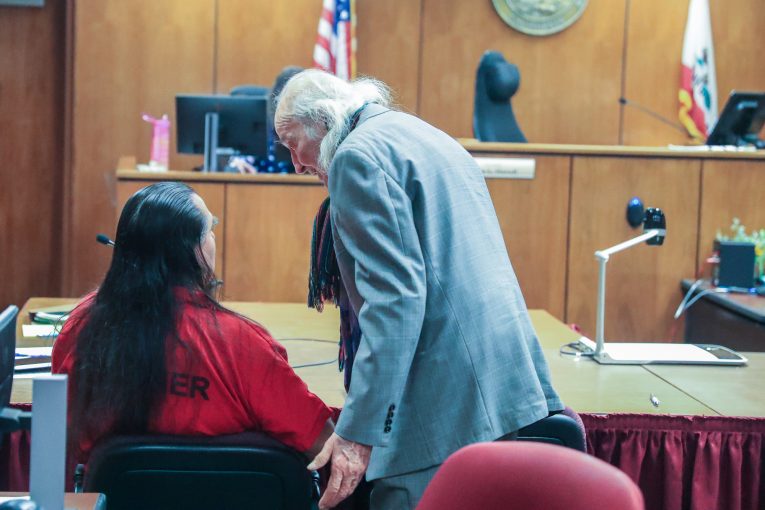
FRESNO, Calif. — Nearly five decades after Douglas Stankewitz was first charged in a Fresno County murder case that once carried a death sentence, the long-running litigation has entered a new phase centered on race, historical bias and access to prosecutorial records under California’s Racial Justice Act.
In a third amended motion filed March 12, defense attorneys for Stankewitz ask Fresno County Superior Court to order the Fresno County District Attorney’s Office to turn over decades of charging, sentencing, jury selection and policy records that they say are necessary to evaluate whether race played an unlawful role in his prosecution and punishment.
Prosecutors are urging the court to deny most or all of the request, calling it overly broad, speculative and unduly burdensome.
The motion is the latest chapter in one of California’s most closely watched legacy criminal cases.
Stankewitz, who is Native American, was originally charged in 1978 with first-degree murder, robbery, kidnapping and related allegations.
He was sentenced to death after a 1983 retrial. That death judgment remained in place for decades until May 3, 2019, when he was resentenced to life without the possibility of parole, according to the defense filing.
The Vanguard has extensively covered the case over the years, including habeas proceedings, resentencing litigation and more recent efforts by defense counsel to challenge aspects of the prosecution under evolving state law.
The current battle turns on Penal Code section 745(d), the discovery provision of the California Racial Justice Act, which allows a person seeking relief under the statute to request evidence relevant to a potential violation upon a showing of good cause.
Defense attorneys J. Tony Serra, Peter Jones, Curtis Briggs and Marshall Hammons argue they have met that threshold many times over.
“The Fresno District Attorney’s office, through a California Public Records Act has stated that it can provide some of the data needed for analysis,” the motion states. “Mr. Stankewitz has a statistician who is able to analyze the data. Therefore, Mr. Stankewitz is asking that the court expedite the consideration of this motion.”
At the center of the filing is an expansive request for historical data dating back to Jan. 1, 1972.
The petitioner seeks records involving all murder prosecutions, special-circumstance filings, cases in which the death penalty was sought or later abandoned, life-without-parole sentences, retrials after penalty reversals, and any internal office policies governing death penalty decisions, anti-bias safeguards or incentives tied to capital verdicts.
The motion also seeks training materials concerning race, religion or national origin in capital prosecutions, information about internal sentencing recommendation processes, and any evidence that a judge, attorney, law enforcement officer or juror involved in the Stankewitz case “exhibited bias or animus toward Mr. Stankewitz because of his race.”
One of the most pointed requests concerns jury selection in the 1983 retrial. The defense alleges prosecutors improperly questioned and removed the only qualified Native American prospective juror and says it has repeatedly sought juror notes that have never been produced.
“Because Mr. Stankewitz is Native American, and because the prosecution improperly questioned and excused the only Native American juror, defense counsel has made repeated requests for discovery of juror notes,” the motion states. “To date, no juror notes have been produced.”
The filing goes beyond the individual case and places Stankewitz’s prosecution within a broader historical narrative of anti-Indigenous discrimination nationally, in California and in Fresno County.
The motion cites scholarship on genocide, anti-Native stereotypes, white supremacist activity, local discrimination controversies and statewide incarceration and death-row demographic data that defense counsel say help establish why discovery is warranted.
The petitioner also points to statistical disparities.
Citing statewide reports, the motion states that “68% of the people on Death Row are people of color” and argues that people of color serving life without parole outnumber white prisoners by nearly two to one.
The filing further contends youthful offenders of color have historically received death sentences at disproportionately higher rates than white peers.
Under the petitioner’s theory, the requested data would allow an expert to determine whether similarly situated defendants of other races were treated more favorably in charging or sentencing decisions and whether Native defendants faced disparate outcomes in Fresno County.
“Our statistical expert, Beth Redbird, requires specific documentation listed below to conduct a proper disparity analysis to assist Mr. Stankewitz in formulating arguments pursuant to the Racial Justice Act,” the motion states.
The respondents, however, contend that the request stretches the Racial Justice Act far beyond what the statute permits.
In an opposition filed by the Fresno County District Attorney’s Office, the respondents argue Stankewitz has not shown “good cause” or a plausible factual basis connecting the massive data demands to an actual violation in his case.
They contend the motion relies on historical articles, generalized claims of discrimination and unsupported assumptions rather than evidence specific to the prosecution.
“As will be explained below, Defendant’s request should be denied,” the respondents wrote.
The opposition repeatedly characterizes the requests as a fishing expedition. Respondents say much of the sought-after material either does not exist in searchable form, was never maintained in the way the defense assumes, would require creation of new records, or is protected by privilege, privacy laws or work-product doctrine.
They also argue that many records from earlier decades predate modern electronic case-management systems, meaning retrieval would require manual review of paper files stored off-site.
“For records that are not available by way of a query, the Department is not reasonably able to manually search through potentially thousands of filings over 50 years to locate the cases that may fall within Defendant’s search parameters for retrieval of cases,” the opposition states.
The respondents further dispute the defense focus on the Native American juror issue, arguing the claim was previously litigated in habeas proceedings as a Batson challenge and that the Racial Justice Act does not automatically entitle the defense to every privileged internal note related to jury selection.
Respondents also contend the motion comes too late. They note the Racial Justice Act was enacted in 2020 and argue Stankewitz could have raised many of these issues earlier, including during prior remittitur proceedings and habeas litigation.
The petitioner filing counters that the statute has evolved, that additional provisions became effective Jan. 1, 2026, and that discovery should be evaluated under the law’s intentionally low threshold. It argues courts should view claims “as a totality, rather than in isolation,” and that discriminatory effect — not only discriminatory intent — can establish a violation.
That disagreement reflects a larger statewide legal debate over how forcefully California courts will implement the Racial Justice Act in older cases.
Since its passage, the law has become one of the most significant post-conviction avenues for challenging alleged racial bias in charging, jury selection, sentencing and courtroom conduct.
But courts are still defining how much evidence a moving party must present before gaining access to sensitive prosecutorial records.
For Stankewitz, a successful Racial Justice Act claim could affect the validity of prior proceedings, sentencing outcomes or future relief efforts, depending on how the court rules and what evidence emerges.
The matter is scheduled for hearing May 29 in Department 74 before a new judge, according to the filings.
Follow the Vanguard on Social Media – X, Instagram and Facebook. Subscribe the Vanguard News letters. To make a tax-deductible donation, please visit davisvanguard.org/donate or give directly through ActBlue. Your support will ensure that the vital work of the Vanguard continues.
