
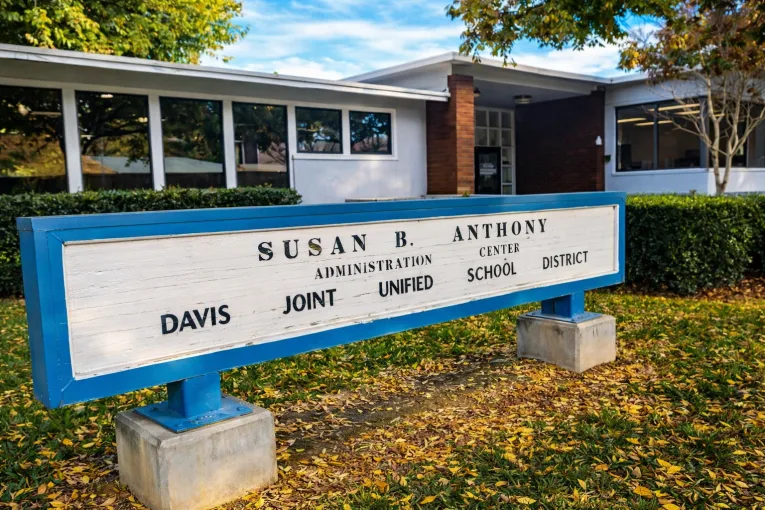
DAVIS, Calif. — As DJUSD continues to grapple with declining enrollment, budget shortfalls and the prospect of school closures, a number of community members have pointed to administrative spending as a major culprit.
But a detailed review of district financial documents by the Vanguard suggests that while administrative compensation in DJUSD is somewhat above state averages, the scale of those costs is insufficient to fundamentally alter the district’s long-term fiscal trajectory.
The analysis, based on official DJUSD budget documents and California Department of Education financial reporting, found that direct classroom instruction remains by far the district’s largest expenditure category. Administrative spending, depending on how it is defined, occupies a significantly smaller portion of the budget than critics often imply.
The Vanguard examined DJUSD’s unrestricted general fund expenditures using California’s Standardized Account Code Structure, or SACS, reporting system. Under the district’s official accounting classifications, core general administration — categorized as Functions 7000 through 7999 — totaled approximately $9.6 million in fiscal year 2024-25 unaudited actuals, representing 11.73 percent of unrestricted general fund expenditures.
That figure is budgeted to rise to about $10.33 million, or 12.41 percent, in fiscal year 2025-26.
By contrast, unrestricted classroom instruction spending — categorized as Functions 1000 through 1999 — totaled approximately $45.3 million in 2024-25 and is budgeted at roughly $46 million in 2025-26.
In both years, instruction accounted for slightly more than 55 percent of unrestricted general fund spending.
On DJUSD’s own unrestricted Form 01, core general administration is roughly one-eighth of the unrestricted general fund, while direct instruction remains a little over one-half.
Those numbers complicate claims that administrative spending alone is driving DJUSD’s fiscal distress.
More importantly: even substantial cuts to administration would almost certainly produce savings too small to close the district’s structural deficit or eliminate the enrollment-driven pressures now confronting the district.
The district’s fiscal problems are largely rooted in declining enrollment and the way California funds schools based on Average Daily Attendance, or ADA. The report noted that DJUSD’s ADA declined from 7,250.59 to a projected 7,186.62 between 2024-25 and 2025-26.
As enrollment falls, districts face a difficult reality: many operational costs remain fixed even as revenues decline. Schools still require principals, counselors, custodial staff, transportation systems and maintenance regardless of whether enrollment falls by several hundred students.
That dynamic has increasingly squeezed districts across California, particularly in communities with aging populations and high housing costs.
The Vanguard also found little evidence supporting claims that DJUSD has experienced a recent explosion in central administration costs. In fact, one official district measure showed the opposite trend.
Using the district’s Program Cost Report Schedule of Central Administration Costs, the analysis found that total central administration costs declined from approximately $11.58 million in 2023-24 to roughly $10.54 million in 2024-25. The district’s official ratio of central administration costs to direct charged and allocated costs also fell from 8.75 percent to 7.96 percent.
Our findings point in the opposite direction from the rhetoric that ‘administration is exploding. Between FY 2023-24 and FY 2024-25, the verified CAC total fell by about $1.04 million, or roughly 9%.
The board-and-superintendent line item alone reportedly declined by approximately $282,500 over that period. Other general administration and centralized data processing costs also decreased.
At the same time, the Vanguard analysis found that DJUSD’s administrative salary share is somewhat higher than comparable districts.
According to the district’s School Accountability Report Card salary comparison table, administrative salaries accounted for 6.51 percent of DJUSD’s budget, compared to 5.4 percent for similar districts statewide. Teacher salaries, however, were also above peer averages, accounting for 31.45 percent of the budget compared with 28.37 percent statewide among comparable districts.
The analysis cautioned against conflating salary comparisons with broader expenditure analysis because the SARC comparison only measures salary shares, not total district spending. It does not include benefits, technology, audits, contracts or other operational overhead that appear in broader expenditure reports.
The analysis further emphasized that disagreements about “administrative spending” often stem from accounting definitions rather than factual disputes.
Under California’s accounting system, many functions that critics may consider “administrative” — including school principals, instructional supervision, librarians, media services and educational technology support — are not classified under the 7000-series central administration category. Instead, they are grouped under broader instructional support functions.
As a result, broader definitions of administration can produce dramatically larger percentages.
The report found that if the entire 2000-2999 instructional support category is combined with the 7000-series general administration category, administrative-style spending rises to approximately 25 percent of unrestricted expenditures.
But the analysis stressed that this broader definition includes site leadership and instructional support services, not simply district office bureaucracy.
The narrower definition measures district office and general administration spending alone, while the broader definition also includes school leadership and instructional-support functions such as principals, instructional supervision and educational support services.
The analysis also found that DJUSD remains above California’s classroom compensation requirement for unified school districts. In 2024-25, the district reported that 56.16 percent of current educational expenditures went toward classroom compensation, above the state minimum threshold of 55 percent.
That finding undermines arguments that administrative growth has come at the direct expense of classroom spending, at least under the state’s official financial metrics.
None of this means administrative spending is irrelevant. DJUSD’s administrative salary share appears moderately above average compared to similar districts. Thus critics are not “imagining the issue out of thin air.”
But the broader fiscal picture suggests that even aggressive administrative cuts would not resolve or meaningfully reduce the district’s budget crisis.
If DJUSD were somehow able to eliminate several million dollars in administrative costs — an unrealistic scenario given operational requirements — the district would still face long-term enrollment decline, rising pension obligations, inflationary pressures, maintenance costs and declining state revenues tied to ADA losses.
The Vanguard analysis ultimately concluded that the district’s fiscal challenges are more structural than administrative.
The available financial data does not support the idea that administrative spending is overwhelming the district’s budget. DJUSD’s unrestricted Form 01 documents still show instruction accounting for roughly 55 percent of unrestricted expenditures.
The data shows that central administration costs declined in the most recently completed fiscal year, although the district’s adopted 2025-26 budget projects a modest increase in core general-administration spending.
As Davis debates school closures and fiscal restructuring, the data suggests the district’s problems are unlikely to be solved through administrative cuts.
Follow the Vanguard on Social Media – X, Instagram and Facebook. Subscribe the Vanguard News letters. To make a tax-deductible donation, please visit davisvanguard.org/donate or give directly through ActBlue. Your support will ensure that the vital work of the Vanguard continues.

“ANALYSIS: ENROLLMENT DECLINE, NOT ADMIN COSTS, DRIVES DJUSD FISCAL CRISIS”
The oversized school system drives the DJUSD fiscal crisis and admin costs add to the problem.
“That figure is budgeted to rise to about $10.33 million, or 12.41 percent, in fiscal year 2025-26.”
Just wondering what caused that increase (well-above the rate of inflation).
Also, the article above refers to a “report”, but it is not clear what this is referring to.
I’d like to see someone like Matt analyze all of this, though I’m pretty sure you are correct (in that DJUSD is going to have to shut down a school or two).
By the way, wasn’t there some tentative plan to move one of the programs (something like Independent study) into Patwin’s campus? (After the district moves its headquarters to a new building?)
In other words, would they possibly still be keeping their actual campuses/buildings (other than the current administration building) if they only have to shut down one school, for example?
Ron O
Why do you care about DJUSD? You live in Woodland, having chosen to leave Davis. You have no visible interest in this question. David, I hope you ignore his inquiry.
How would you know whether or not I pay DJUSD taxes, regardless?
You do realize another commenter on here (and the moderator of the Vanguard itself) doesn’t live in Davis. I believe he pays DJUSD parcel taxes.
Also, as noted quite a few times – DJUSD is poaching students from Woodland.
But I have an idea – how about if you focus on the arguments/points, instead of “me” if you don’t like what I have to say?
And aren’t you advocating for non-residents to move to Davis in the first place?
Of any commenter on here, who do you think knows what non-residents seek more than I do – per your own comment?
Ironically, if I did live in Davis “today”, I wouldn’t be subject to DJUSD parcel taxes regardless of whether or not I pay them now.
But this isn’t what drives me to comment on the Vanguard, nor is it related to my goal of preserving farmland. (And truth be told, the latter interest extends beyond Davis or Woodland.)
I like the “Village Farms” site just the way it is, and I like the Shriner’s site that way as well.
I don’t know why anyone would look out over the “Village Farms” site and think to themselves how much better it would be if covered in housing. Every time I shop at Nugget, and every time I travel past the site I think the same thing.
Won’t you join me?
Great article David.
One thing I have a hard time getting my head around is why closing a school, versus closing a couple of classrooms in each school, saves more money.
It would be really interesting to see how a third party, with a focus on students and parents, would go about imagining our next ten or twenty years.
Jason, that “imagining” is called having a community “Vision” … knowing/articulating (1) where we are as a community, (2) where we want to go in the next 5-10-25 years, and (3) having a plan for ensuring that we are on track for getting there.
Since our current official City Budget documents the fact that we as a community in the last 25 years have built up over $500 million of needed street, greenbelts and building repairs, and only have $233 million of funding, leaving a $267 million unfunded liability, as well as crumbling streets, weed infested greenbelts, and leaky buildings, professional General Planning professionals would probably advise us that it is is a good idea to add a (0) sep to (1), (2), and (3) which honestly and transparently describes how we got into the current mess.
Bottom-line, in the words of the current Chsir of the Planning Commission when she was on the FBC, ”We have promised ourselves a rich and robust suite of services, but not stepped up with the necessary Revenues to pay for those services.”
In addition, we arguably have abdicated our right to call ourselves a University Town because arguably the core competency and valuable output of a University Town is Intellectual Capital creation. Compared to 25 years ago, we have less than half as many Davis residents filling Intellectual Capital Creation jobs, and many of our leading Intellectual Capital Creation companies (e.g. CalGene and AgriQuest and Z-World, etc) have left Davis. What we arguably are now is a foods and beverage services town whose customers happen to be mostly students … creating full stomachs rather than intellectual capital.
So I don’t think we need a third party to imagine for us. We need to have the courage and fortitude to take on that task ourselves.