
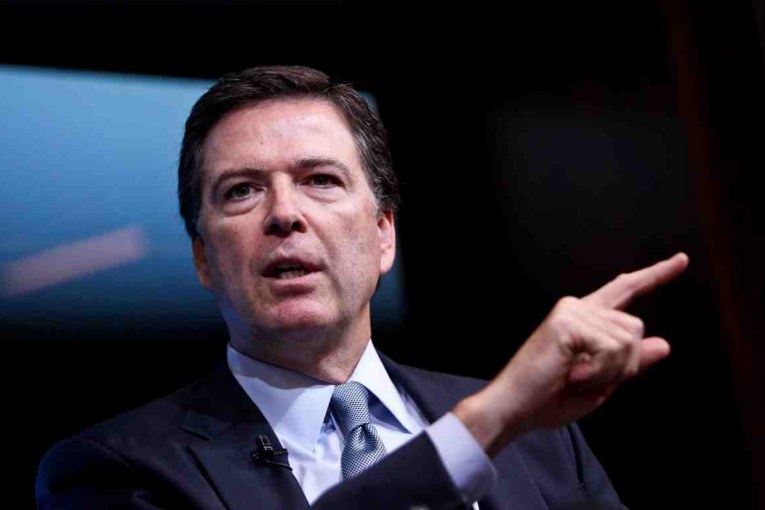
WASHINGTON — A new analysis from the Cato Institute is criticizing a federal case brought against former FBI Director James Comey, arguing that it raises significant constitutional concerns and may not withstand scrutiny in court.
According to the analysis, James Comey is accused of making threats against former President Donald Trump. The case centers on a social media post in which Comey shared a photo of seashells arranged on a beach to form the numbers “86–47.”
Prosecutors argue that this image could be interpreted as a coded message, with “86” sometimes used as slang meaning to get rid of or eliminate someone, and “47” referring to Trump as the 47th president. Because of this interpretation, the image has been viewed by some as a potential criminal threat, raising questions about whether the post constitutes protected speech or crosses a legal line.
According to the U.S. Department of Justice Office of Public Affairs, the indictment includes two counts under 18 U.S.C. § 871. It alleges that James Comey “knowingly and willfully made a threat to take the life of, and to inflict bodily harm upon the President of the United States.”
The analysis says the case “has ventured into the realm of legal parody” and argues the government’s argument is “destined to collide with the First Amendment.”
The case will be reviewed by U.S. District Judge Louise Wood Flanagan. According to the article, it is “highly probable” the judge will dismiss the case “long before the matter reaches a jury” due to how unusual the charges are.
The Cato Institute also notes that the court could invoke the Hyde Amendment, which allows defendants to recover legal fees in cases of improper prosecution. It states that “given the absurdity of the charges,” the government could be required to pay Comey’s legal expenses.
The article also examines broader concerns about the Department of Justice, describing the prosecution as “aggressive posturing” by Acting Attorney General Todd Blanche. It further notes that Blanche faces pressure to prove himself by succeeding where his predecessor, Pam Bondi, fell short, suggesting the case may reflect internal political pressure within the Department of Justice.
A major focus of the article is the lack of accountability for prosecutors. It argues that the case reflects what it describes as “the total lack of accountability for prosecutors,” noting that even weak or controversial cases do not often lead to consequences for those who bring them.
The article suggests that this can raise concerns about how prosecutorial decisions are reviewed and whether there is enough oversight within the Department of Justice.
It further explains that prosecutors are protected by absolute prosecutorial immunity. This protection shields them from being sued for actions taken within their official roles.
As a result, the article argues prosecutors can act “confident that even a high-profile failure carries no real penalty.”
It also criticizes the Department of Justice’s internal oversight system, especially the Office of Professional Responsibility. The article describes it as “a veritable graveyard where allegations of prosecutorial misconduct go to die,” suggesting a lack of transparency and meaningful accountability.
In response to these concerns, the article calls for congressional action, arguing that Congress has the authority to use funding decisions and new laws to increase oversight, allow lawsuits against federal officials, and limit legal protections that currently shield prosecutors.
The analysis concludes that without changes, prosecutors may continue to bring questionable cases without consequences. It warns that “ridiculous cases like the Comey seashell indictment stand to become the rule rather than the exception.”
As the case moves forward, the court’s decision could help define how far prosecutors can go when interpreting threats and whether symbolic actions can be treated as criminal behavior under the law.
Follow the Vanguard on Social Media – X, Instagram and Facebook. Subscribe the Vanguard News letters. To make a tax-deductible donation, please visit davisvanguard.org/donate or give directly through ActBlue. Your support will ensure that the vital work of the Vanguard continues.

As much as I don’t like Comey and felt there were several other things the DOJ could’ve gone after him for this “8647” is not one of them.
This is Trump at his worst.
But somehow, Comey has managed to piss-off the Democrats (regarding Hillary’s emails – which some claim led to Trump’s initial victory) AND now Trump himself.
It looks like there might be much more to the Comey indictment than just the 86 47 Instagram post.
Stay tuned:
DOJ AG Todd Blanche said, “Well, every case requires an investigation. And what you just showed is, is one part of that investigation. What you just showed is the Instagram post. Rest assured that the career assistant United States attorneys in North Carolina, the career FBI agents, the career Secret Service agents that investigated this case, didn’t just look at the Instagram post to walk away. That’s why you saw an indictment last week, not withstanding the fact that it was last May that the post was made. So I am not permitted to get into the details of what the grand jury heard or found, as you know. But rest assured that it’s not just the Instagram post that leads somebody to get indicted.”