
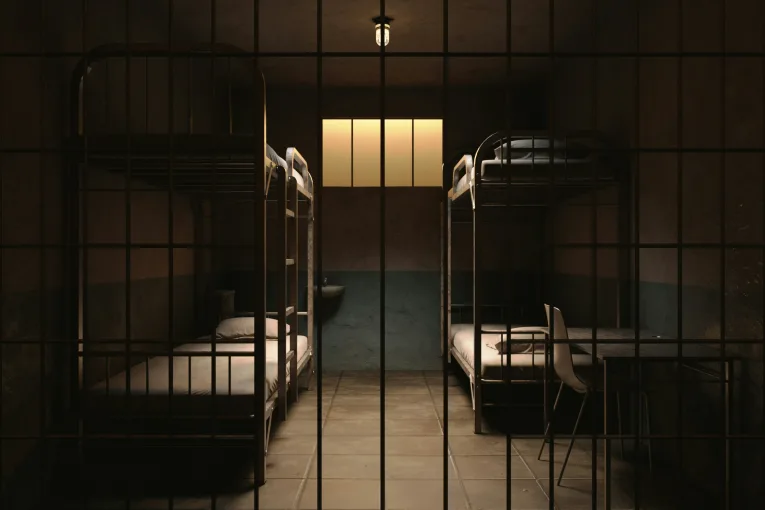
Sleep deprivation is a hidden crisis in U.S. jails and prisons. Insomnia rates are alarmingly high, up to 81%. This is far above the general public. For women inside, the problem is even worse as their sleep is more often disturbed. Insomnia often starts or gets worse after arrest, rising from 50% before arrest to 79% after. This is not just about feeling tired, poor sleep predicts violent behavior and makes people more aggressive.
Jails and prisons are inherently noisy and bright environments. During the night, lights often remain on and routine safety checks cause constant disruptions. Beds are typically uncomfortable, and temperatures are frequently unregulated. Privacy is limited, along with any consistent sense of personal safety. Daily movement is often restricted, which can lead to excessive daytime napping and disrupt natural sleep rhythms.
Together, these conditions severely interfere with a person’s sleep cycle.
In 2019, U.S. Federal Judge James Donato issued a preliminary injunction finding that a California jail’s practices were unconstitutional. Donato cited examples such as waking incarcerated people at 2:30 a.m. for medication distribution and at 4:00 a.m. for breakfast service. Given the severity of these practices, Judge Donato ordered changes, emphasizing that sleep is essential to health.
This was a major legal statement, yet the problem continues everywhere. Nighttime checks and lights are meant to prevent suicide, but they may have the opposite effect. To ignore chronic sleep deprivation is to ignore one of the root causes of poor mental health. Practical changes can help such as dimming lights, providing earplugs, and adjusting schedules. Better bedding and climate control are also needed. These steps create more humane environments.
Sleep deprivation is a known form of torture, but US courts struggle to define when it crosses that line. Some courts have weakened past decisions by justifying its use for prison management. This makes accountability difficult as there is no clear legal threshold. How many sleepless hours does it take for the practice to be considered torture? Without a bright-line rule, abuse continues. The severe health effects are well documented, yet the legal gray zone remains. The proposed “6/24 Rule” creates a vital bright-line standard. It mandates at least six hours of uninterrupted sleep for detainees establishing a clear legal standard to prevent sleep deprivation, a form of psychological torture that causes severe harm and compromises justice.
The impact on mental health is severe. Pamela San Miguel, (Psychiatric Mental Health Nurse Practitioner, St. Paul, Minnesota), explains the clinical effect. “A lack of restorative sleep can impair emotional regulation,” she says. It also diminishes “a patient’s ability to engage in therapeutic communication.” This breakdown stalls rehabilitation before it can even begin.
Deanna Dwenger, (Chief Behavioral Health Advisor, Elevatus Architecture & Former Executive Director of Behavioral Health, Indiana Department of Correction) sees the systemic failure. “Comprehensive approaches to sleep simply aren’t embedded in the system,” she notes. The prevailing attitude is dismissive. She often hears, “They have plenty of time to sleep.” This ignores all the environmental barriers to quality rest. The consequences are particularly dangerous for some. “For individuals with bipolar disorder – a population that’s overrepresented in correctional settings -, disrupted sleep is especially dangerous,” Dwenger warns. “It can directly trigger manic episodes.” This then impacts judgment and safety for everyone inside.
The demand for help is real. Kirstin Travieso, (Staff Psychologist Federal Bureau of Prisons – South Carolina), confirms this from daily experience. “A majority of my clinical contacts are to discuss poor sleep,” she says. Inmates actively seek both education and treatment. The system’s response, however, is often inadequate.
A proven solution exists. It is called Cognitive Behavioral Therapy for Insomnia, or CBT-i. It is a non-pharmacological treatment. A shorter version called Brief Behavioural Therapy for Insomnia or BBT-i also works well in prisons. Studies in prisons show powerful results, A single session of CBT-i has shown improvements in sleep for up to 96.4% of participants, It also helps with anxiety and depression. These therapies teach new sleep habits and they are also perfect for settings with limited clinical staff.
Practical changes can also help. Deanna Dwenger has even proposed innovative ideas. She is looking for a company to explore “secure Murphy beds.” This would create a physical distinction between rest space and living space. Small changes can make a big difference.
Our recent report documents how sleep deprivation in corrections is a public health emergency and a human rights issue. It is linked to suicide and severe psychological harm, yet it is not tracked in any systematic way. Collecting more data on sleep patterns and behaviour, by reporting on noise, light, sleep disruptions and through anonymous inmate surveys, would drive oversight and political reform.
The goal is clear. We must prioritize sleep health in our justice system. As Pamela San Miguel suggests, providing “sleep education early at intake” is a critical first step. Also, Deanna Dwenger puts it best. “If we want incarcerated people to return to their communities healthier, we must treat sleep as a critical pillar of care.” It is essential for human dignity, rehabilitation, and safer communities. Science has acknowledged the harm. Now we need the will to act.
Mariam Assem
Research Fellow, Health Culture Foundation.
David Bishop
Chief Executive Officer, Sleep Equity Project.
Kalman Gacs
Managing Director, Health Culture Foundation.
Follow the Vanguard on Social Media – X, Instagram and Facebook. Subscribe the Vanguard News letters. To make a tax-deductible donation, please visit davisvanguard.org/donate or give directly through ActBlue. Your support will ensure that the vital work of the Vanguard continues.

Good article!
As someone who has spent some time in jail, the dysregulation tactics are completely antithetical with anything coming close to “corrections”.