
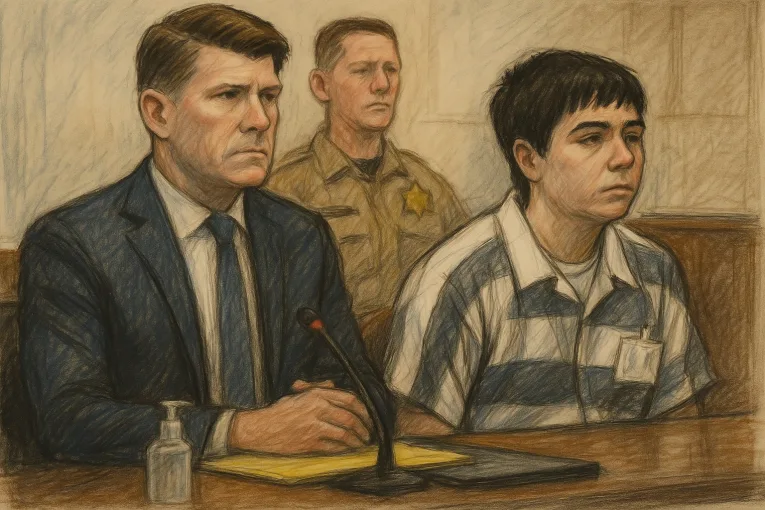
WOODLAND, Calif. — The retrial of former UC Davis student Carlos Dominguez proceeded this week in Yolo County Superior Court, with jurors hearing testimony about the deadly 2023 Davis stabbing attacks while confronting the central question that has defined the case from the outset: whether the accused acted with criminal intent or as a result of severe mental illness.
Dominguez is being retried on charges related to the deaths of David Breaux and Karim Abou Najm, as well as the stabbing of Kimberlee Guillory during a series of attacks that frightened the Davis community in the spring of 2023.
The retrial follows a mistrial last year after jurors acquitted the accused of first-degree murder but were unable to reach unanimous verdicts on manslaughter and attempted murder charges. Prosecutors subsequently elected to retry the unresolved counts.
Over the past several days, attorneys have continued presenting evidence and witness testimony to a new jury. While several witnesses testified about the victims, the attacks and the timeline of events, much of the proceedings have centered on the accused’s mental state at the time the stabbings occurred.
The retrial follows years of legal proceedings complicated by competency issues. Shortly after his arrest in 2023, Dominguez was found incompetent to stand trial after being diagnosed with schizophrenia and was committed to a state hospital for treatment.
Criminal proceedings resumed only after doctors determined he had regained competency.
One of the most significant issues facing jurors is the accused’s dual plea of not guilty by reason of insanity. Jurors must first determine whether prosecutors have proven the charged crimes beyond a reasonable doubt before considering whether severe mental illness affected the accused’s ability to understand the nature or wrongfulness of his actions.
Rather than focusing primarily on personal stressors in the accused’s life, prosecutors have placed greater emphasis on evidence suggesting marijuana use may have contributed to his mental state leading up to the attacks.
The defense is expected to continue emphasizing extensive evidence of schizophrenia and psychosis that emerged before and after the incidents.
During Friday’s proceedings, jurors heard testimony from witnesses connected to the victims, including a former UC Davis student who testified about his friendship with Karim Abou Najm and recalled seeing him shortly before the fatal stabbing on April 29, 2023.
The testimony provided additional context about the impact the attacks had on the Davis community and those who knew the victims personally.
On Tuesday, jurors heard testimony from witnesses connected to the fatal stabbing of Abou Najm in Sycamore Park. Much of the day’s proceedings focused on testimony from Dr. Phillip Massie, who encountered Abou Najm shortly after the attack, as well as testimony from Davis resident Tiffany Hodgins, who described her encounter with Najm shortly after he was attacked.
Dr. Massie returned to the witness stand for a second day of testimony. Because of the anticipated length of the trial, he remains subject to recall and may be called back to testify at a later date.
During questioning, Dr. Massie discussed his observations from the night of the stabbing and elaborated on details that were not specifically addressed during the previous trial.
Among those details was his recollection of seeing an individual moving through the area while appearing to dodge tree branches. His testimony continued to focus on the events immediately following the attack on Abou Najm and his efforts to provide aid after discovering the injured victim.
Notably, he discussed how he observed who he would later identify as Carlos Dominguez fleeing the scene on Abou Najm’s bicycle. Throughout his testimony, prosecutors appeared focused on establishing a detailed timeline of the events surrounding the stabbing and the actions taken by those who responded in the immediate aftermath.
The prosecution next called Tiffany Hodgins, a resident whose backyard shares a fence with Sycamore Park near the area where Abou Najm was found after the attack. Hodgins testified that she was at home with her daughter when she heard someone repeatedly calling for help.
She described the cries as muffled rather than loud but said they were distinct enough to catch her attention. Concerned by what she heard, Hodgins testified that she looked through the fence separating her property from the park and observed an individual using a phone flashlight.
Hodgins described moving toward the bike path, where she encountered what she characterized as a chaotic scene.
According to Hodgins, she observed a severely injured person lying on the ground while another individual performed chest compressions in an effort to save the victim’s life. Her testimony offered jurors a firsthand account of the emergency response that unfolded in the minutes following the stabbing and highlighted the urgency of the efforts made by community members before emergency personnel arrived.
Jurors also heard testimony from a forensic specialist involved in the investigation. The witness discussed evidence processing procedures and the collection of physical evidence related to the case.
Prosecutors used the testimony to continue building the evidentiary foundation surrounding the Sycamore Park attack, specifically regarding DNA evidence found on the victim’s bicycle, which Dominguez reportedly used to flee the scene following the attack.
While much of the testimony was technical in nature, it provided jurors with additional insight into the investigative steps taken after the stabbing and how evidence was documented and preserved.
In a separate development during Tuesday’s proceedings, Deputy Public Defender Dan Hutchinson questioned a witness who had previously testified in the case regarding communications with prosecutors before or after providing testimony.
During questioning, Hutchinson asked whether the witness had a conversation with one of the district attorneys sometime before or after testifying. The witness acknowledged having a conversation.
The court heard that the witness had exchanged emails with Deputy District Attorney Matt DeMoura regarding questions about the accused and general questions about how courts operate.
The defense raised concerns that the witness may have received information that could potentially affect testimony that should be based solely on personal memory and knowledge.
At the beginning of the questioning, the defense also raised concerns about a separate conversation that allegedly took place in court between a witness and a deputy district attorney outside the presence of the defense.
The defense argued that the discussion may have involved guidance regarding testimony and asked whether any advice had been provided. The attorney involved in that conversation was neither DeMoura nor Deputy District Attorney Alex Kian, the prosecutors assigned to the case, according to court records.
The witness denied receiving such guidance and characterized the interaction as a brief conversation that occurred behind closed doors.
Hutchinson argued that regardless of whether advice had been given, the conversation should not have occurred because outside influences should not play a role in testimony or affect a witness in any way.
As proceedings wrapped up for the week, Judge Samuel T. McAdam addressed the jury regarding the large volume of evidence presented throughout the trial.
Acknowledging the complexity of the case, McAdam advised jurors that the evidence may seem overwhelming but encouraged them to continue evaluating it carefully and in good faith.
Jurors were instructed to return to court as testimony continues in what has become one of the most closely watched criminal cases in recent Yolo County history.
As the retrial moves forward, questions surrounding Dominguez’s mental state at the time of the attacks continue to loom over the proceedings. The original trial centered largely on whether Dominguez was suffering from severe psychosis and schizophrenia during the stabbings.
While neither side disputes that Dominguez carried out the attacks, prosecutors contend that the acts demonstrated intent and awareness, while defense attorneys maintain that Dominguez was experiencing significant mental illness that impaired his ability to understand reality.
The Davis stabbing spree generated widespread fear throughout the city in 2023. The attacks resulted in the deaths of community member David Breaux and UC Davis student Karim Abou Najm, while longtime Davis resident Kimberlee Guillory survived a separate stabbing days later. The incidents prompted heightened police presence, changes to university safety recommendations and widespread concern throughout the community until Dominguez was arrested.
Although testimony over the last several days has provided additional details about the victims, the timeline of events and the investigation, the central question facing jurors remains largely unchanged from the first trial: whether the accused’s actions were the product of criminal intent or severe mental illness.
Follow the Vanguard on Social Media – X, Instagram and Facebook. Subscribe the Vanguard News letters. To make a tax-deductible donation, please visit davisvanguard.org/donate or give directly through ActBlue. Your support will ensure that the vital work of the Vanguard continues.
