
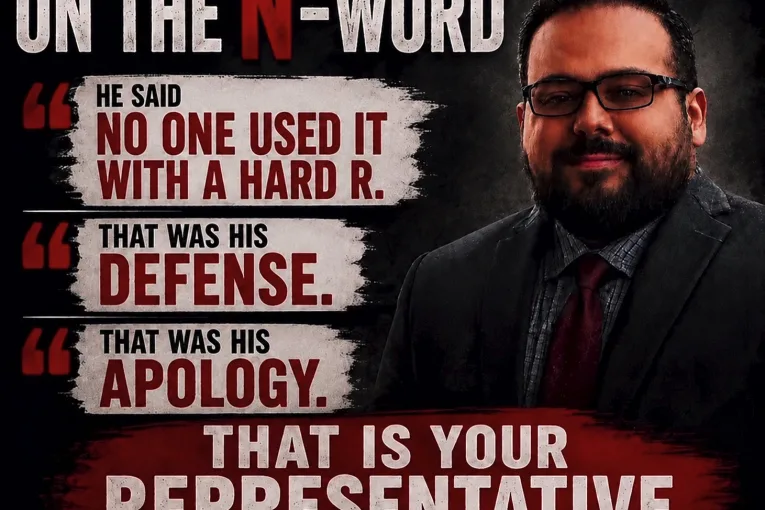
A nonprofit newsroom’s landmark legal win exposes a city’s pattern of hiding records. But the timing of the ruling — and the slowness of courts — may have already shaped who runs San Jose for years to come.
By Susan Bassi, Fred Johnson, Faith Strader
Thirty-three days after a fierce courtroom battle, a judge issued her ruling in one of the most consequential public records cases in Silicon Valley’s recent history. On Saturday before the local primary election, Santa Clara County Superior Court Judge Helen Williams shut down the City of San Jose’s attempt to permanently block a lawsuit over a secret racist group text message chat discovered on a convicted child sex abuser’s phone. The case can now proceed.
It was a win for the law firm that filed it, a win for the nonprofit newsroom that commissioned it, and a win for the principle that government officials cannot hide embarrassing communications behind legal technicalities. But for local candidates and voters casting ballots in San Jose’s June 2 primary, it arrived too late.
WHAT IS “TAMMANY HALL”?
To understand why this matters, start with the name. The original Tammany Hall was a 19th-century New York political machine notorious for corruption, patronage, and using government power for personal gain. That a group of San Jose elected officials and political operatives allegedly chose that name for their own private group says something about how they saw themselves.
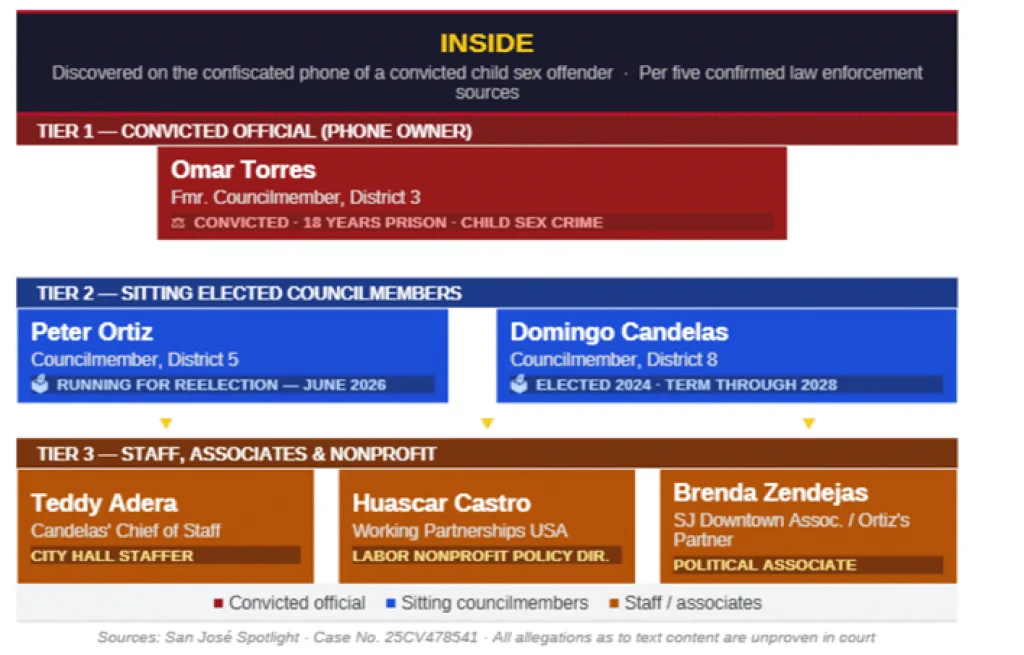
According to the lawsuit, five law enforcement sources whose identities were confirmed by San José Spotlight, the group text chat included Councilmember Peter Ortiz (District 5), Councilmember Domingo Candelas (District 8), and former Councilmember Omar Torres. Torres is not a peripheral character: he was convicted of child sex crimes and sentenced to 18 years in state prison. It was during the investigation into those child sex crimes that San Jose police found the text chat on his confiscated phone.
The thread also allegedly included Candelas’ chief of staff Teddy Adera; Huascar Castro, Housing and Transportation Policy Director at Working Partnerships USA; and Brenda Zendejas, community relations manager for the San Jose Downtown Association and Ortiz’s partner/ campaign manager, according to Spotlight.
Working Partnerships USA is a prominent Silicon Valley labor policy nonprofit with deep roots in the region’s Democratic political establishment. The alleged presence of one of its senior policy staffers in a private chat with sitting elected officials raises serious questions about how publicly progressive organizations relate to the officials they help elect.
WHAT THE MESSAGES SAID
The content of the chat, as described by law enforcement sources to San Jose Spotlight, is blunt and deeply troubling. The messages allegedly included the N-word and referred to Mexicans as “scraps,” a slang term used to refer to Southern California gang members.
Consider the context: Ortiz represents District 5, which includes East San Jose neighborhoods that have long struggled with poverty, overcrowding and underinvestment — communities that are heavily Latino and that trusted him with their votes. Candelas’ District 8 is similarly constituted. These men campaigned as champions of their communities. The alleged content of their private texts tells a starkly different story.
Prior reporting, including a 2018 story in The Daily Fold, documented that Ortiz’s background included gang ties that surfaced during his school board race. The alleged use of the term “scraps” — Southern California gang slang — in the Tammany Hall chat has led many observers to ask whether those associations were ever genuinely behind him.
Sources also allege the councilmembers used the group text to discuss city business and meetings, which under California law would make those communications public records regardless of what phone they were sent on. That detail is legally critical — it is the heart of why San José Spotlight believes the records must be disclosed.
How the City Fought to Keep the Chat Secret
San José Spotlight did not go to court immediately. First, reporters went through proper channels — the California Public Records Act, which gives every Californian the right to government records. The City and San Jose Police Department denied five separate public records requests from Spotlight to release the communications.
The SJPD’s response to one request was particularly revealing: officers stated that the records “would be considered records of investigation (case file) and would be exempt from public disclosure.” In other words, San Jose buried a chat about neighborhood politics and city council business inside a child sex abuse investigation file — and then used that placement to justify secrecy. Spotlight’s legal team argues the texts were placed there precisely to shield them from public view. Local News Matters
Sources also said two other councilmembers engaged in a scheme to conceal their emails about Torres — hiding whether they knew about his potential criminal behavior before his arrest. The pattern, the lawsuit argues, is not carelessness. It is a system. Davis Vanguard
McManis Faulkner: The Firm That Fights City Hall
When five public records requests and months of reporting produced nothing but stonewalling, San José Spotlight turned to McManis Faulkner — one of Silicon Valley’s most prominent litigation firms — and to attorney James McManis personally.
McManis previously went toe-to-toe with San Jose in a 2009 lawsuit over concealed communications about a development proposal from former Mayor Tom McEnery, who received millions from the city’s redevelopment agency for the project. He has deep history with this opponent. He also has a theory of the case that goes beyond any single set of documents.
McManis said the issue has evolved beyond the content of the texts themselves and into a statewide war against government secrecy. A separate lawsuit filed in 2026 by McManis Faulkner seeks to compel the City to implement a permanent, court-ordered monitor to ensure compliance with public records law, citing a “pathological hostility” to public records requests. That case describes not a city making honest mistakes, but one systematically deceiving the public it is legally required to serve.
The Tammany Hall lawsuit, filed October 29, 2025 , lays out the legal stakes plainly. The California Public Records Act and the state constitution guarantee access to government records. Think of it as a legal promise to every Californian: if a government agency has documents about the public’s business, the public has the right to see them. The lawsuit argues that allowing the City to “escape public scrutiny through dishonest assertion of exemptions and hasty, fruitless searches directly defies the legislative intent of the CPRA and California Constitution, as well as the City’s own Sunshine Ordinance.” San José Spotlight
The City responded with a demurrer — a procedural motion arguing the lawsuit was legally flawed and should be dismissed entirely before any evidence was ever considered. On April 28, 2026, Judge Williams heard oral arguments. The case was submitted for decision. Then both sides waited. And waited.
The 33-Day Clock — and the Ruling That Came One Day Too Late
Here is where the timeline becomes politically decisive.
The case was argued on April 28 and submitted for decision. For thirty-three days, Judge Williams deliberated in silence. The ruling landed on a Saturday, May 30, 2026 — filed with the court clerk the day before San Jose voters cast ballots in the June 2 primary election.
That timing is not incidental. It is the mechanism by which delay becomes damage. Winning a demurrer does not release the records. It means only that the lawsuit survives to continue — that the City failed to kill it at the first hurdle. The actual text messages themselves will not emerge until after the court holds its July 21 case management conference, sets a further briefing schedule, and eventually issues a final order compelling disclosure. That process could stretch into fall. It could easily run past the November 3 general election runoff.
What that means in plain terms: voters in District 5 went to the polls on June 2 never having read what Peter Ortiz allegedly wrote about their neighborhoods and their neighbors when he believed no one was watching. Supporters who might have reconsidered their endorsements had a single day’s notice between the ruling and the vote — and no actual records to examine. Political donors who might have redirected their money had no reason to act. The primary was decided on incomplete information, and that is precisely the outcome produced by months of city stonewalling followed by a month of judicial deliberation.
Endorsements That Held Despite the Allegations
The political establishment’s response to the scandal has been instructive. The Santa Clara County United Democratic Campaign gave Ortiz a sole endorsement for his District 5 reelection race in 2026, even as the lawsuit was active, the law enforcement sources fully on record, and the allegations completely public. That is the organized Democratic Party machinery of Santa Clara County — the same county where the texts were discovered on a convicted child molester’s phone.
Supervisor Sylvia Arenas, who nominated Ortiz to the county’s Child Abuse Prevention Council, is running for reelection and has not explained why she chose him, what she knew about his associations with Torres at the time, or why she has taken no action on the council’s composition in the two years since Torres’ conviction.
District Attorney Jeff Rosen, seeking a fifth term, prosecuted Torres only after police obtained a recorded confession — and his office holds the Tammany Hall text messages, employing the senior prosecutor who chaired the Child Abuse Prevention Council throughout the Torres investigation while two of Torres’ closest associates sat on the council beside him. Rosen’s office has not publicly addressed why it has not made those texts available.
Who Spoke Up — Including the Mayor Who Is Now Running for Governor
Not everyone in San Jose’s political world closed ranks around Ortiz and Candelas. Mayor Matt Mahan previously called for the texts to be released, saying he was “especially concerned” about allegations of a cover-up, and that if the messages met the usual standards for public disclosure, they should be made public to maintain trust with the community.
Mahan announced a run for California governor in January 2026, joining a crowded Democratic field as a moderate candidate promising to “put toxic politics aside” and tackle homelessness. He is leaning heavily on his record as San Jose mayor as he heads into the nonpartisan June 2 primary for the statewide race. His public stance on Tammany Hall — calling for transparency where Democratic colleagues stayed silent — now follows him to a statewide audience, distinguishing him from an establishment that chose to look away.
Also calling for disclosure: San Jose NAACP president Sean Allen, the Black Leadership Kitchen Cabinet of Silicon Valley, the AFRO-Upris coalition, the Race Equity Action Leadership (REAL) Coalition, Councilmember Bien Doan, and former Councilmember Nora Campos.
Yet even some who called for release ultimately stood by the officials at the center of the allegations. After meeting privately with Ortiz and Candelas, NAACP president Sean Allen described the conversations as “honest, necessary and affirming of their values and commitment to standing with our communities.” That formulation — acknowledging harm while defending the officials — drew sharp criticism from community members who felt it substituted reassurance for accountability.
What Happens Now — and Why November Still Matters
Judge Williams’ May 30 ruling overruling the City’s demurrer in its entirety means San Jose Spotlight’s lawsuit moves forward to its next phase. A case management conference is scheduled for July 21, 2026, at which the court will chart a path toward a final decision on whether and how the records must be disclosed.
What it does not mean: the texts will be released soon. The records that could finally tell San Jose voters what their elected officials actually said about them remain locked inside a city hall that spent seven months fighting a court case rather than simply turning them over.
If there is a November runoff in District 5 — which San Jose’s top-two primary system makes likely unless Ortiz wins outright with more than 50 percent of the vote — voters may finally have the complete picture before casting their decisive ballot. Or the city may find new procedural obstacles. Given the litigation history described in McManis Faulkner’s separate public records lawsuit — the one characterizing San Jose’s behavior as “pathologically hostile” to transparency — no one should assume the city will comply quickly, quietly, or completely.
What is certain is this: a small, award-winning nonprofit newsroom and a tenacious Silicon Valley law firm forced the most powerful city government in the South Bay to defend its secrecy before a judge — and lost the first round. The records are coming. The only question is when, and whether it will be in time for voters to decide what to do with what they finally learn about the people they elected to represent them.
Follow the Vanguard on Social Media – X, Instagram and Facebook. Subscribe the Vanguard News letters. To make a tax-deductible donation, please visit davisvanguard.org/donate or give directly through ActBlue. Your support will ensure that the vital work of the Vanguard continues.
