
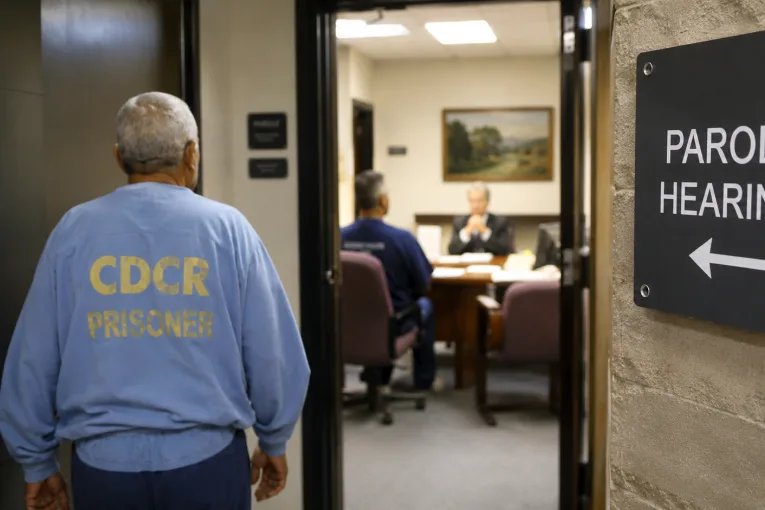
SACRAMENTO, Calif. — As California lawmakers and prosecutors push new restrictions on elderly parole following public controversy surrounding several high-profile cases, Keith Wattley, founder and executive director of UnCommon Law, argues the debate has become increasingly detached from both data and public safety realities.
In an interview with the Vanguard, Wattley said recent efforts to curtail elderly parole are driven more by politics and public fear than by evidence about crime, aging and recidivism.
“These people are trying to gut one of the state’s safest and most cost-effective release mechanisms and for reasons that have nothing to do with public safety and really everything to do with scoring political points,” Wattley said.
California’s elderly parole process allows certain incarcerated people who have reached specified age and time-served thresholds to appear before the Board of Parole Hearings for consideration. The process does not guarantee release. Instead, parole commissioners must determine whether an individual currently presents an unreasonable risk to public safety.
Wattley argued that parole grants remain relatively rare.
“It gives people a chance to be considered for release. It is far from a guarantee for release,” he said.
According to Wattley, parole grant rates for elderly parole candidates have historically been low, with fewer than 10 percent of first-time elderly parole candidates receiving release.
“We’re also seeing that it’s in response to the publicity over the last couple months, the parole grant rates overall are going down,” Wattley said. “Not because people are presenting any new risk to public safety, but just because there’s outcry about it.”
The elderly parole program originated during California’s prison overcrowding crisis and subsequent court-ordered reforms. Initially, eligibility was limited to people age 60 and older who had served at least 25 years. The law was later modified to include people age 50 and older who have served at least 20 years.
Wattley said the program was specifically designed to identify incarcerated individuals who statistically present the lowest public safety risk while also reducing the costs associated with maintaining an aging prison population.
“Elderly parole was something that was first instituted in response to court orders about overcrowding, was later placed in our statute and recognizes that people age out of crime,” he said.
One of the central arguments advanced by supporters of elderly parole is the substantial body of criminological research showing that criminal behavior declines sharply with age.
“We also know that people who were released from elderly parole don’t recidivate,” Wattley said. “In general, in any kind of parole consideration in California, at least the discretionary parole, recidivism rates have consistently been between one and 3%.”
According to Wattley, the recidivism rate for elderly parole recipients is approximately 1.8 percent.
“The recidivism rate is 1.8% and without a single purported incident of sexual recidivism from this program, not a single one,” he said.
Those findings mirror decades of criminological research demonstrating that aging is among the strongest predictors of declining criminal activity.
“There’s a dramatic drop off when people turn 25, but an even more pronounced drop off when someone hits age 45,” Wattley said.
He described aging out of crime as one of the least controversial findings in criminal justice research.
“I want to say it is kind of one of the least controversial findings of decades of research is that people age out of crime, especially violent crime,” he said.
The debate over elderly parole has intensified amid heightened public attention surrounding the release of certain individuals convicted of serious offenses. Critics argue that some parole decisions demonstrate weaknesses in the system and justify tighter restrictions.
Wattley disagreed, arguing that public fear often overshadows empirical evidence.
“Fear overrides facts,” he said. “We’ve seen that in pretty much every area of our society here in the US for sure in recent years.”
He added that public officials frequently exploit emotional reactions to crime rather than focusing on solutions that could help survivors heal.
“I think that the way in which some lawmakers and sheriffs or police are really weaponizing the pain and anguish of crime survivors, it’s really disappointing. It’s unfortunate. It’s offensive even,” Wattley said.
Rather than continuing to spend large sums incarcerating people who no longer present a meaningful threat, Wattley argued the state should invest more heavily in services for victims and survivors.
“The money that is being spent to incarcerate people who are not a risk to public safety after a couple of decades should instead be spent to provide real support for crime survivors in the form of trauma recovery centers, restorative justice programs, other kind of support for the healing work that would make a real difference for so many survivors,” he said.
The fiscal dimension of the debate has become increasingly significant as California’s prison population ages.
Wattley said incarceration costs rise dramatically for older adults because of healthcare expenditures.
“A person who’s incarcerated, it may cost on average 140 or so thousand dollars per year, but then you basically double that when someone is at an advanced age,” he said.
According to Wattley, annual incarceration costs can reach approximately $230,000 to $240,000 for people in their 80s.
“The additional cost is primarily driven by healthcare costs,” he said.
Despite these growing expenditures, Wattley argues the return on that investment is minimal when individuals have already aged beyond the years associated with elevated criminal risk.
“The returns on the investment are pretty much nonexistent because people have already aged out of crime,” he said.
Wattley also stressed that elderly parole involves multiple layers of review before any individual is released.
Candidates undergo extensive psychological evaluations and risk assessments before appearing before parole commissioners.
“They undergo a whole series of very rigorous risk assessments conducted by psychologists and then they undergo lengthy evaluation by our parole commissioners,” Wattley said.
Commissioners must determine whether a person “no longer presents an unreasonable risk to public safety” before parole can be granted.
Even then, additional review may occur before release is finalized.
“Only then does their parole grant get reviewed by the governor or potentially result in their release,” Wattley said.
The discussion frequently returns to high-profile cases such as the David Allen Funston case, which generated substantial public concern and scrutiny of the parole process.
Wattley said focusing narrowly on selected statements from parole hearing transcripts can create a distorted picture of how decisions are made.
“If you review transcription parole hearings and if you just cherry-pick a few lines that are of concern, but if you ignore all the protective factors that reduce the risk of re-offense, then you get a one-sided story,” he said.
He argued that parole commissioners evaluate not simply past conduct but also whether individuals understand the factors that contributed to their crimes and have developed strategies to avoid repeating them.
“The board wants to know that the person has learned to identify what the risk factors are, what the triggers are to that potential behavior occurring and whether they have put in place effective coping mechanisms so they don’t repeat that behavior,” Wattley said.
According to Wattley, the broader narrative portraying California’s parole system as fundamentally broken is unsupported by available evidence.
“If you have people who are rarely granted parole and even more rarely re-offending, then you actually don’t have a real problem,” he said. “You have a perception problem, you have a fear problem.”
Wattley also expressed concern about legislation that would further politicize parole decisions.
He pointed specifically to proposals intended to make individual parole commissioner votes more publicly visible.
“If they would publicize individual commissioner votes from en banc proceedings, it would add political pressure in exactly the cases where independent evidence-based judgment matters the most,” he said.
According to Wattley, public campaigns surrounding specific cases are already affecting decision-making.
“I think we’re already seeing that the parole grant rates are going down in just the two months since the Funston case was first publicized,” he said. “Not because people became more dangerous, because parole commissioners became less willing to make the evidence-based decisions.”
For Wattley, the evidence points toward expanding rather than restricting elderly parole.
“We need to expand rather than restrict elderly parole,” he said. “A lot more people can be released, can and should be for a lot of reasons.”
He warned that continued reliance on fear rather than evidence could undermine one of California’s most effective public safety tools.
“When we say that we believe in transformation, rehabilitation, and a real assessment of public safety risk, we can’t operate this way,” Wattley said.
Follow the Vanguard on Social Media – X, Instagram and Facebook. Subscribe the Vanguard News letters. To make a tax-deductible donation, please visit davisvanguard.org/donate or give directly through ActBlue. Your support will ensure that the vital work of the Vanguard continues.
