
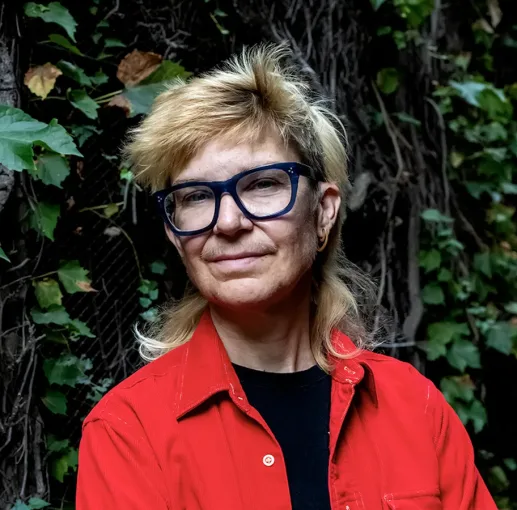
Deconstruction is an inside-out, stakeholder-produced interview project that presents questions formulated by imprisoned scholars—members of the Merced College Alpha Gamma Sigma Honor Society community housed at Valley State Prison (VSP), a men’s prison in central California—posed directly to members of the academy, authors, and activists whose works intersect with our plight: the relational condition of unfreedom we identify as “the carceral state of being.” Building insurgently without permission—or assistance—from the container, in partnership with the Justice for Everybody movement (J4EM), and the Yale Institute on Incarceration and Public Safety (YIIPS), the captive-organized Carceral Studies Journalism Guild (CSJG) pursues, deconstructs, and introduces the embargoed inside knowledge most confined learners are deprived of.
Erica Meiners is a professor of Women’s, Gender, and Sexuality Studies at Northeastern Illinois University, co-editor of the anthology, The Long Term: Resisting Life Sentences, Working Toward Freedom (Haymarket, 2018), and co-author ofAbolition. Feminism. Now. (Haymarket, 2022). Her community-building work supports liberation mobilizations that center access to free public education for all and other queer abolitionist struggles, including Critical Resistance; the Prison + Neighborhood Arts/Education Project; the Illinois Death in Custody Project; and the Education for Liberation Network. A prolific generator of scholarship and ideas that interrogate the intersection of the state’s killing power, the violence work that inflicts said power, and the bodies targeted by said power, Erica is as personally accessible and engaging as her published work. After we invited her into the Deconstruction project in late 2025 via email, Erica was quick to respond, conveyed that she was “really honored” that we had reached out, and made time to answer our questions.
On a -25C polar vortex day in Chicago, it is Erica’s off-the-wrip warmth, self-deprecation, and reflexive transparency that renders her such an inviting subject. “Organizing,” she says, “is about keeping myself or others I love alive, or with the aim of flourishing.” Calling herself a lover of “cross-country skiing,” who “keeps bees,” and lives in a “chaotic queer household,” she’s worked “for decades, largely in maximum security prisons in Illinois,” and “across other institutions and infrastructures of the carceral regime,” abiding an analytic that, for her, “is a feminist one, particularly, a Black and queer feminist one.” A self-professed “worker” who likes jobs that make her “feel useful,” (she has washed dishes, and worked in bars for years), Erica is a Scorpio who hails originally from Canada and tells us that “smartness or brilliance feel shiny, and brittle, and lonely—and I am none of those things.” It makes endearing sense that an abolitionist educator, who has co-authored a book alongside Angela Y. Davis and Gina Dent, and teaches at a “working class public open enrollment university,” might humbly admit to being “often thrilled” that she is “just mediocre.”
Of course, when one reads Erica’s work it is clear that she is anything but. On EBSCO, captive scholars with DOC-issued college program laptops can download various examples of her work, including “Fierce Urgency of Now: Building Movements to End the Prison Industrial Complex in Our Schools”(Multicultural Perspectives), “Abolitionist Entanglements with Guards: Engagements to Deepen Analysis and Organizing”(Social Justice), and “Gendered Movement: Negotiating Youth, Sex and Harm in the US Carceral State”(Children & Society). What distinguishes Erica so clearly from those who think, speak, and publish about coalition building, is that, unlike too many who posture in solidarity with captives without actually working in tactical unity with their causes, she directly engages, leans in, and shows up “with clear eye radicalism.”
The season of our dialogue followed what Erica called “a hard fall” for Chicago, where “ICE has been abducting people from across the city, particularly in the neighborhood that I live in, which is a migrant port. But while the street-based snatching by masked and armed federal agents in unmarked vehicles has been horrific, the resistance has been equally amazing. For months, everyday people on bicycles, sporting bandanas and orange whistles have been mobilizing to track what’s been unfolding. Seeing everyday people show up with righteous anger—more importantly, show up organized—has been amazing. The level of infrastructure that developed is mind blowing! Almost every message that has gone around since the ICE abductions started, about how we could be/are organizing has had the tagline: Do not trust the Chicago police! This is a win from years of abolition feminist organizing.”
In our conversation, Erica described her writing projects as “attempts to think through problems in these practices,” and “document what we tried, or what we did.” In a Truthout piece with Priya Kandaswamy published in March 2025, Erica emphasized the pernicious power of correctional guards’ unions, the explosive persistence of state prison budgets that supplant those of public universities, and the redlining and censorship that criminalizes life-giving resources for people living outside the hetero-normative nuclear paradigm. Writing with Shannon Perez-Darby and C. Hope Tolliver for Truthout some months later about the centrality of family separation tactics to US state violence amid the ongoing ICE crackdowns, Erica urged readers to “blow the whistle” so hard “that the vibrations force the system to crumble.” For the captives trapped inside the container who look out at the chaos via prison day room televisions—a sort of allegoric cave—and ponder how to simultaneously mitigate what prison takes, defend against the harm its lash causes, and escape its leash with something worth carrying into freedom, deciding how to resist—how to safely manifest abolition in a coordinated manner from confinement—too often leaves novice thinkers searching for both answers, and allies.

When interviewed by Emily Thuma for a special issue of the Scholar & Feminist Online titled “Abolition Feminism & the Politics of Reproduction,” Stevie Williams—a Black, queer abolitionist organizer imprisoned in Philadelphia and the 2024 recipient of the Writing Freedom Fellowship—pointed to a solidarity problem in prison organizing, saying “in abolitionist work, we talk about relationships, but I don’t see people being intentional about relationship building with people who are inside, with imprisoned people.” Stevie is the founder of In the Belly, publishes regularly for Critical Resistance’s The Abolitionist, and coordinates a network of abolitionist study groups in Pennsylvania via 9971. For someone as active in the work as Wilson is to flag a gap in the human chain, and feel compelled to ask those engaged in abolitionist work: “Did you make an intentional effort to be directly connected to people inside?” signals a need for those in allyship with captives to reevaluate who is doing what, with whom, and to what end.
In her writing, Erica invokes Ruth Wilson Gilmore’s description of a nation “predicated on the humiliation, exclusion, and premature death of too many,” and affirms that “our work as educators is not simply to challenge laws and policies that disenfranchise and dehumanize, but also struggle against the practices and logics of disposability.” Harnessing Critical Resistance’s organizing tenets, in order to apply them here—within the belly of the beast—so that we might build for ourselves principled stakeholder-driven communities of care that afford us safety, and nurture our capacity to learn insurgently, requires an allyship with folks who foster these practices for the benefit of those stuck in the school-to-prison pipeline, and are being ripened for liquidation. Because schools and prisons are symbiotic sites of the same punishing techniques born of prison that have been perfected by the state (surveillance, criminalization, and immobilization) and projected upon the society beyond the material penal regime, public school classrooms—be they within or beyond the prison fence line—represent terrains ripe for radical incursion.
For folks on the inside who rarely see radicals standing in the few shared spaces that allow for a collaborative building of what Erica describes as “transformative justice responses to harm” while being contained, we see opportunities for experimenting with insurgent meaning making methods of our own design. When she espouses how “educators committed to social justice… must engage and commit to a radical abolitionist politic and pedagogy that disrupts the facilitation of the carceral state,” she insists that “education for liberation requires our bold critique, creative acts, and a willingness to take risks outside of the status quo.” We agree. For those of us stuck behind the wall who too often feel left isolated from the application of those principals—here, where we need them most—we seek engagements that disrupt the status quo that leaves us unable to learn from our betters. Many of us are asking when (or if), the “Ask, Listen, and Imagine” mantra becomes a thing confined people get to partake in. Who listens when we declare what we need? There is an uncomfortable, disruptive, and ironic truth idling within the prison classroom that too few educators seem willing to acknowledge: we, the captives, are sitting in those spaces—where the violence workers have no presence—waiting to meet a thinker like you.
For example, in California, the state has perfected the “cooptation protocol,” and is brazenly seeking to rebrand its punishment sector with the more user-friendly “California Model” label. The state recently passed SB 551—a law that promulgates a legislative finding that the harms caused by living/working inside one of our so-called “reformed prisons” for one year and reduces one’s life expectancy by two years. Those of us who were banished from higher education for three decades following Clinton’s 1994 Crime Bill, but are now able to earn AA/BA degrees using our liberated Pell grant eligibility—like Ghost, whose Gladiator School piece in Slate describes his journey—wrestle with the internecine conflict posed by daring to covet the very thing the state will coopt in order to justify the existence and expansion of its de facto role as the proprietary guarantor of public safety.
“I do think there’s a political moment, now,” Erica says, “as Pell grants are reinstated for those inside; and the liberal wing (if there is one), in some wealth hoarding private and public universities, are seeing degree programs in prison as a kind of liberal ‘redemption project.’ Can we use those channels that are opened by the ‘good intentions’ and see what we can do with them? I do like the idea of external scaffolds—critical; however, conversely, that is one racket I have been trying to run for a few years with mixed success. The liberal script is deep. The ability of the carceral regime to coopt the dearth of people in university settings (especially the fancy places), who are willing to work collectively,—really collectively, across all kinds of divides—all have repositioned these ‘education in prison programs’ in ways that make abolition insurgencies almost impossible.”
Reflecting in a 2022 article on how the “years of intimate pat-downs” she has been subjected to while working directly with residents of the carceral state at a maximum security state prison has informed what shea knows “about the prison, those locked inside,” and the “outside communities which feed this system,” the educator who refers to us as her “comrades” doesn’t neglect those who perform the prison’s paid violence work. Erica wrestles critically, and empathically, with the challenge of “rendering the harm of guard work visible,” while thinking about “what is lost” as they are “left out of our engagements.” Leaving no stone unturned, Erica described in our exchange her role as “part of a project in Illinois that works to support access to education for people inside prison and after release, and more centrally works to redistribute resources and support abolitionist organizing.” In a piece co-written with Chrissy Anderson-Zavala, Patricia Krueger-Henney, and Farima Pour-Khorshid, Erica explains how “rather than a focus solely on piecemeal reforms that buttress carceral logics and practices, abolition demands a holistic analytic that addresses the roots of harm” and raises the tensions and possibilities of liberatory and loving educational practices in school spaces.
Applying that same lens to e-classrooms found inside prisons—school spaces—requires a reimagined protocol by which radical liberatory practices can be insurgently deployed in collaboration with captive scholars, in order to deliver the flourishing possibilities that the rest of the prison is hellbent on murdering. For those ideologically straight-jacketed from thought-experimenting how to share classroom space with us without hitting the reformist tripwire, Erica’s education work in spaces behind/beyond the wall alike, models what formation mobilization can look like when our struggle for community safety, inside knowledge, and justice for everybody are surfaced, and centered above dogma.
“My responsibility,” Erica says, “is to try to imagine, practice, and proliferate ways to get coworkers, or people who are somehow tethered to that fare, to do this work, (and) leverage resources—the few that we have—differently. I tried all different kinds of things, from doing workshops at academic conferences, to publishing suggestions in academic and non-academic spaces that university-based researchers read, igniting dialogue about how prison education programs are just replicating the carcerality often of the prison, and inviting questions. I can say, in a state like Illinois, where we have a Democratic super majority and the Governor is going forward—of course, with resistance from us—to build two new prisons that are ‘programming prisons,’ highlighting these as spaces that are set up for trauma-informed services, and for education—blah, blah, blah… and so forth—that the fight is about how astutely the carceral regime is able to absorb our demands and incorporate them into the carceral landscape. Great—2026—we are building prisons with the tag line ‘they have excellent therapy and education,’ services we cannot get in the free-world. Totally askew.”
Here in California, seizing upon the collective purchasing power our captive student status creates via the revenue our enrollments generate, we envisioned a student union effort to coordinate the withholding of our participation (a defund-the-campus student strike mechanism). This would empower us to harness our academic freedom autonomy and shape the curation of the course offering menus that dictate our learning experience. After several desert years, we recently forced a Women’s Studies course to be offered here, which will be available in the fall. However, though Ethnic Studies is a state-mandated graduation requirement for both high school, and California State University graduates alike (prisons here confer high school diplomas, and the state’s public universities partner with the prison system to confer AA/BA degrees), college students at Valley State Prison (VSP) have yet to have the opportunity to satisfy the Ethnic Studies requirement by enrolling in an African American/Black Studies course. Though courses are taught here both in-person, and online via Canvas, not a single teacher in the nation has responded to VSP’s local recruitment efforts.
We’re situated in a backwater section of the state, the hotels suck for visitors, and it’s a grind to travel out to us. Those instructors who do commit and put up with all the prison-created search protocols, and logistical obstacles in order to stand in classrooms with us, are real soldiers. We salute them, and there is no doubt that the in-person experience is the most effective mode for us, in all respects; however, our learning options need not be artificially landlocked by who can physically show up, especially when digital solutions allow us to be connected to the best teachers/mentors, no matter where they camp. The well-intentioned folks stuck in last decade’s thinking about what’s best for us, need to shed that paternalism, and really hear us when we tell you: “Teach us online!” Frfr. If you were in prison, would you rather have no class, or be taught online by someone like Orisanmi Burton, using Canvas? Online teaching is easy to do, less time-consuming than having to physically appear, and the digital portal does not shrink what you can curate for us. You Zoom-film your lectures, drop us PDF quizzes and exams, we upload our essays, and you post grades. It’s not hard.
For conscientious students of abolition surviving confinement, it is a completely righteous cause to oppose the expansion of the carceral state—something all of us can agree on. However, to those pointing from freedom to the absurd budget priorities reflected in how prisons avail to captives the “services” the public cannot but should be able to access (e.g. mental health, self-help programming, trauma-informed interventions, and higher education vertices), we assert that these services are not objectively corrupted nor are we compromised simply because the regime deftly valorizes its mission in self-serving ways by pointing to the objective good those services perform. We have to embrace the urgency of real-world aides that preserve our safety and enable our flourishing, no matter their non-reformist reform implications.
Unless of course, we are to remain addicted, gang-affiliated, illiterate, and emotionally unregulated in prison.
Our college community offers the widest variety of degree options of any in-prison college program in the nation. We were the first in-prison college students in the country to use laptops. Our honor society community—the largest of any comparable free-world college in the state—is the only such honor society in the nation that conditions its membership upon the verified performance of community service work. Our debate team is the first in the state to engage out-of-state scholars. We spend our statutory entitlement to Pell dollars to fund our ascendency; and when we achieve an educational milestone—be it a high school diploma, GED, AA, BA, or MA degree—we reduce our sentences by six months.
Questions abound.
Does anybody dare tell us—or publish—that we should refuse to learn, we must forgo knowledge, or that, in keeping with abolition’s principles, we are obligated to boycott what higher education feeds us, lest we somehow be complicit in the regime’s propagation of carceral power? Should we not wield our student status as a calling card that affirms our right to stretch civic engagement to the bounds of humanhood? Is there an abolitionist who teaches, but believes we forfeit the right to be students ourselves?
Our learning momentum can’t be maintained and our gains can’t be consolidated without externals forming human land bridges where gaps exist. We need good people positioned in the foreseeable spots in order to never allow the prison to erase a win or claw back our programming by pointing to a lack of capacity that we could have planned for and held, had we been in greater coordination with the academy. We represent income potential for distanced teachers. How many of you reading this have PhD advisees right now who could easily plug into us and teach digitally what we can’t get taught in person? All of you do. Advisees do what their advisors suggest that they do. So, there should be no shortage of online courses being offered to us. The in-prison college landscape is the safe space academic freedom terrain we need to seize, hold, and expand; however, we can’t do that unless we have the academy standing there, using all of its tools and insisting to be plugged into us. We need to remove the instructor scarcity excuse from the problem and self-solve our learning riddle. People in unions are well-trained to understand how the exercise of leverage and the positioning of people shape practices. We don’t need a student strike; we need a teacher availability overload.
“Of course,” Erica says, “everyone everywhere merits access to free and high-quality education.”
Ironically, the in-prison college classroom—provided abolitionist educators occupy it—represents the final frontier for the proliferation of the anarchy that allows the ungovernable student to thrive. We know precisely how the system asserts its inapposite arguments; but we also know that our societal return is made more viable when we are able to consume the forbidden knowledge that enabled our greatest abolitionist thinkers to earn their PhDs. Nobody should use their critiques of the material carceral state to velvet hammer, sus, or side-eye our pursuit of the very academy knowledge that catapulted our ideological mentors into thought leader status.
We proposed to Erica that by declaring jails and prisons “urban communities” and pairing confined scholars with external historians, and geographers—the thinking being that we could replicate Michelle Jones’s in-prison work, form a constellation of captive scholars, and use their in-prison college enrollment as an insurgent excuse to clandestinely map the origin story of the nation’s prisons—we might generate new critical prison studies scholarship, excavate more ways to indict the apparatus by historicizing its satellites, and expand our civic reach in order to “humanize residents as they resist civil death.”
Erica responds, “From the way this question is phrased, I am interested. I want to say, both ‘let’s try it,’ and the cynic in me wants to say, ‘if you have to make the case that you’re human, the war has already been lost.’ There was a wonderful group in Chicago called the Young Women’s Empowerment Project—a group of young people who were involved in sex work who put out this FAQ for university-based researchers—probably ten or fifteen years ago; basically, the message was essentially both ‘nothing about us without us,’ and ‘we don’t need you to study us anymore.’ Of course, this isn’t unique. Across history, many groups who are engineered to be more precarious have recognized that of all the things they need, research is not that. We experiment, we try, we work collectively, we assess and reassess.”
We loved the framing of “nothing about us without us,” and it’s something we resonate with in our collective work. Radical carceral journalism—the way we assess and reassess—enables captives to autonomously shape-shift from subject matter to primary source, from body to human, from authors of violence whose mistakes criminologists’ study, to becoming authors of the ignored histories that disarticulate the material carceral state (the very thing criminologists have ignored). By interrogating the techniques born of prison, we aim to decode the relational human condition that results from the state’s projection of carceral power—the carceral state of being.
Radical carceral journalism—the way we assess and reassess—enables captives to autonomously shape-shift from subject matter to primary source, from body to human, from authors of violence whose mistakes criminologists’ study, to becoming authors of the ignored histories that disarticulate the material carceral state (the very thing criminologists have ignored).
Erica tells us about having “just finished a meeting with people who have been supporting Stateville Speaks, one of the longest-running newsletters in the country that was started by people inside Statesville Prison and is now run by a hybrid inside/outside scrappy little crew. It mainly has an Illinois readership, and our last issue was about the proposed prison rebuilds in the state.” Revisiting how the Democratic supermajority in her state allocated just under $1 billion to rebuild two new prisons, she adds that “even though we have about 12,000 empty beds… I think the fact that the state is just fiscally dead broke might propel some center and left organizations to sign onto that coalition. But, getting people home, which is also the goal of this coalition, is a harder sell.”
Any state proposing the construction of two new prisons while carrying heavy in-state prison vacancies that amount to the equivalent population of four California prisons is one that has been captured—think elite capture—by the prison guard union, and the PIC interests that drive our commodification.
“The current issue we’re working on,” Erica reports of Statesville Speaks, “is on censorship.” We’d like you to note how she isn’t merely on a call about an insurgent publication—she is lending her expertise to help shape its messaging. “The state DOC has dumbly decided that only electronic correspondence is going to be admitted to the prison system,” Erica continues. Note, too, that this change is coming to California as well. “The state, perhaps two years ago, started to slowly implement an electronic communication system. I’m very interested in the work you’re doing with Inside Knowledge; I do think this tech holds radical potential. Tell me more what this looks like–what it is–who has access, how, etc.,” Erica asked, inviting us to tell her more about our ongoing and forthcoming projects.
There was a time, at the dawn of tablet penetration, when it made sense to flag the predatory swerve of Securus, GTL, and their ilk. We get it, and we say “thank you” to everyone who pumped consumer advocacy on behalf of us, and our price-gauged families; but we, like our comrades in Connecticut, now enjoy toll-free outbound phone calls. We can call anybody from a hands-free tablet while sitting in the dayroom, walking the track, or huddled in a learning circle. This really highlights Stevie’s critique about why there isn’t enough outside-in connecting happening, right? If solidarity is free to folks who say they care about forming allyships with captives, why aren’t more captive contacts on people’s phones? We all have some recalibrations to make about possibility.
Text messaging is not cost-prohibitive. We publish our articles, and email our allies using the text messaging app, via either comrade boomerangs, or being directly anchored. By the way, we are an unfunded info war militia. We both earn less than $14 a month slaving for the state, and we use all of that money to fund our work, forgoing commissary. We can also videocall directly into any setting wherein a phone can be secreted (college classrooms, conferences, hacker hives, rallies, hood interventions, editorial meetings, funerals, birthday parties). Who’s feeling insurgent?
The unsung tablet silver lining too few seem willing to even acknowledge—we are rarely given agency to participate in conversations about the utilitarian uses of tablets, and people cringe at having to salute anything that serves us well—is the ocean of life-affirming teachable moment self-help content available to us for free idling on Edovo, a platform ZERO abolitionists have exploited—where are they? NONE of their books, talks, podcasts, or academic papers are available for stakeholder consumption there—why the hell not? Few are even aware of Edovo—so, frfr, who’s not paying enough insurgent attention to our struggle?
Edovo became a priority in our strategizing after we test-drove its capabilities, following our prison’s fascistic impoundment of the 80 copies of PEN America’s The Sentences That Create Us writing guide our Barz Behind Bars workshop ordered, and had shipped here by Haymarket. Essentially, the prison seized the learning material we were already using in our FUBU-style self-teaching practice, refused to let us access the books, and thwarted the Mellon-funded mechanism by which Haymarket’s product was to flow to captives for free. Ghost personally appealed the seizure, was threatened by officials to stay silent, published an article about it anyway—he named and shamed the state employees involved—spoke out about it publicly on the Everyday Injustice podcast, and reached out to Moira Marquis, the then-Director of PEN’s Justice Writing Program, who now runs Prison Banned Books Week, seeking her advocacy.
Moira wrote two letters, sent to two different VSP Wardens over a multi-month period, affirming PEN’s support of our Barz community, requesting our use of the books, and offering to provide return postage to pay for their return. Our prison lied to her by saying the books would be distributed in-prison; in fact, they haven’t been seen since. So, we got insurgent—Ghost told Moira about the Edovo platform and asked her to position the guide there as an on-demand digital PDF—and now it is available for free to more than a million people on the inside. In fact, it has been so heavily consumed by captives using their DOC-issued tablets, it is now listed by Edovo as a “Best of Edovo” selection, which speaks not just to how Edovo, Haymarket, and PEN were unaware of the possibilities for collaboration (Ghost revealed a distribution blind spot), but also how, when we snatch agency for ourselves, we prove that we know best what we need, and how to access it.
There has always been good cause for educators who are willing to stand inside prison classrooms, and deliver higher ed instruction to the captive scholars chasing the degree opportunities made possible by the return of our Pell funding eligibility, to reject asynchronous educational platforms offered via third-party providers that do not require on-site logistics, as alternatives to in-person teaching. However, that is a tired construct that no longer applies post-COVID. We need to distinguish signal from noise, because the legit Pell-funded degree programs operating in partnership with prisons now are not the tablet-based hustlers who climbed into the space unchecked and diploma-milled the game early on. We use Canvas-enabled laptops now and move assignments back-and-forth digitally between students and real-life instructors, in a normalized—albeit monitored—manner, such that, even where there is not in-person instruction, the online prison learning intranet-based experience is comparable to the current free-world online student experience.
As stated earlier, we’re focused on resolving why we can’t find a single human willing to teach a Black Studies course to any of the 7,000 people housed across the street from each other at VSP and Central California Women’s Facility (CCWF). We have an accredited college ladder system that can seamlessly travel a newbie student from GED, to AA, and to BA, for free, without accruing any student loan debt. Conversely, we are out here enduring the daily humiliation of being subjected to the sexualized trauma of mandatory cavity searches, as the cover charge our bodies pay in order to even enter these classrooms. So, before anybody proposes that we link arms in order to deploy a Sostre-style bodily defense of our “final citadels,” (trust, we’ve thought about it)—by doing so, we’d be signing ourselves up for SHU terms that disqualify us from the college program, and allow them to claw back our laptops—why not just agree to teach us an online course?
See, though we have all these tools and opportunities, the prison itself is working against us, by forcing us to strip-out in order to attend class. It’s a carceral warfare project campaign of humiliation aimed at killing our spirits. They essentially hope to dissuade us from pursuing an education by abusing and demoralizing us. It’s sick. They have the mag wands you encounter at concerts and sporting events, the walkthrough metal detectors you pass through at the courthouse (as found in most of the militarized public schools criminalizing kids), and the ION x-ray body scanners used at airports—state of the art tech tools that can see through our clothes/bodies, and detect anything inserted/secreted on our person, and/or within our bodies—without demeaning us, right there, on hand, in the same room they use to force us to spread ourselves open. They simply refuse to use those tools; they shut them off, unplug them, and force us into the humiliation ultimatum.
There was a brief moment when we—mostly the lifers among us—thought that we might be punking out by acquiescing to the indignity protocol. We nearly decided, en masse, to refuse the process, stay home, and shut down the semester via boycott; however, the sad secret we don’t like to share with the world, is that we would have merely caused a brief cessation of classes, and been banned from college, as there are 500 ready-to-be-coopted replacement students who have been waitlisted for three years, and would strip-out in order to supplant us in those classrooms, acquire our laptops, walk at graduation, and earn the concomitant sentence reduction time credits everybody earns by completing a college course. Apathy, self-interest, and desperation permeate what should be a unified body of like-minded soldiers. Too many of our peers—particularly the ones with determinate sentences—are just too thirsty for the transactional benefits of fitting themselves into what the PIC has erected for them. For anybody who is lacking moral courage, they can always opt to lens it this way: for every committed distanced teacher we find to teach us online, 28 of us avoid cavity searches.
Erica’s ideas about delivering higher education in prisons and being open to exploring how best to deliver knowledge within the container, is not a shared monolithic logic among abolitionists.
The trench that pipes bodies from a criminalizing public school system into the carceral container, has been excavated by what Dylan Rodriguez describes as “the disorientation of the teaching act,” whereby the “global U.S. prison regime… has become a primary condition of schooling, education, and pedagogy at every site.” Citing the ways higher ed programs in prison can undermine Black education, or create hierarchies and gatekeeping, Rachel McMillian, an educator who teaches at Indiana University Indianapolis and a scholar who views Black anarchism as “a vision of the world that is free from the control of the State, absent white supremacy and capitalism, and anchored in radical community care,” says that, “I simply can’t valorize higher ed in prison when I’ve had personal experience of people being shipped away from family members in order to make room for an institution of higher education.” An organizer who considers Erica “a dear, dear friend,” Rachel’s lament embodies the tension that frays the lifeline some captives feel is the connective tissue that binds them with the iconic thinkers whose ideas about struggle and resistance inform their very existence as they negotiate the cooptative trappings of confinement. “I’m not side-eying higher ed in prison,” Rachel shares via email, citing “personal experience with the ways that higher ed has opened so many amazing doors for my loved ones inside and during the process of returning to their communities,” but candidly observed that “this work is messy and tangled, and people can have vastly different experiences, which is why I believe that higher ed programs/institutions are worthy of receiving both honor and critique–in the Black feminist tradition, it’s never and either/or—it’s always a both/and for me.”
So, we see Edovo as a two-way portal—think of it as a television network—that we need to program ourselves, in order to position the mental diet brain food we cannot access otherwise, be it because of censorship or the cost-prohibitive nature of printing and mailing dangerous thought crime content into prisons. The Inside Knowledge channel we are curating in partnership with J4EM/YIIPS—which they have graciously committed to funding (Edovo isn’t free, or cheap)—has already secured, for example, the IP use rights for All Of Us Or None’s newspaper archive, and thanks to help from Johanna Fernandez, our use of all of Mumia Abu-Jamal’s books, writings, and audio, including the books and films made about his life. Of course, brother Mumia can’t access Edovo in Pennsylvania yet, nor can our folks in Connecticut who publish Liberation Live!; but it’s about pushing embargoed content where we can, using tools our allies have overlooked. Campus lectures, audio book versions of nonfiction books, and all of the annual Eyes on the Prize documentary films that serve as cultural ethnographs, and thus, are so vital to self-knowledge—all of that, and more—is what we aim to point into our people. With the digitization of all inbound prison mail on the horizon, the digital tech space is going to become the most important terrain to understand and navigate. How else might you ever position culturally vital on-demand video for captives to consume? Not a single James Baldwin book is available to us on Edovo, nor is Toni Morrison’s Beloved, Ralph Ellison’s Invisible Man, or AYD’s Are Prisons Obsolete?—a pedagogic blasphemy—but they all could be. We aim to change that.
As for Inside Knowledge, this is a revolutionary FUBU-style information-based insurgency, which circumvents the censorship-driven methods of the PIC’s carceral warfare project, by rooting vital life-affirming content within the enabling tech of Edovo, an Illinois-based company whose resident-facing app lives on the platforms of most of the DOC-issued tablets used by captives in America, reaching more than one million people. During COVID, content providers—particularly faith-based organizations—flooded Edovo with digital learning materials in order to bridge quarantined congregants to teachings they couldn’t access in person.
We have always viewed this digital space—as well as the prison college classroom itself—as the next frontier of anarchy, radical organizing, and self-determination for captives, as these domains present the last vestiges of terrain where censorship, restrictive mail policies, and pedagogic bias can be resisted from within the PIC, provided the academy stands with us. Echoing Stevie’s lament, the sad fact that the vast universe of abolitionist thought is invisible on Edovo, is precisely why we are SOSing this alarm. Notwithstanding what abolitionists have done for captives, and the debt we owe those whose work affirms our humanity, the abolitionist thought desert that is Edovo, and the absence of radicals teaching us in our prison college classrooms (in person and/or online), reflects just how little re-imagining our best thought leaders have been engaged in when it comes to helping us learn what they know, and how best to teach one another safely.
We have not hidden our criticism of the many journals and publishers who fail to value captives as people deserving to access their products; just as well, we don’t particularly valorize public-facing news platforms that don’t facilitate our access to their content. As long as we can’t read The Atlantic, The New York Times, or The Guardian here, we consider them to be platforms that don’t acknowledge us as even being worthy of reading their products; lest we subscribe or become a commodified “prisoner/inmate” story for their subscribers to read about, we don’t exist to them. Conversely, for example, Adam McGee at Inquest, is a legit abolitionist editor in the publishing space working from an academic institute who elevates captive testimony, invites our perspectives, and positions our work alongside lettered thinkers, to echo Edovo’s usefulness as a vital boomerang. Inquest is poised to launch on Edovo, and for the first time, distribute a printed version directly into captives. Charlotte West, the editor of College Inside (she co-published our work in Open Campus, Slate, and the San Quentin News), took her printed and mailed newsletter covering higher ed issues in prisons digital, by placing it on Edovo. We are finally starting to see a sort of consensus slowly forming, but too many players in the space have yet to wake up. We are the alarm clock.
In our conversation, Erica describes a stand-alone in-state boutique college degree program ran by a “fancy university” that moved people near Chicago downstate, that lacked “linkages or connections to outside organizations, inside networks, etc..” She asks us to consider: “How can we have a coalition that does this work?”
“Abolition means dismantling or removing the institutions and systems—such as prisons and policing—that perpetuate violence and mask our ability to address root issues,” Erica writes, “but abolition also means opening up flourishing life pathways for all.” Exploring how captives might intellectually flourish while confined, as incoming mail becomes digitally scanned/screened, books become increasingly banned, and programming budgets are slashed, necessarily requires an examination of how best to connect the bodies whose minds are most in need of radicalizing stimuli, with the embargoed critical prison studies education and Black feminist politicization strategies that incarcerated scholars thirst for. To even begin that inquiry, we must agree that captives are—and have a right to become—scholars. Does anybody think we don’t? There should be consensus among all thinkers that we do not forfeit our right to an education while ensnared, which, if agreed upon, leaves us to ponder how we might claim any space within the prison that affords us a modicum of ungovernability, anarchical place-making, or an autonomous police-free zone wherein we might create FUBU agendas, curricula, and mobilizations that can be nurtured insurgently. If “freedom is a place,” wherein Ruthie teaches us we might combine “our social capacity to organize ourselves,” why shouldn’t we declare the in-prison classroom our carceral warfare battlefield? If, as Kaia Stern tells us, “Human connection is contraband,” doesn’t our Pell grant-enabled purchasing power allow student bodies to shape our environment? If our student agency creates an in-prison economy that compensates teachers to be our interlocutors, shouldn’t our most radical thinkers be sharing space with us?
There should be consensus among all thinkers that we do not forfeit our right to an education while ensnared, which, if agreed upon, leaves us to ponder how we might claim any space within the prison that affords us a modicum of ungovernability, anarchical place-making, or an autonomous police-free zone wherein we might create FUBU agendas, curricula, and mobilizations that can be nurtured insurgently.
State DOC’s who eye boutique partnerships with fancy university partners are usually piloting a project tied to a grant that dictates rigid operational parameters that don’t permit “not us” synergies—no matter how wise/effective—that dilute their “only us” taking of sole credit when seeking funding renewals. We see this everywhere in prison programming.
Erica drills down: “What is the strategy? How are we bringing as many people along as possible? How much stronger could this little network be if they were willing to work in coalition? Right now we have all these silos of people working, often thinking that our role is tactically smart… but like so many other people I’m hungry for a more integrated architecture that corresponds to a strategy. Without that, we have individual actors ping-ponging around with no accountability, and no way to think about their work, in relationship to the other mobilizations, manifestations, (and) constituencies. Strategy matters. The moves for people on the outside… are different than the moves for people inside. Also, we need people being antagonistic to the prison, people also acting as smugglers–and conduits–and so many more positionalities and moves. This should be a hydra-headed coalitional framework with a corresponding architecture.”
“What is the strategy? How are we bringing as many people along as possible? How much stronger could this little network be if they were willing to work in coalition?”
– Erica Meiners
Mapping her questions onto our work, we think the answers lie in, as a first step, exploring ways to braid our Witness platform, Critical Resistance, J4EM, Liberation Live!, Statesville Speaks, Inquest, AOUON, S&F Online, The Abolitionist, 9971, and In The Belly—just to name a few movements oriented in the same direction—in order to bring together (we count eleven) hydra heads.
Our writing community was forged from poetry, using works by Randall Horton, Gwendolyn Brooks, John Murillo, Etheridge Knight, and A. Van Jordan—books by Black writers—that landed in our prison’s dayrooms, courtesy of the Mellon foundation’s support for Freedom Reads, a curated library from which we cleaved the elements of an introspective poetry workshop syllabus, called “Barz Behind Bars: Healing Through Verse”—a FUBU-style peer-facilitated literacy project deployed at 11 prisons. Sadly, the library featured hardly any radical polemics, and almost no historical nonfiction titles, save for Elizabeth Hinton’s first book, From The War on Poverty to the War on Crime: The Making of Mass Incarceration in America, which captured our imagination.
When we wrote to Elizabeth at Harvard where she was teaching, and wherefrom she and Garett Felber had traveled members of the Harvard College Debating Union into MCI-Norfolk for an in-prison debate while spearheading the Beyond the Gates initiative, aimed at pushing Harvard to offer an in-prison learning program for incarcerated people, Elizabeth leaned in. She trusted us with her cell number, put us on the phone with Brandon M. Terry and Heather Ann Thompson, filmed an on-camera interview answering our questions about her book, and created an annotated index of the Critical Resistance records contained within Cartons 39/40 of the Schlesinger Library’s archive of Angela Y. Davis’s papers (so we could read CR’s earliest literature ourselves). Elizabeth furthermore sent us a transcription of the Radical Commitments: The Life and Legacy of Angela Davis conference convened at the Radcliffe Institute for Advanced Study, which gifted us commentaries from Angela, Elizabeth, Brandon, Ruthie, Barbara Ransby, Beth E. Richie, Robin D. G. Kelley, Kaia Stern, Erica Huggins, Farah Jasmine Griffin, Gina Dent, Evelyn Brooks Higginbotham, and the departed Kathy Boudin.
Elizabeth introduced all of us to Black radical feminism, critical resistance, and abolition.
Surprisingly, we ran into walls built by a criminologist who teaches at VSP for CSU Fresno and runs the BA degree program offered here, and we set up a debate program that we sought to expand resident access to. When we asked J4EM/YIIPS to reach out to this person to offer support for expanding who could partake—namely, new undergraduate BIPOC students who had been ignored by the existing debate team hierarchy—CSU Fresno refused to expand the program to include these BIPOC learners. We were shocked that instructors at CSU Fresno being paid to teach captives using our Pell dollars, obstructed us from exposing more students to the forensics experience, and thwarted the prospect of our folks having normalized inside-out virtual debate engagements with top schools like Harvard, Yale, and Columbia. So, we went to officials at Merced College—the community college AA degree provider here—and created an inclusive debate team community with them. That motley team of undesirables, with us coaching it, will now be participating in a debate exhibition with students attending Yale Law School, pitting general education students against graduate level thinkers attending the nation’s premier law school. Obstructions can come from within too.
Integration requires a willingness—and a capacity—to interlock one’s architecture with another’s; we are but students of what Angela, Ruthie, and Dylan Rodriguez have built for us to imprint upon. We have taken their insights and applied them to our circumstance, opting to carve for ourselves an autonomous lane of unencumbered speech, and exercise it to steadfastly question the state power that pressurizes our carceral state of being. With an eye toward positioning captive perspectives in conversation with the academy’s best thinkers and placing those dialogic firsts where bodies within the container—not so much the public—can access them, it is essential that we be working with the smartest, and most credible humans in the space. People like Erica, who empathize with the folks who succumb to the trappings of violence work and seek to reorient their sense of economic survival in service of our safety, perform a thankless public service.
“The way you describe the work that you’re trying to do, horizontal political education across you comrades who are incarcerated, is not unlike the horizontal political education that I try to do in my paid job,” Erica says. “I tell myself there are degrees of being a violence worker. I teach a class in justice studies that invariably is full of BIPOC folks, lots of dudes who need a j-o-b, they’re majoring in justice studies because it’s a pathway to become a cop or some functionary. Some of them work as a security guard or as a corrections officer while they’re winding their way through their degree. Most of them have loved ones directly impacted by the carceral state. They are the first in their family to go to college, though sometimes, so fucking smart, scared of life, and cannot show it. They know no one hires a poet. They’re survivors, often family is counting on them. I often feel successful if I’ve pushed someone from a career goal of a cop, to maybe a social worker or parole officer.”
We are reflexively torn by our solidarity with the people of the working class, and the survival instinct that defends against the crushing leverage the California Correctional Peace Officer’s Association deploys against our captive interests, via organized work refusals (designed to thwart programming and secure overtime), obstructing the implementation of body-worn cameras (intended to evade accountability for misconduct and captive abuse), and opposing the closure of unnecessary prisons (preserving employability self-interests). Educators aside, the public service employee unions that intersect with carcerality, on the whole, have not been, and are not often kind to us here. If you’ve ever watched the nurses who work at prisons walk casually as they respond to a stabbing incident, you need only observe that callous phenomenon of apathy once, in order to understand just how meaningless our lives are to those who are paid by the state to protect us from the premature death prisons deliver. When the cameras are gone, this is not “Prisneyland” as some like to say it is.
Our intimate familiarity with the brutality of our state’s most powerful public employee union—the sustained exposure to its dark energy that we endure—perpetuates a vortex of complex trauma that can sometimes smother our capacity to recognize other humans not as threats, but the “accomplices” Stevie says we seek out in the name of abolition. Building one of abolition democracy’s “new institutions” from a prison cell, is a jujitsu of resistance that requires a rare form of collaboration not easily found.
“Working class, systems impacted communities, like myself,” Erica says in our exchange, “tell us that our abolitionist work must also be opening up life pathways! Yes to close prisons, get people home, experiment with practices of accountability, repair and healing; and also how do we work towards making jobs like a guard or a cop obsolete?”
As Erica further writes in “Abolitionist Entanglements,” “unraveling and engaging people’s attachments and engagements with the working structure of the prison is necessary abolitionist labor.” She adds it signals a need to “deepen sites of praxis” What is so inspiring about Erica’s work, is that she asks the questions we all need to chase answers for point-blank: “What kinds of abolitionist and feminist interventions are possible and necessary?” Though she describes police and corrections officers as “foot soldiers who execute, literally, the killing power of the state,” Erica—whose empathy is evident—urges engagement, for “to fail to engage these working bodies entrenches an asymmetry: it further flattens or erases the violent cords that bind.” At a time when the pursuit of freedom and justice for everybody is a full-time occupation, Erica works.
An empty classroom in a prison is whatever we can turn it into, provided outside educators share the space with us, curate the curricula they know we need, and center the texts that convey the forbidden knowledge now beyond our reach. If Erica can engage these violence workers, why can’t the academy’s most insurgent minds stand in the pedagogic gap, share the classroom with us, and umbilical the survival ethos that downloads to us the inside knowledge George Jackson had to smuggle? We deem in-prison higher ed both possible, and necessary. We view the in-prison classroom as the next abolitionist frontier. We don’t need to declare in-prison college professors obsolete; we need the most radical members of the academy to “occupy” these spaces with us, to ensure we get the mental nourishment the system doesn’t want us to acquire.
To those who organize nontraditionally with captives directly via DOC tablet and are thus prevented from in-class participation–we see you, and we salute you–consider teaching online and deploy the grad students you advise to form a human chain. Abandoning the space amounts to abandoning us. It’s an indefensible posture to assume, and it denies us access to your genius.
CORRECTION 06/22/26: A previous version of this article referred to Stateville Speaks and Stateville State Prison as “Statesville Speaks” and “Statesville State Prison,” respectively. It has been amended.

