

OAKLAND, Calif. — California Attorney General Rob Bonta and Gov. Gavin Newsom have launched coordinated legal action against five California cities that the state alleges have repeatedly failed to comply with California’s Housing Element Law, escalating the Newsom administration’s campaign to enforce local housing planning requirements as the state’s housing shortage continues.
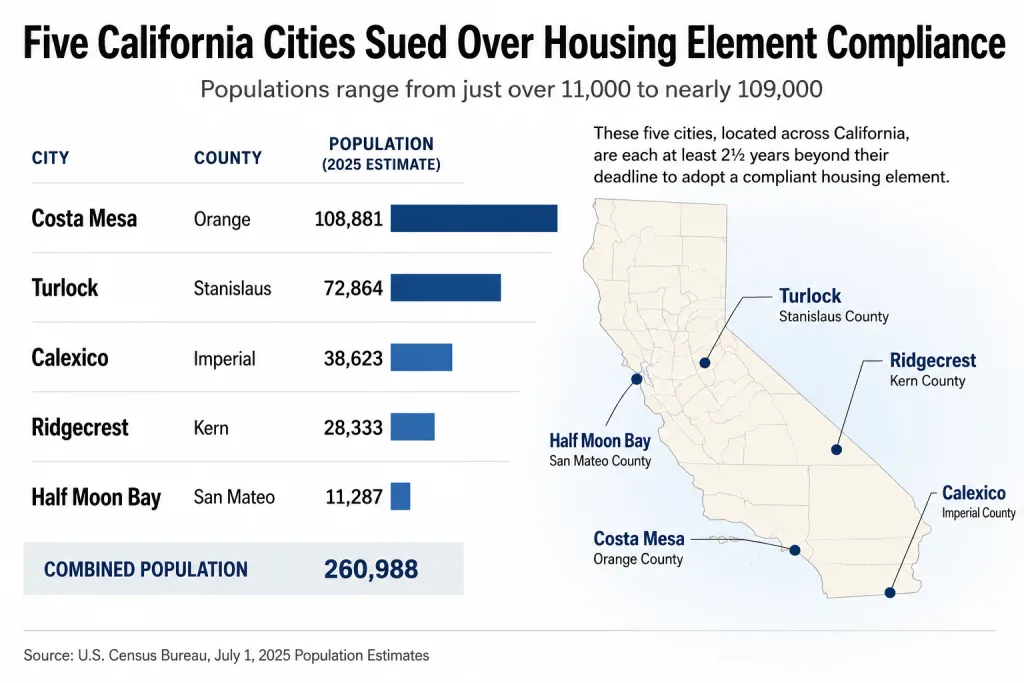
The lawsuits, filed against the cities of Calexico, Costa Mesa, Half Moon Bay, Ridgecrest and Turlock, seek court orders compelling each jurisdiction to adopt housing elements that comply with state law. The complaints also request declaratory and injunctive relief and ask the courts to impose penalties authorized under California law.
Announcing the actions, Newsom sharply criticized local governments that continue to resist state housing mandates.
“California can’t solve the housing crisis while some cities sit on their hands and dare us to do something about it,” Newsom said. “These five jurisdictions had every chance to follow the law and plan for their fair share of housing. They chose not to, so now they’ll answer for it in court. Housing law applies statewide, and no city gets a pass.”
The legal actions come as California nears the end of its sixth housing planning cycle. According to the administration, more than 95% of jurisdictions have adopted housing elements that the California Department of Housing and Community Development has determined comply with state law. The five cities named in the lawsuits are each at least two-and-a-half years beyond their compliance deadlines, according to the state.
Attorney General Rob Bonta said the lawsuits reflect the state’s determination to ensure every community contributes to addressing California’s longstanding housing shortage.
“California’s housing crisis demands action, not excuses,” Bonta said. “Jurisdictions that remain out of compliance with our Housing Element Law are standing in the way of the homes Californians need. We are well past the halfway point of the current housing planning cycle, and timely compliance is not optional.”
Bonta continued, “As I’ve said many times, no local government has to solve this challenge alone, but every local government has to do its fair share. Today, we’re showing how serious we are about ensuring that every city and county in California adopts a housing element. Restoring the California dream will take an all-hands-on-deck effort.”
Housing and Community Development Director Gustavo Velasquez said most California jurisdictions have ultimately complied after working with the state, but emphasized that enforcement remains necessary when cities refuse to do so.
“The vast majority of California’s cities and counties have stepped up to achieve housing element compliance,” Velasquez said. “For the small number that are still falling short, the actions we are taking today should send a clear message: no community is exempt from doing its part to solve our housing crisis. Alongside Attorney General Bonta, Governor Newsom and HCD will continue to hold local governments accountable for complying with state law.”
According to the administration, each of the five jurisdictions received repeated opportunities to resolve the issues before litigation began. The state said HCD issued formal notices of violation, allowed each jurisdiction 30 days to respond in writing, and conducted two rounds of meetings with local officials before referring the matters to the Attorney General’s Office.
The state also warned that additional lawsuits could follow against other jurisdictions that fail to remedy violations after receiving notices from HCD.
California’s Housing Element Law has required cities and counties since 1969 to prepare housing plans addressing the needs of residents across all income levels. Every housing element must identify housing needs, analyze barriers to development, identify sufficient land for future housing and establish programs to facilitate residential construction. The plans must also be reviewed and approved by HCD before being adopted.
The state’s lawsuits emphasize that the housing element is more than a planning document.
The complaints allege California continues to experience an affordability crisis that “is hurting millions of Californians, robbing future generations of the chance to call California home, stifling economic opportunities for workers and businesses, worsening poverty and homelessness, and undermining the state’s environmental and climate objectives.”
Each complaint also states that “a key contributor to this crisis is the failure of local governments to plan for the necessary housing supply.”
According to the legal filings, every city is legally required to update its housing element during each planning cycle and identify adequate sites capable of accommodating its Regional Housing Needs Allocation, commonly known as RHNA. The complaints explain that the housing element must also identify governmental constraints that limit housing production and establish programs to remove those barriers.
The lawsuits further note that HCD possesses statutory authority to review local compliance, revoke housing element certification and refer noncompliant jurisdictions to the Attorney General after providing notice and opportunities to cure deficiencies.
Although filed in different counties, the complaints against Turlock, Calexico, Ridgecrest, Half Moon Bay and Costa Mesa contain substantially similar allegations. In each case, the state asks the court to issue a writ of mandate ordering compliance with California housing law, declare that the city violated its statutory obligations and award any fines, penalties and other relief authorized by law.
The administration argues the consequences of noncompliance extend beyond litigation. Under California’s Housing Accountability Act, jurisdictions without compliant housing elements may become subject to the “Builder’s Remedy,” which limits their ability to deny qualifying housing developments based on local zoning rules. In addition, Senate Bill 1037, signed into law in 2024, authorizes civil penalties for jurisdictions that remain out of compliance, with penalty funds directed toward affordable housing within the affected communities.
The state also points to prior enforcement efforts as evidence that litigation can produce results.
According to the administration, settlements have already been reached with Hollister, Artesia, La Habra Heights, Malibu, Fullerton, Coronado and San Bernardino after those jurisdictions agreed to bring their housing elements into compliance.
Officials also cited Huntington Beach as an example of the potential financial consequences of continued noncompliance. The administration said a Superior Court judge ordered the city in May 2026 to pay $160,000 in penalties after refusing for years to adopt a compliant housing element, with additional fines of $50,000 per month until compliance is achieved.
Newsom has made housing production one of the central priorities of his administration, combining enforcement with regulatory reforms intended to accelerate housing construction.
According to the governor’s office, the Housing Accountability Unit has supported development of more than 13,500 housing units, including more than 3,800 affordable homes, through enforcement actions and collaboration with local governments. The unit’s responsibilities were expanded in 2024 to include oversight of state laws affecting homelessness and homeless housing.
The administration argues its broader strategy includes streamlining housing approvals, funding affordable housing and shelters, enforcing local compliance with housing law, expanding behavioral health services through Proposition 1, implementing the CARE Court program and addressing homeless encampments statewide. The governor’s office also cited a reported 9.5% decline in California’s unsheltered homeless population last year as evidence that those efforts are beginning to produce measurable results.
Whether the five cities ultimately prevail or reach settlements with the state will now be decided through litigation in their respective county superior courts. For the Newsom administration, however, the lawsuits send a broader message that California intends to use both administrative enforcement and court action to ensure local governments comply with state housing planning laws.
Follow the Vanguard on Social Media – X, Instagram and Facebook. Subscribe the Vanguard News letters. To make a tax-deductible donation, please visit davisvanguard.org/donate or give directly through ActBlue. Your support will ensure that the vital work of the Vanguard continues.

Newsom won’t be happy until he destroys the beauty of places like Half Moon Bay.
It’s time to vote Democrats out.
Steve Hilton is even more prohousing than Newsom – haven’t you read his housing proposal?
https://davisvanguard.org/2024/03/hilton-unveils-policy-paper-on-housing-affordability/
Did DG just what about / both sides KO ?
Go Calexico, Costa Mesa, Half Moon Bay, Ridgecrest and Turlock! Shish Boom Bah!
” . . . Newsom sharply criticized local governments that continue to resist state housing mandates.”
And they sharply criticized Newsom. Strange how Newsom resists the national government, but can’t take it when local government resists the state.
No he said we ought to vote the Democrats out based on what Newsom is doing and I was pointing out that Steve Hilton would probably go further, so his comment was not well considered.
Regardless of Hilton’s housing policy, it’s still time to vote out Democrats.
How’s that for “well considered”?
It negates your previous point and becomes simply a partisan rather than policy preference on the specific issue of housing.
Keith O
What’s your alternative since Hilton also wants to take away local control? Your statement is irrelevant without proposing a solution.
How is doing so different than you demanding housing policy without having any financial skin in the game?
Calexico? Hilarious. You’d probably have to INCREASE the cost of housing there in order to meet the minimum standard of “affordable”. And Turlock isn’t all that far behind.
In any case, NONE of this is related to development of farmland outside of city limits. And the reason for that is because there is no law requiring cities to do so. (It’s that simple.)
The state’s laws deal with the plan INSIDE of city limits. (Which never pencil out, by the way. But at least you’ve got to submit a fake plan.)
I was more interested in their choice of Turlock
I missed “Ridgecrest” (in Kern county). Sounds like a place that someone from Tiburon might have a vacation home (adjacent to a military base in the Mojave desert).
Sounds like they routinely get 75 mph winds there as well, so they’d better use cables to tie down the new houses. (Sutro actually had to do that with his large house in Nevada – which subsequently burned down anyway.)
https://en.wikipedia.org/wiki/Ridgecrest,_California
My college buddy grew up in Ridgecrest so I’ve actually been there. If people think the state won’t come for Davis because it’s small and insignificant, the fact that the state is going after Turlock and Ridgecrest should disabuse people of that notion.
Sure – if the city of Davis stood in the way of what the state requires of cities WITHIN city limits, then that would be true.
But it doesn’t apply to land outside of city limits.
You’re drawing a distinction (repeatedly) that doesn’t exist in the state’s eyes. Their only concern is that housing built – where and how, I think they do not care.
You are incorrect regarding this. The state’s laws only address land within a city – they don’t require cities to expand their boundaries to address their mandates. (If they did so, the entire major population centers along the coast would not be able to address these “mandates”. Of course, they’re not actually addressing the mandates anyway, so the state has no choice but to accept fake plans.)
What you mean to say is that the state “doesn’t mind” if a city CHOOSES to expand in order to address these mandates. But the state will never, ever REQUIRE a city to expand in order to address the mandates, because that’s not in the state’s laws. And again, see the comment regarding the major population centers along the coast, which aren’t expanding to address these “mandates”.)
What you’re suggesting is that the state would view a place like Davis “differently” than all of the major population centers along the coast. And again, there is no law (not even an “implied” law) which states this.
The state wants to see fake plans WITHIN city limits. (In fact, they’d reject a plan that states that housing will be built outside of city limits.)
We’re not going to resolve this issue today.
Ron O
Please provide chapter and verse with associated supporting court decisions that back up your assertion about the scope of state law. Otherwise it’s just your opinion and as we’ve highlighted before its often incorrect. David’s point is spot on–you’ve continually asserted that the state would not step in to enforce these laws when cities fail to comply with the HEs. And now you’ve been proven wrong. Falling back on a nuanced interpretation of state law does not make up for your incorrect assessment of the overall situation.
What are you talking about, Richard?
Not only have I not been “proven wrong” – it’s actually the opposite in that David (and you?) are implying that a non-existent law exists.
Though it is true that neither David nor you can prove that Santa Claus exists – for the same reason.
The examples in this article also don’t address land outside of city limits – for that same reason (no law forcing cities to expand their boundaries, for the reasons already discussed).
San Francisco, for example, is not filling in the bay (or claiming part of Daly City) for the purpose of meeting fake requirements.
Can suing jurisdictions over housing quotas be considered “state sanctioned violence”?
This gets way off topic, but yes. Max Weber characterized the modern state as: “A human community that (successfully) claims the monopoly of the legitimate use of physical force within a given territory.” In the end, all laws are enforced at the point of a gun. But I digress. If you want to discuss this further, email me.
So from now on when the State of California forces cities to do anything it can be referred to as violence?
Got it!
You’re missing the point AND I told you this was off-topic. All government is violence. Why? If I steal something from a store, I break the law. Potentially that means, someone with a gun will take away my liberty. If I go to court, there are guys with guns who will take me into custody as a means of enforcing the laws. The question isn’t whether the state is violent, the question is whether it’s authority and rule is legitimate.
The state’s actions in this case are civil (not criminal) in nature. And in fact, are not even directed at individuals.
One wonders what would happen if a city decided to (also) not pay any fine or penalty. What would the state do then – dissolve a city and/or appoint its own people to run it?
And would some council member, for example – end up in prison? (Something tells me that nothing would happen to them, individually.)
It’s the same thing. Look what happened in Little Rock in the 1950s, the governor refused to follow the supreme court order on desegregating schools, a civil matter, and ultimately Eisenhower had to send in the National Guard. At the end of the day, state authority is based on violence or the threat of violence. It is state sanctioned violence. That doesn’t mean it’s illegitimate (necessarily).
You’re really stretching here David.
Not all. I think the key point you are missing is that all state authority ultimately rests on violence or the threat of violence. I’m not arguing that it’s illegitimate though at times it can be.
O.K. – so send in the National Guard to build some housing. Got it. (Though they might want to learn some homebuilding skills so that it doesn’t turn out like something from The Three Stooges.)
Same thing regarding the overall integration of new housing into a city. Otherwise, it will turn into the Winchester Mystery House of Infrastructure (regarding all of the components of a city which serve developments, including roads, police, fire, schools, etc.).
On the other hand, cities will save money by not having to hire planning departments, etc.
I’m not advocating that approach, only describing how government in fact works. Most of the time, we do not rely on state violence, only the potential threat of it.
Keith O
You stepped into that one! You got a lot more than you bargained for–enforcing private property rights is backed by state sanctioned violence!
Richard, try following the conversation.
I didn’t step into anything.
The state also warned that additional lawsuits could follow against other jurisdictions that fail to remedy violations after receiving notices from HCD.
For Davis, that begs the question, “Has the City received any official notice (s) of violations that need to be remedied … and have not been remedied?”
Davis is currently in compliance and with ground breaking on two projects downtown we will likely not be in that bad of shape with the state until sometime after 2030.
On that we agree. Probably not in bad shape until 2038 with densification rezones along our public transportation corridor.
The whole length of Anderson from Covell to Richards could easily be rezoned. The logical elementary school for DJUSD to close is in that corridor. Sale of that parcel would raise a lot of money for DJUSD.
At least on paper.
They should let me come up with the fake plan – I could do so within about 5 minutes with a marking pen.
And if the state doesn’t like it, I’d hand them the pen. (Needless to say, they have no authority to start marking up farmland outside of city limits, anyway.)
And even if they somehow obtain such authority, I’d also let them deal with the ENTIRE thing – including all of the infrastructure needed to support it.
Pretty sure that the state is not going to want someone like me being “told” what to do (e.g., as a council member somewhere), unless they could hold me personably accountable – in which case I’d resign (and let them appoint their own flunkie – who would still have to deal with such issues).
And if they then wanted to fine “the city” (whatever that means) – after they somehow forced me out, they’re then going to have to deal with angry residents, business owners (and even angry developers) at that point.
It has to be a bit more than marking pen on paper. Just as they did for the 3rd submission of this current Housing Element, the City has to commit to actually densify the zoning of the specifically listed parcels.
You are dreaming if you think you can rezone an area and expect it to magically redevelop. That isn’t how the world works.
The way the City got this current Housing Element certified was by committing to rezone sites. As is always the case, the decision to redevelop rests with the property owner. That would be the case in the next Housing Element as well.
HCD’s 2/8/2024 letter to the City read as follows:
HCD is pleased to find the adopted housing element, including all technical
modifications, in substantial compliance with State Housing Element Law (Gov. Code, §
65580 et seq) as of the date of this letter. The adopted element addresses the statutory requirements described in HCD’s April 3, 2023 review. This finding of compliance is based in part of the successful completion of required rezones to make adequate sites available pursuant to Government Code section 65583.2, subd. (h) and (i), as demonstrated by Ordinances 23-166 and 23-167.
The listed sites were/are:
1100 KENNEDY PLACE
1021 OLIVE DRIVE
3500 CHILES ROAD
3425 CHILES ROAD
3015 COWELL BLVD
4600 FERMI PLACE
2740 COWELL BLVD
4920 CHILES ROAD
2932 SPAFFORD ST
1800 RESEARCH PARK DRIVE
1616 DA VINCI CT
Ridgecrest is out of compliance? Is there actually housing demand in Ridgecrest? The place looks like an old mining town ready to cash out. Maybe they should demand that the military build housing at China Lake like Davis and UCD.
“Saying no still works” (from the article below that I just happened across).
“One population projection foresaw 1.3 million people living in the county by the year 2030.”
As the Bay Area filled up, developers turned their eyes northward to the flat plains and open hills and valleys of Sonoma County, which had recently welcomed a new U.S. 101 dual-highway. Sonoma’s entire coastline was slated for a series of high-rise developments. All the cities along the new Highway 101 corridor, from Petaluma to Healdsburg were being plotted out for “Grow North” housing developments and new commercial centers and industrial hubs. A new lake behind a Warm Springs Dam on the upper Dry Creek (Lake Sonoma) was going to provide an unending water supply. One population projection foresaw 1.3 million people living in the county by the year 2030.
“Not so fast”
“None of that came to be because a new generation of county leaders, activist citizens and preservation-minded farmers steered the county in the opposite direction.”
“In 1971, California’s state legislature had mandated that all 58 counties adopt General Plans to control and shape the ongoing pressures of population growth and development demands on the Golden State. Some counties, such as Lake and Mendocino, filed lawsuits to resist drafting a general plan.”
“But, in Sonoma County, a new — and much younger — team of planners, elected officials and activist citizens dove into the long-range planning studies, public hearings and final drafting with enthusiasm and bold visions.”
I remember this time, and met Koeningshofer at a local event when I was a teenager. (I didn’t find him very friendly – which stuck with me, but that ultimately doesn’t matter to me.) I do vaguely recall that social justice was starting to become intwined with all of this at the time, as well.
In any case – to this very day, the entire area doesn’t look all that different from the time I was a kid. And at this point, I’m confident that it will pretty much look the same essentially forever – despite the state’s fake “requirements”.
(Though I have noticed more “density” lately – usually by redeveloping existing properties within these cities.)
https://www.sebastopoltimes.com/p/in-terms-of-development-sonoma-county
One recent/ongoing exception, however, is this development:
https://www.pressdemocrat.com/2022/03/17/commentary-permit-sonoma-and-the-questionable-harbor-view-project-in-bodega-bay/
“I think the key point you are missing is that all state authority ultimately rests on violence or the threat of violence.”
As a last resort, sure. But it’s far more likely that the state would punish a misbehaving jurisdiction by denying it access to any state funds not statutorily mandated. Subordinate public agencies rely on state grants and other disbursements for a host of matters essential to their effective operation, so I don’t expect the National Guard to come charging into Ridgecrest or Turlock.