
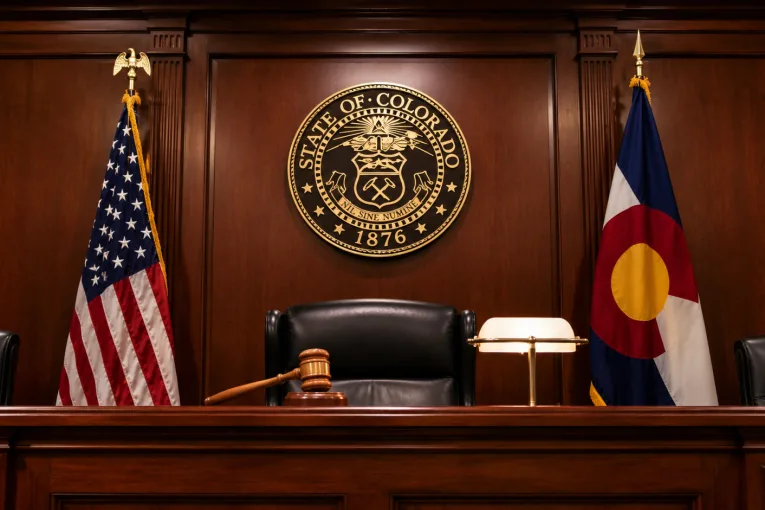
DENVER — A preliminary hearing in Denver District Court on Friday focused on surveillance footage, forensic evidence and disputes over the admissibility of an edited video compilation as prosecutors sought to establish probable cause against the accused, who faces one count of first-degree murder.
Judge Nikea T. Bland presided over the hearing. Prosecutor Hall called homicide Detective Thomas as the prosecution’s principal witness, while defense attorney Harris represented the accused.
Detective Thomas testified that officers responded to reports of a shooting near Interstate 70 on March 17, where they found the victim suffering from multiple gunshot wounds.
According to the detective, the victim had been driving a work van while on the job that day. First responders transported the victim to University Hospital, where he was pronounced dead shortly after noon.
Thomas testified that the medical examiner ruled the death a homicide caused by multiple gunshot wounds. The autopsy recovered four bullets, including one fragmented projectile, and documented injuries to the victim’s hand, chest, cheek, neck and legs.
Much of the hearing focused on surveillance footage collected from nearby businesses and members of the public. The prosecution introduced several video exhibits depicting events leading up to the shooting.
According to Thomas, footage from a nearby restaurant showed the victim’s van being overtaken by a black SUV that stopped in front of the vehicle. Two individuals then exited the SUV and approached the victim before an altercation occurred.
The detective testified that the accused was driving the SUV. Additional footage showed another vehicle stopping nearby before the SUV left the area. Emergency responders arrived later.
The prosecution also presented video submitted through Crime Stoppers, a program used by law enforcement to collect information from the public.
Thomas testified that investigators received the recording on March 18, one day after the March 17 shooting. The video captured three gunshots, and the detective testified that the physical characteristics of the shooter were consistent with those of the accused.
Another surveillance recording from a nearby business showed both the black SUV and the victim’s white work van traveling through the area. Although trees obstructed part of the view, three gunshots could be heard on the recording, according to Thomas.
One of the hearing’s most contested issues involved a video compilation prepared by investigators that combined footage from multiple surveillance cameras.
Defense attorney Harris objected to the compilation, arguing that the extent of the edits and any added annotations were unknown. Harris contended that the original surveillance videos, rather than an edited version, should be considered by the court.
Hall responded that the compilation was created to illustrate the geographic relationship among the various recordings and argued that Detective Thomas had already reviewed the original footage before preparing the presentation.
The court overruled the defense’s objection and admitted the edited compilation for purposes of the preliminary hearing, noting that the detective had reviewed the original recordings.
The judge’s ruling allowed the court to consider the compilation in determining whether sufficient evidence existed to proceed while leaving questions about its admissibility at trial for a later stage.
The prosecution also presented evidence recovered during the investigation. Thomas testified that officers located a black 2014 Jeep Grand Cherokee matching witness descriptions at a residence less than 2 miles from the shooting scene later on March 17.
According to the detective, investigators identified the vehicle through features including chrome trim, distinctive wheels, a black license plate, a red marker and a bike rack.
Thomas testified that the Jeep was registered to the accused and was seized and searched by investigators. Officers recovered a shell casing from inside the vehicle, along with swabs of suspected blood and cellular material.
Additional suspected blood was observed on the rear passenger-side wheel and fender. The detective testified that the victim appeared near that portion of the vehicle in the surveillance footage.
Investigators also collected the accused’s clothing after his arrest and submitted it for gunshot residue testing. Thomas testified that the testing returned a positive result. A search of the residence the following day uncovered a firearm, magazines, a gun case and cleaning supplies in the accused’s bedroom.
According to Thomas, forensic testing later concluded that shell casings recovered at the scene and bullets removed during the autopsy had been fired from the firearm recovered from the residence.
During cross-examination, Harris questioned Thomas about the broader investigation. The detective testified that five 911 callers reported the incident, but none witnessed the shooting itself.
Harris also highlighted that officers recovered methamphetamine from the victim’s backpack inside the work van and noted that the accused was taken into custody without resistance during a traffic stop after telling officers he intended to turn himself in.
The defense introduced photographs documenting injuries to the accused’s face, eye, lip and hands and questioned Thomas about cellphone evidence indicating the accused sent a text message approximately 15 minutes before the shooting.
Harris also noted that the victim’s cellphone could not be successfully extracted and pointed to surveillance footage showing the victim exiting his van and approaching the accused’s Jeep before the shooting.
During questioning, Harris asked Detective Thomas to interpret portions of the surveillance footage. Hall objected, arguing that the detective should not be asked to speculate about what the videos depicted.
Harris responded that a broader interpretation was appropriate at the preliminary hearing stage because the issue before the court was probable cause rather than guilt. The judge sustained the prosecution’s objection.
Harris concluded by highlighting the accused’s lack of prior criminal convictions and arguing that the evidence supported a theory of self-defense.
As the case moves through the criminal justice system, the preliminary hearing concluded with the court taking the evidence under consideration.
To comment please go to one of these social media platforms:
Facebook: https://www.facebook.com/DavisVanguard
LinkedIn: https://www.linkedin.com/company/peoples-vanguard-of-davis-inc/
Instagram: https://www.instagram.com/davisvanguard/
X: https://x.com/davisvanguard
Bluesky: https://bsky.app/profile/vanguardnewsgroup.bsky.social
Subscribe to the Vanguard News letters. To make a tax-deductible donation, please visit davisvanguard.org/donate or give directly through ActBlue. Your support will ensure that the vital work of the Vanguard continues.
