
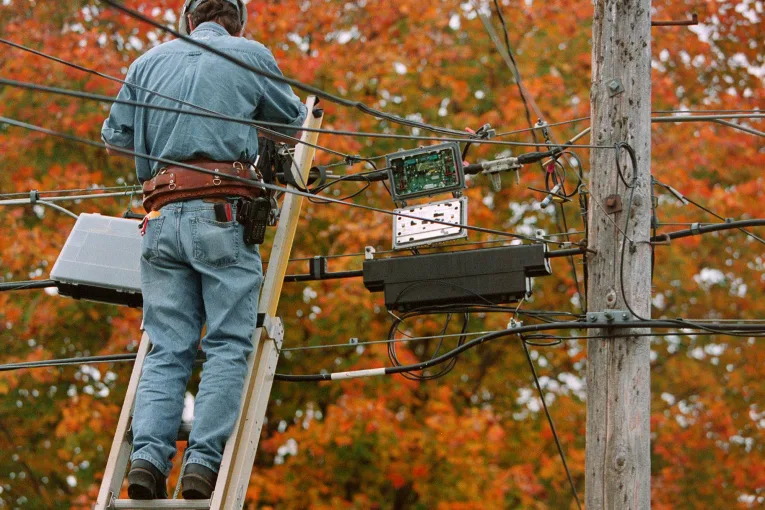
The utility company’s proposal to discontinue services was approved by Federal Communications Commission in win towards goal of ending landline services
AT&T has announced that it plans to move away from copper-based services, including phasing out landline services, across California starting June 1, 2027. The plans could come to fruition after the Federal Communications Commission (FCC) accepted the company’s proposal to discontinue landline service to homes and businesses in California. It is estimated to affect approximately 184,000 homes.
The decision to end services comes to a backlash against various different residents across California. The Rural County Representatives of California released a statement on the issue.
“Across California, AT&T customers are receiving notices stating that their traditional landline service will be discontinued and encouraging them to switch to alternative technologies,” the statement reads. “For many households — particularly seniors, rural residents, and those who depend on reliable service for health and safety — and small businesses, these notices create unnecessary confusion and concern about losing a vital connection.”
California governor candidate Steve Hilton shared on X the letter he wrote to FCC Chairman Brendan Carr.
“For many Californias, especially seniors, rural residents, people who rely on landlines for medical alerts of caregiver contact, and families in areas prone to fires, storms, floods, earthquakes, and power outages, landlines are not a luxury,” the letter reads.
AT&T released a news statement in regards to their plans to move towards fiber and wireless networks instead of copper.
“Only 3% of households we serve in California still use traditional phone service,” it reads. “We’re taking a phased, year-long approach to upgrade customers in these areas where better, more reliable services are available. Transitioning from copper also allows further investment in more modern services.”
The approval by the FCC does not officially allow AT&T to disconnect services, but continues their years-long push towards the end of their landline services.
In 2024, the California Public Utilities Commission (CPUC) rejected AT&T’s application to end their Carrier of Last Resort (COLR) status, which requires landline service. A COLR is a telecommunications service provider who is obligated to ensure anyone in California has access to safe, reliable and affordable telephone service.
In December 2024, AT&T also announced they planned to end all copper-based services across the U.S. by 2029.
In May 2026, AT&T filed a lawsuit against the CPUC and state Attorney General Rob Bonta to relieve them of their COLR obligations and further the path for the utility company to discontinue services.
The Rural County Representatives of California, California State Association of Counties, The Utility Reform Network and the Communications Workers of America, filed an amicus curiae brief in June in support of the CPUC and the Attorney General in the lawsuit.
Ryan Campbell, Tuolumne County Supervisor and CSAC Executive Committee Member, commented in a release about the filing.
“When disasters and power outages strike, losing reliable communications can isolate entire communities and delay emergency response when seconds matter most,” Campbell said. “California must preserve the longstanding obligation that ensures every community has access to dependable telephone service.”
While there are pending lawsuits and petitions, California rules remain in place and protect landline services till further decisions are made.
Follow the Vanguard on Social Media – X, Instagram and Facebook. Subscribe the Vanguard News letters. To make a tax-deductible donation, please visit davisvanguard.org/donate or give directly through ActBlue. Your support will ensure that the vital work of the Vanguard continues.

Maybe AT&T can sell all that copper to feed it’s meth habit :-|
The solution is obvious here. AT&T wants to exit the land line business. If the state finds it so important, it should acquire the franchise and equipment at the market value (apparently pretty small if AT&T wants to abandon it in place) and set up a statewide communications utility that applies appropriate rates. Those rates most likely should be cost based. However, rural residents have grown accustomed to receiving highly subsidized services (which has led to excessive and environmentally damaging population growth in exurban and rural communities) and the state may need to also subsidized this service in those communities where this service is critical for a transition period. (The state is ordering PG&E to heavily subsidize rural electric service through wildfire mitigation investments that benefit less than 50,000 customers but the rest of us pay for.)