
Do not be fooled. Models template futurities, in the same way origin stories indict contemporary propagandist framings of uncomfortable historical atrocities that stain the collective memory. California’s very statehood was built upon a proto-genocidal construct of slaver ambition that oozes like a slow lava from the mouth of an actively hidden-from-view open wound volcano, conveniently rebranded as a “Rehabilitation Center.”
For captive radicals engaged in critical prison studies, San Quentin will always be the bulldozed crime scene where the state’s first prison Warden—a white slave owner—secured a lease from the state legislature, which permitted him to lease captives out to area businesses for personal profit, and did not move to have him prosecuted after profiting from the orchestration of a conspiracy involving the cell extraction, kidnapping, human trafficking, and slave auction sale of two of the state’s earliest Black teenage so-called “youth offenders” in his care. The commodification of Black bodies inherent to racial capitalism has always been a keystone of California’s carceral model, just as the Thirteenth Amendment’s enshrinement of servitude has worked to perpetuate the “normalization” of what I call, “the carceral state of being.”
Non-reformist reforms as social changes that unravel social control
Self-activity is not just the hallmark of agency. As the French Austrian philosopher André Gorz theorized in the 1960s. It underpins a captive’s capacity to embody the Marxist aim of “social change,” via the compulsory “worker” predicament caused by imprisonment. Ironically, the same forced servitude condition (modern slavery) prison compels, also creates a construct whereby, if captives are able to “implement or control” the “non-reformist reforms” that result in the “decentralization of the decision-making power, a restriction on the powers of State or Capital,” or “a victory of democracy over the dictatorship of profit”—such as, power acquired without the vote, or electoral politics (we can’t vote)—then the university experience within prison must be viewed as a viable means of power acquisition for captives trapped in the carceral container.
In California, being assigned to an academic program (enrolled in college classes) satisfies the compulsory assignment dictum that otherwise compels the servitude we view as slavery. Without voting, changing a law, or striking, if captives simply enroll in higher education— serve our academic self-interests—we concomitantly avoid the forced labor that awaits us, if otherwise unassigned.
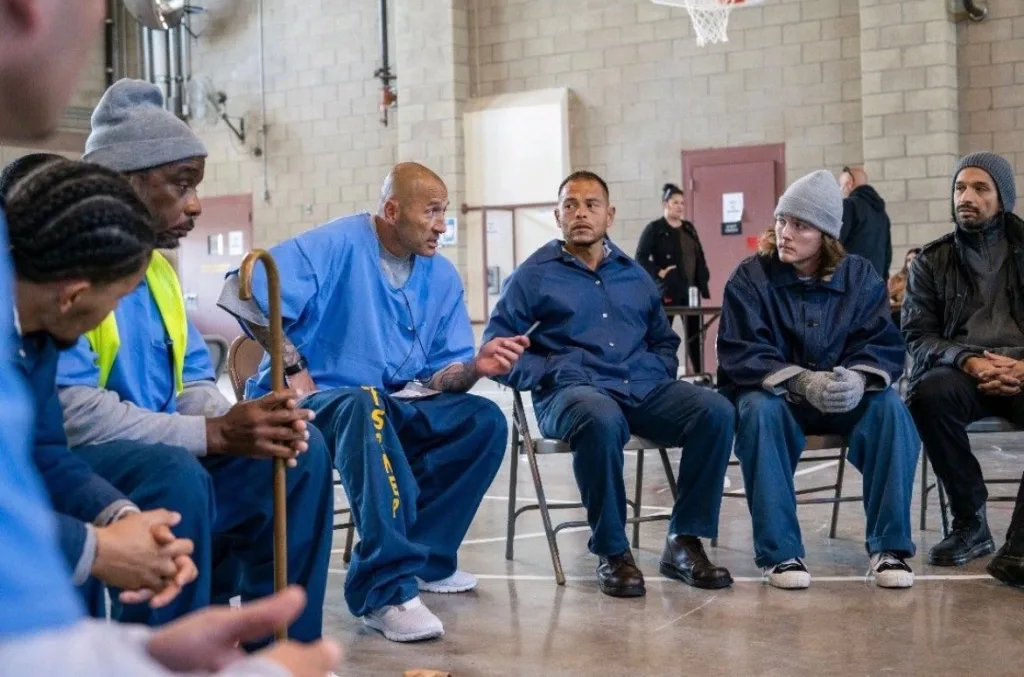
We have the power to wield our college enrollment agency as a protective measure that prevents the servitude that feeds the racialized capitalism aims of the prison industrial complex, while occupying the classroom — one site within a prison devoid of violence workers — wherein we can commune, acquire embargoed knowledge, and organize ourselves. In this way, at least for those of us surviving and resisting the Golden Gulag’s many counterinsurgencies, our student body constitutes a “collective formation” that Ruth Wilson Gilmore teaches us can “shake the ground… deeply into the state.” They can’t work the students, ya dig?
Of course, what Orisanmi Burton describes as the Carceral Warfare Project, works overtime to subvert our ability to form ourselves into collectives of our own making, in order to thwart our insurgent tactics. When we use education to avoid forced labor, the apparatus targets our fugitivity for disruption.
Unable to prevent classroom operations, our Warden criminalized studenthood, deploying a dehumanizing regimen of sexualized violence upon academic achievers as the cover charge students must pay to gain entry to the classroom. Via Memorandum, body cavity searches became compulsory for college students, though the handheld wands you encounter at concerts/sporting events, walk-through metal detectors deployed at Court buildings, and the full-body x-ray scanner technology used in airports—three top-tier contraband interdiction technologies—were each at hand, and in working condition. They literally unplugged these tools and forced us into grouped strip-searches, for no legitimate penological purpose.
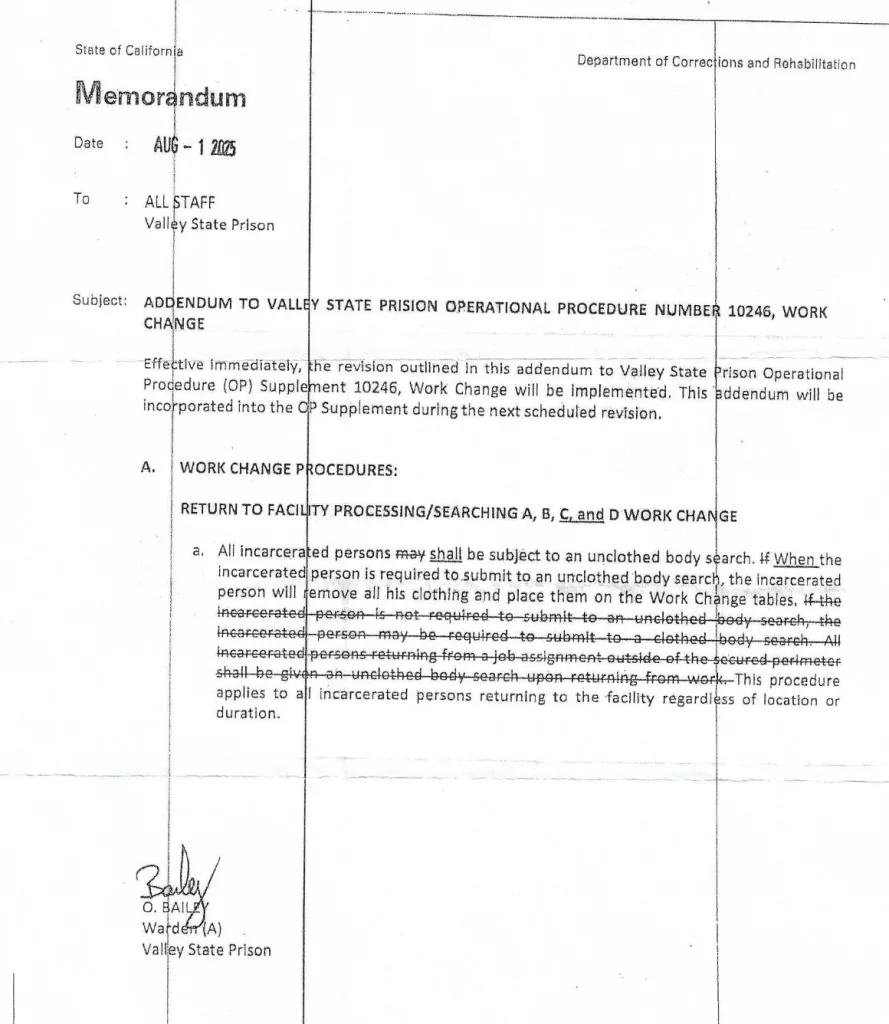
Our Warden abandoned the noninvasive protocols capable of seeing through one’s body while clothed, in favor of a strip-search indignity campaign, designed to dissuade students from pursuing a degree. Had we summoned our inner Martin Sostre, and defended our “final citadels,” we’d have been in the hole, removed from college (something most people are waitlisted up to three years for), and forced into labor once released from Ad-seg anyway, without access to college.
So, though we endured the indignities, we found solidarity in the shared struggle and refused to let them dissuade us from attending class. Via collective perseverance—suffering—we maintained our grip on higher education. We modeled a quiet resistance; now, the Warden’s Memo serves as a glaring indictment that belies any attempt by the state to posture as anything but a harm-inducing dehumanization machine.
Throttling the carceral arts as counterinsurgency
The Valley Adult Music Program (VAMP), and the Art of Recovery Therapy (ART), were resident-driven creative communities that served thousands of residents here for over a decade, courted hundreds of thousands of dollars in operational equipment/supplies from donors, and organized fundraisers that distributed tens of thousands of dollars to area charities annually, allowing residents to make a constructive living amends. Since Covid, the donated musical equipment (hundreds of instruments, and live PA gear) and art supplies have been confiscated via conversion, and both programs disbanded.
Five years into this anti-arts new normal, and seven years after his raucous on-the-yard concert here, Grammy-winning rapper Common’s long-awaited Rebirth Of Sound (ROS) music studio program launched in 2025. However, despite the predictable thirst with which the prison seized the opportunity to bring in its own cameras and push out a promotional trailer hyping the program’s promise, the prison also began throttling what ROS could do.
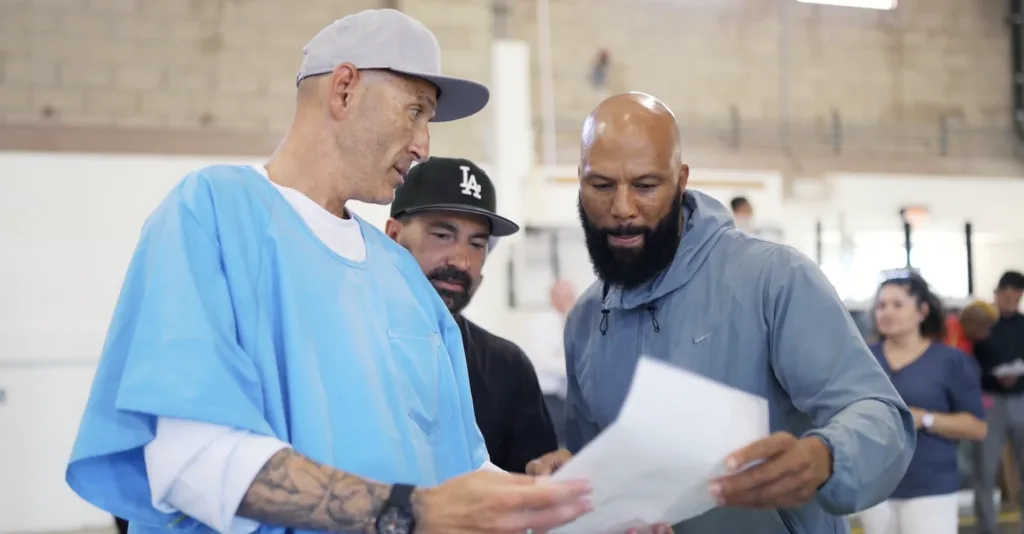
The FL Studio DAW software remained locked (the prison claimed their IT staff couldn’t unlock it for months, even though the same program is functional within the Media Center, three classrooms down the same corridor); creators couldn’t save their work; new instruments languished in the warehouse for months because prison staff refused to retrieve them; the session runtime was slashed; and unlike every other service provider whose facilitators are given keys and supervise the program space themselves, the ROS experience often has three free-staff observers (prison employees) sitting in on the class and intruding on the safe space. With cameras already overhead, it was as if they were sent in to surveil the facilitators (criminalizing them), and police the deeply personal traumatic shares made by participants.
None of those obstacles prevented the work, because art, like struggle, persists by any means. When there were no drums, Sneaks slapped his hands on a table top — literally. When there was no Smart Board (though every other classroom has the use of one), Marcel Woodruff and Syrup used markers on a grease board to break down somatic abolition. When one of the studio monitors got damaged and became inoperable, the class worked with one speaker only. Solidarity of purpose prevailed over any impediment. As William Anderson teaches us, we must “use the conditions that the state has placed on us to inform our most radical incursions, rather than asking the state to change, when we should know by now that it certainly won’t.”
That said, a digital drum set, replacement Yamaha studio monitor, and a new Neumann microphone quickly slid into ROS just in time for a groundbreaking Sound of Redemption workshop experience, produced by Songhai “Judge” Armstead, who, due to the Warden’s direct advocacy, secured departmental approval to film and document the insertion of music industry producers Mars and Ant Clemons, “Songs From the Hole” producers JJ88, and Richie Reseda, and Death Row Records founder Michael “Harry O” Harris, who led a two-day masterclass-style creative incubator for our ROS cohort. This is the same Warden who, months ago, approved our resident-led Carceral Studies Journalism Guild community to self-direct a documentary film using cameras and mics furnished by Yale University’s Justice For Everybody Movement.
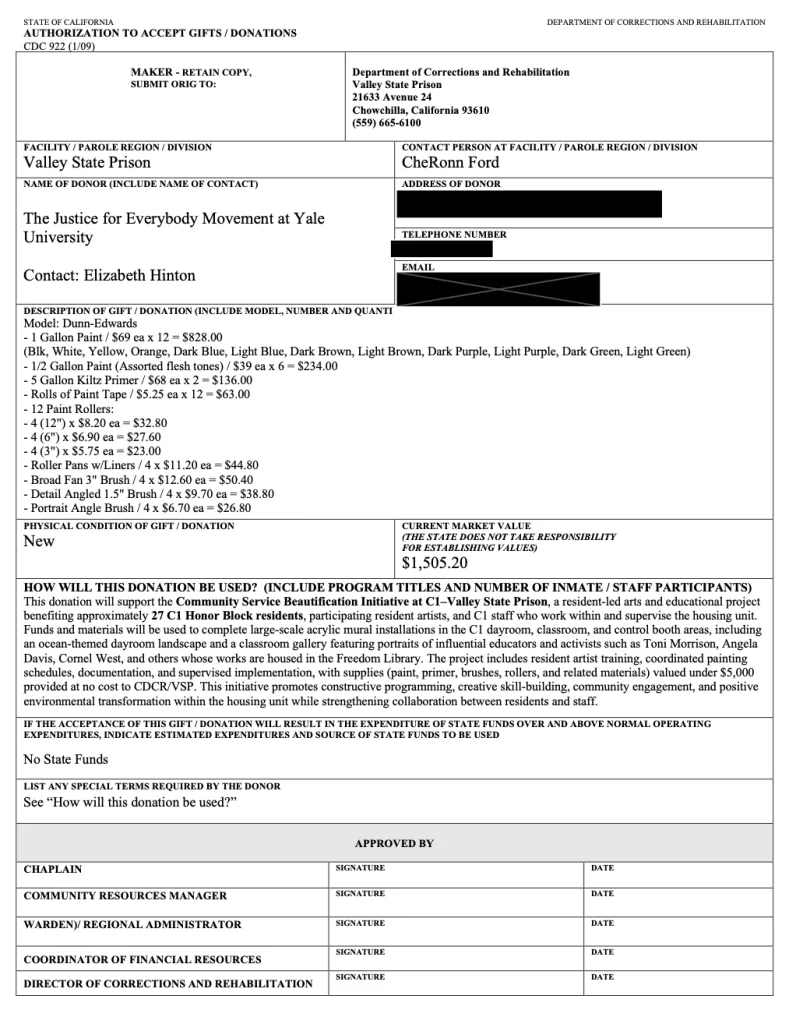
Not that cosmetically beautifying a prison mitigates the harm it is designed to inflict, but even this is weaponized against us. When college students here residing within the Honor Dorm asked the Warden for permission to paint their housing unit’s classroom interior with iconic likenesses of thinkers like Toni Morrison, Angela Davis, and Cornel West, the donation form securing the Yale Institute on Incarceration & Public Safety’s fiscal commitment to furnish the paint, rollers, pans, brushes, and painter’s tape needed to complete the project (amounting to more than $1,500.00) went ignored for months, while administrators told residents at internal town halls that beautification projects could not proceed due to a lack of funds and supplies.
So, when the Governor signs a bill like SB 551, which declares that for every year one spends living or working inside a California prison, two years is cleaved from one’s life expectancy, touts normalization, and declares harm prevention as one of the prison’s codified objectives, do not expect to see real change on the ground.
California’s model is a lie.
However, a righteous Warden can become a change agent, provided they use their authority to defend the few safe spaces that don’t intrinsically harm captives, and actually nurture our in-community care work. During a filming break, without my instigation, the Warden looked over, called me by my government first name (itself a rare peek into his own recognition of my humanity), and said, “I haven’t forgotten about the answer I know you’ve been waiting for (referring to the paint project request)— you gotta be patient, these things take time.” He didn’t need to address it, but he did; he could have let the elephant idle, but he chose to signal to me that he was carrying it around. Better than a “no,” I suppose.
I sense the human within the Warden—that part of him that gives us dap handshakes and bro-hugs without flinching—and part of me respects the part of him that doesn’t care that the foulest of COs loathe him for it. Channeling Reginald Dwayne Betts, if prison has taught me anything, it has taught me how to wait; and so, I wait for the paint, as I reflect on being stripped out by the same projection of carceral power that said “yes” to the very things that have given me agency. Contradictions abound.
One irony that connects back to college life is how multiple line staff and management level custody officers — the very folks often demonized as the tips of the carceral state’s spear — have been the ones to champion the for-us-by-us “networks of mutual aid, survival programs, and circles of care” that Saidiya Hartman implores us to create, within the very housing unit classroom the prison refuses to allow us to paint.
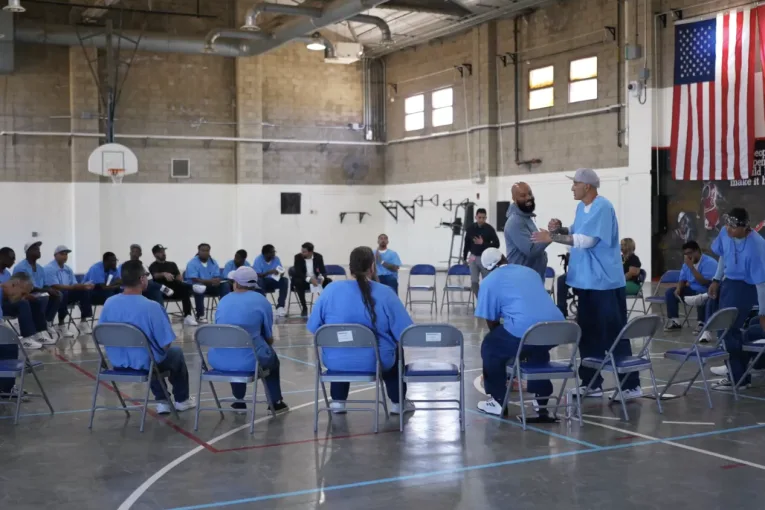
Associate Warden Chanelo, Lieutenant Arias, and two of the C1 Honor Dorm’s lead COs endorsed a Memo granting permission to resident mentors to occupy the classroom to facilitate multiple self-help modalities, whereby self-organized captives can enter a quiet space, close the door, and commune in-circle to explore trauma reconciliation, interpersonal neurobiological processes, emotional regulation, alternatives to violence, and parole suitability. This work serves as an extension of the Merced College Alpha Gamma Sigma Honor Society’s community service mission, and provides for the living amends opportunity the cessation of formalized self-help programs stole from us.
NBC called this place “Prisneyland,” in a series of stories that falsely framed the California Model as a mission shared by San Quentin and Valley State. Before those episodes aired, Valley State had lost its California Model funding, and with it, the so-called normalization promised by the trappings of carceral humanism. The only thing normal about this place, is its propensity for thwarting everything that nurtures our safety and sanity. It is, after all, the location of state-sponsored premature death for captives. There are some harms that only a God-fearing Warden can eradicate from the normative projections of punishment meted out by the prison regime. Everything on God’s time. Pray for us.
