
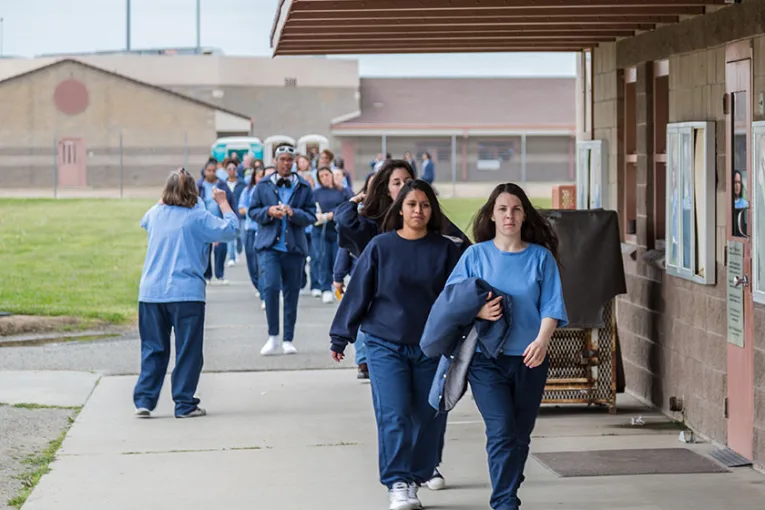
The U.S. Department of Justice has found that California’s two women’s prisons have systematically failed to protect incarcerated people from sexual abuse and harassment by staff, violating their constitutional rights and prompting survivor advocates to demand both sweeping reforms and the release of people who have endured abuse behind bars.
The federal investigation into the California Institution for Women and Central California Women’s Facility found a pattern and practice of failing to protect incarcerated people from sexual abuse by correctional staff, according to a statement released by the Solidarity Committee for Incarcerated Survivors. The committee said the findings establish violations of the Eighth Amendment’s prohibition against cruel and unusual punishment and the Fourteenth Amendment right to bodily privacy.
The Justice Department separately said investigators uncovered a longstanding pattern of staff sexual misconduct, inadequate safeguards, failures in confidential reporting, improper investigative practices and insufficient accountability measures. The department also found that CDCR and the two prisons failed to adequately and effectively implement the Prison Rape Elimination Act.
The findings, released Aug. 13, come after years of reports from incarcerated survivors and advocates alleging sexual abuse, harassment and retaliation within California Department of Corrections and Rehabilitation facilities.
According to the Solidarity Committee, the Justice Department found that CDCR and officials at both prisons demonstrated a pattern and practice of deliberate indifference toward the risk of sexual harm by staff.
The committee said incarcerated survivors have reported sexual abuse by staff for decades, only to face institutional inaction and, in some cases, retaliation after making complaints. It also said CDCR has implemented only one recommendation from a community report submitted to the Legislature more than two years ago.
Amika Mota, executive director of the Sister Warriors Freedom Coalition, said the federal findings validate what incarcerated survivors have been reporting for years.
“Nothing in the Department of Justice’s report should come as a surprise to anyone who has listened to incarcerated survivors,” Mota said. “For years, women and gender-diverse people inside California prisons have reported ongoing sexual abuse, harassment, retaliation, intimidation, and a system that too often protects the people causing harm rather than the people reporting it.”
“Survivors have been telling the truth,” Mota continued. “This report confirms what they have risked their safety to expose: the abuse is not isolated—it is structural and systemic.”
Mota said incarceration should never subject a person to sexual violence or force survivors to choose between reporting abuse and maintaining their safety or access to necessities.
“No one is sentenced to enduring sexual violence,” Mota said. “No one should have to risk their housing, their work assignment, their access to basic necessities, or their physical safety simply to report abuse by the very staff entrusted with their custody.”
“And no survivor should be forced to remain confined in the same system—and sometimes alongside the same people—responsible for their harm,” she added.
While advocates are calling for stronger safeguards within the prisons, Sister Warriors argues institutional reforms alone cannot adequately address the harm identified by the Justice Department.
“The only way to truly protect survivors from abuse inside these prisons is to get survivors out of them,” Mota said. “California must pursue releases and pathways home for people who have survived staff sexual abuse and retaliation.”
“Cameras, investigations, training, and reporting systems may provide important safeguards, but they cannot heal the violence that has already occurred or guarantee safety within an institution where the power imbalance that enables this abuse remains intact,” she said.
The Solidarity Committee similarly called for the immediate release of people who have experienced staff sexual abuse, arguing that the Justice Department investigation demonstrates that the prison system has failed to provide a safe and rehabilitative environment for survivors.
The committee noted that many incarcerated survivors had experienced sexual abuse before entering prison, making staff sexual misconduct and retaliation particularly retraumatizing.
Mota also called for immediate measures to protect incarcerated people who remain at CIW and CCWF, including passage of Assembly Bill 464, authored by Assemblymember Cecilia Aguiar-Curry, and Senate Bill 337, authored by Sen. Caroline Menjivar.
According to Sister Warriors, the measures would strengthen protections against retaliation, increase oversight and documentation, improve accountability for staff misconduct and prevent staff who commit serious abuse from returning to positions of authority within CDCR.
“Survivors have been telling us for years, and now the United States Department of Justice has documented the consequences of failing to listen,” Mota said. “AB 464 and SB 337 are urgent protections, and they should be passed and signed without delay.”
But Mota said legislative reforms should not become a substitute for releasing survivors.
“Accountability cannot end with reforming the conditions under which survivors remain incarcerated,” she said. “California must bring survivors home. Anything less leaves people trapped inside with their assailants, in the very system the federal government has now found is failing to protect them from sexual abuse.”
Leesa Nomura, a formerly incarcerated membership organizer for the California Coalition for Women Prisoners, said CDCR should implement recommendations developed by advocates in 2024.
“CDCR must immediately make changes based on the proposal that our working group made in 2024!” Nomura said. “As survivors, we will not accept such egregious violations of our constitutional rights and constant traumatization of our lives!”
Nomura drew a comparison with the sexual abuse scandal at the now-closed Federal Correctional Institution Dublin, a federal women’s prison in California.
“Ironically, the same abusive prison staff culture occurred at FCI Dublin,” Nomura said. “Dublin was a federal facility which was overseen by the DOJ and had to be shut down and is now under a consent decree to enforce required changes.”
“If prison officials on all levels cannot provide safe environments for the people who live inside their facilities, survivors need to be released into environments where true safety and rehabilitation can be provided,” Nomura said.
Cynthia Totten, deputy executive director at Just Detention International, said the abuse described by the Justice Department was preventable.
“Sexual violence in prison is not only just a horrifying crime—it is a completely preventable one,” Totten said. “CDCR officials knew that incarcerated people were being sexually abused, and they took the side of the abusers.”
“The DOJ’s investigative report is just the first step in addressing the rampant sexual abuse in California’s women’s prisons,” Totten said. “The state must overhaul the culture that allowed this crisis to go on unchecked for so many years. And it must release the survivors whose constitutional rights they continually fail to protect.”
PREVAIL, a survivor advocacy organization, said incarceration cannot eliminate a person’s fundamental rights to bodily autonomy and safety.
“Sexual violence is an abuse of power in any setting, and incarceration should never mean surrendering the fundamental right to bodily autonomy and safety,” PREVAIL said. “Survivors deserve to be believed, protected from retaliation, and supported in their healing.”
“These findings must lead to meaningful and lasting change, not simply acknowledgment of the harm that has occurred,” the organization added. “PREVAIL calls for transparency, accountability, survivor-centered reforms, and immediate protections that ensure every person in custody is treated with dignity and is safe from sexual abuse, harassment, and retaliation.”
Alisa Bierria, co-founder of Survived & Punished, argued that CDCR’s failures extend beyond failing to intervene after abuse occurred.
“Whether survivors experience sexual violence before prison or during prison, CDCR has failed survivors repeatedly and deliberately,” Bierria said. “CDCR did not only fail to protect survivors, they actively protected conditions of sexual violence. Freeing survivors is the only way to move forward.”
David Lee, deputy director of ValorUS, said incarcerated survivors must be able to recover from sexual violence without remaining in the conditions where they were harmed.
“No one deserves to experience sexual violence and those that do, should be able to heal on their terms, not be forced to stay in the same conditions in which they were harmed,” Lee said. “Incarcerated people who experience sexual violence deserve strong prevention policies that are effectively implemented.”
Jenny Huang, director of the UC Davis School of Law’s Civil Rights Clinic, said the federal investigation confirms longstanding warnings from incarcerated people and their advocates.
“The DOJ findings confirm what incarcerated people & advocates have known for years: CDCR’s prisons for women are unsafe and retraumatizing for survivors of sexual abuse by prison staff,” Huang said. “It is past time for CDCR to release survivors of staff sexual abuse so they can safely recover and rehabilitate in their community.”
To comment please go to one of these social media platforms:
Facebook: https://www.facebook.com/DavisVanguard
LinkedIn: https://www.linkedin.com/company/peoples-vanguard-of-davis-inc/
Instagram: https://www.instagram.com/davisvanguard/
X: https://x.com/davisvanguard
Bluesky: https://bsky.app/profile/vanguardnewsgroup.bsky.social
Subscribe to the Vanguard News letters. To make a tax-deductible donation, please visit davisvanguard.org/donate or give directly through ActBlue. Your support will ensure that the vital work of the Vanguard continues.
