
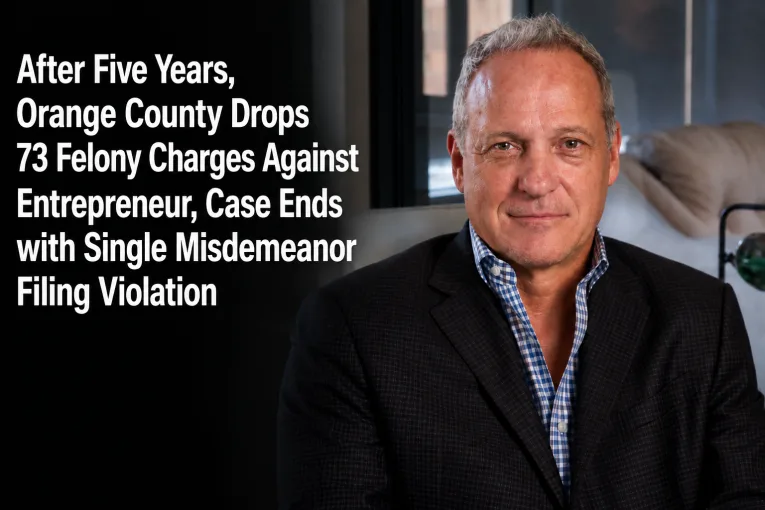
NEWPORT BEACH, Calif. — After more than five years of criminal proceedings, Orange County prosecutors dismissed all 73 felony fraud charges filed against Newport Beach entrepreneur and technology inventor Robert A. Lotter, resolving the case with a plea to a single misdemeanor involving a California securities filing requirement.
The resolution closes a case that began in November 2020 with Lotter’s arrest on $4 million bail and allegations that he defrauded investors through companies he founded to develop early smartphone and cloud-based technologies. According to Lotter, the misdemeanor involved a California “Blue Sky” securities registration filing and did not involve fraud or the sale of an unlawful investment.
Lotter has maintained throughout the case that his investment offerings were either federally registered or exempt under federal securities laws and that the state prosecution improperly characterized the investments as fraudulent.
“This outcome speaks for itself,” Lotter said. “After five years of aggressive prosecution, sensational allegations, and dozens upon dozens of felony charges, the case ultimately resolved with a single misdemeanor securities filing violation and the dismissal of every felony fraud allegation.”
Attorney Robert Barnes, who represented Lotter, said the final outcome stood in stark contrast to the case originally presented by prosecutors.
“This case began with headlines, a public arrest, $4 million bail, and 73 felony allegations all of which portrayed Mr. Lotter as a major criminal defendant,” Barnes said. “Five years later, every felony charge is gone. The final resolution speaks volumes about how dramatically this case changed from the allegations first presented to the public.”
Lotter was arrested shortly before Thanksgiving in 2020 after what he described as a lengthy investigation. He said he and his attorneys had learned nearly a year before the arrest that investigators were examining his business activities and repeatedly offered to cooperate voluntarily.
Instead, Lotter said those offers were declined and he was arrested days before the holiday, remaining incarcerated for 10 days before obtaining a bail reduction from $4 million to $100,000.
During an interview, Lotter called the original bail amount unprecedented for a white-collar case.
“They put me in jail a couple days before Thanksgiving,” Lotter said. “They put me in isolation because the deputies thought the inmates would take me out because of my history.”
Lotter described the reduction in bail as one of the first indications that the prosecution’s allegations would not withstand scrutiny.
“After 10 days, I finally got to see a judge, and I got the bail drop from $4 million to 100,000,” he said. “How did that happen?”
Lotter told the Vanguard that the case never advanced to a preliminary hearing despite years of litigation.
“We didn’t ever got to a preliminary,” Lotter said. “No, what happened is they’d ask a question, we’d give them definitive evidence on bookkeeping, all the different things. We’d give them all the investor records, show them that the SEC already investigated and looked and everything was cleared.”
Lotter said prosecutors repeatedly encouraged him to accept plea agreements that initially involved felony convictions.
“Originally, they wanted me to accept a felony plea,” Lotter said. “Finally, they said, ‘Okay, well, if you pay $3 million in restitution, we’ll drop it to a misdemeanor, but you have to wear an ankle bracelet.’ I said, ‘No.'”
According to Lotter, the final plea involved a misdemeanor securities filing issue rather than any fraud allegation.
“It’s not a fraud charge,” Lotter said during the interview.
The case centered on investments in eAgency and My Mobile Watchdog, companies Lotter founded to develop cloud-based smartphone technologies before the introduction of Apple’s iPhone and Google’s Android operating system.
My Mobile Watchdog pioneered smartphone parental-control technology years before similar products became common and later adapted portions of its patented technology into a law-enforcement platform known as RADAR.
Lotter said RADAR enabled investigators to identify and apprehend online child predators and was used by agencies including Internet Crimes Against Children Task Forces, the FBI, the Department of Homeland Security, Interpol and Scotland Yard. The press release states that one Colorado initiative using the technology resulted in the arrests of 40 suspected child predators within 90 days.
During the interview, Lotter recounted the development of the technology and the transition from commercial smartphone applications to law-enforcement tools.
“I devised with the Orange County Sheriff’s Department sheriffs and detectives,” he said. “I ported my technology over to a law enforcement app we called Radar.”
He added, “We arrested 40 child predators in 90 days.”
Lotter’s companies ultimately secured nine patents covering cloud-based mobile-device monitoring technologies, with portions of the portfolio reportedly receiving independent valuations exceeding $108 million.
Lotter said his companies were preparing significant intellectual property litigation before his arrest.
“What many people never heard is that, before my arrest, eAgency and My Mobile Watchdog were preparing major patent infringement litigation involving technology we spent years developing,” Lotter said. “Respected patent attorneys believed those claims could have generated recoveries worth hundreds of millions, if not over a billion dollars. That opportunity had the potential to dramatically change the future for our investors as well as online child safety. Instead, everything stopped the day I was arrested.”
Lotter said he believes his companies also faced significant challenges from restrictions imposed by technology platforms, particularly Apple. The release points to the U.S. Department of Justice’s 2024 antitrust lawsuit against Apple and a 2023 Forbes investigation examining Apple’s approach to child safety as developments that support concerns he has raised regarding parental-control technologies.
During the interview, Lotter said Apple deliberately prevented parental-control applications from functioning properly.
“Apple has since admitted that they deliberately blocked parental control apps, which I was the very first one,” Lotter said. “They’re now in a Department of Justice antitrust case and 20 states are involved.”
Lotter also alleged that the criminal prosecution effectively destroyed his business while preventing him from pursuing patent enforcement.
The episode remains a serious setback for Lotter, but he remains hopeful.
“Fortunately, I just had an amazing phone call that we’re getting a very top-notch law firm to reinstigate the patent litigation on contingency,” Lotter responded. “I’ve got some prospects, but the charges had to go away, which they finally did. Otherwise, no one was going to do business with me.”
The lengthy prosecution effectively halted business operations, investor communications and intellectual property enforcement while the criminal case remained pending.
Now that the criminal matter has concluded, Lotter said he has resumed communications with investors regarding the future of the companies and potential patent enforcement efforts.
“With the criminal case finally behind me, my focus is on rebuilding,” Lotter said. “I look forward to working with our investors to evaluate next steps for the companies and their intellectual property.”
Lotter said his long-term objective extends beyond rebuilding his businesses.
“Nothing is more important to me than putting this chapter behind us so we can continue developing technology that helps protect children,” he said. “That mission has always been at the heart of what we built, and I intend to dedicate my efforts to protecting our innovations, creating value for investors, and ensuring this technology continues serving families and law enforcement.”
During the interview, Lotter reflected on the personal consequences of the five-year prosecution.
“I’m 69,” he said. “It’s pretty difficult to be hit this hard at this stage of your life when you’ve been successful and you’ve had an impeccable reputation of helping others, and then all of a sudden you’re just basically robbed of your reputation and your income. So it’s been difficult, but I’m turning it around. I’m not a quitter or giver-upper or I’m not a victim.”
The case formally concludes with Lotter’s misdemeanor plea and the dismissal of all felony fraud counts.
According to Lotter, he intends to continue appealing the restitution order while focusing on rebuilding his technology companies, reviving patent litigation and expanding technologies designed to assist parents and law enforcement in protecting children online.
To comment please go to one of these social media platforms:
Facebook: https://www.facebook.com/DavisVanguard
LinkedIn: https://www.linkedin.com/company/peoples-vanguard-of-davis-inc/
Instagram: https://www.instagram.com/davisvanguard/
X: https://x.com/davisvanguard
Bluesky: https://bsky.app/profile/vanguardnewsgroup.bsky.social
Subscribe to the Vanguard News letters. To make a tax-deductible donation, please visit davisvanguard.org/donate or give directly through ActBlue. Your support will ensure that the vital work of the Vanguard continues.
