
By Owen Harrison
CINCINNATI, Ohio — In a victory for Fourth Amendment protections and police accountability, the U.S. Court of Appeals for the Sixth Circuit ruled Aug. 13 that a police officer who tased a nonviolent protester four times in July 2020 is not entitled to qualified immunity at the summary judgment stage.
The decision in Phelps v. City of Saginaw affirms a previous ruling by a lower court. The lower court also denied immunity to Officer Terrance Moore based on evidence that he tased Cornelius Phelps, a protester, while Phelps was not actively resisting arrest and was on public property.
The initial incident occurred in July 2020, amid the aftermath of the murder of George Floyd. Cornelius Phelps and fellow members of the coalition The Ghost of George Floyd, or GOGF, gathered around an informational table near the Fraternal Order of Police lodge in Saginaw, Michigan.
They did so to engage in discussion with officers about police reform, according to the ruling from the U.S. Court of Appeals for the Sixth Circuit.
Police arrived on the scene, requesting that the group disperse and stop congregating, to which Phelps replied that the group was on public property. After a brief interaction, Officer Vincent Jackson asked Phelps for identification.
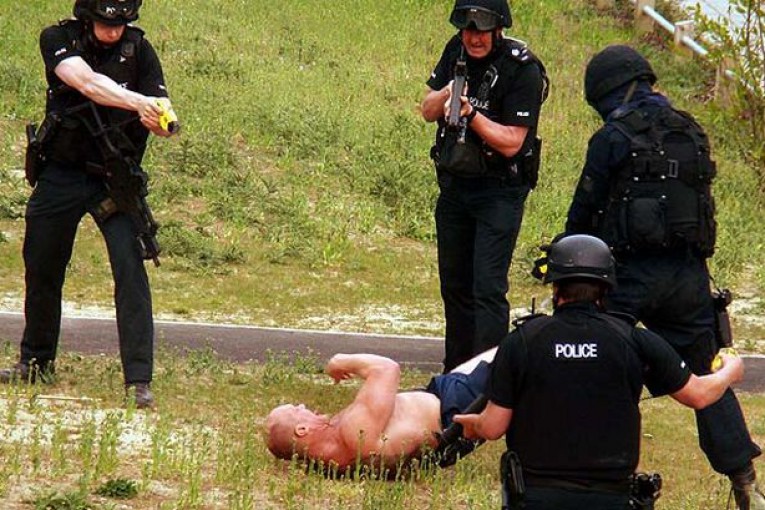
When Phelps did not have any identification, officers Vincent Jackson, Desirae Kzinowek and Terrance Moore began to arrest him, precipitating a struggle. In the ensuing struggle, officers kneed Phelps, and Moore repeatedly tased him before he was handcuffed.
According to the Sixth Circuit opinion, Phelps was seated on the ground, leaning back and facing the officers with his hands open and raised before Moore first deployed his Taser. No officer was touching Phelps at that point, and the court said a reasonable jury could conclude that Phelps was not physically resisting when Moore tased him.
Moore ultimately tased Phelps four times, including after Phelps told officers, “I can’t move.” The opinion states that a bloody wound was visible on Phelps’ left arm where the Taser probes first struck him and that he later urinated blood.
Following Phelps’ arrest, he was acquitted of trespassing, while the resisting arrest and obstruction charges were dismissed. In May 2023, he sued the city of Saginaw, the Fraternal Order of Police Associates and the arresting officers for violating his constitutional rights, as well as under various Michigan assault and battery laws.
The district court ultimately granted summary judgment to the defendants on the claims except for Phelps’ excessive-force claims against Moore. The court concluded that Phelps had presented sufficient evidence that Moore used excessive force by tasing him in violation of his Fourth Amendment rights and that Moore was not entitled to qualified immunity because the right not to be tased while not actively resisting was clearly established by July 26, 2020.
Evaluating the decision, the appellate court determined that a reasonable jury could find that Phelps posed no immediate physical threat and that the use of force was unnecessary at the time of his arrest. The court also upheld the lower court’s decision denying Moore qualified immunity under the circumstances.
The court found that a reasonable jury could determine Phelps’ actions amounted, at most, to passive resistance and that the repeated use of a Taser therefore constituted excessive force under the Fourth Amendment. The majority also concluded that by July 2020, Sixth Circuit precedent had clearly established the right of an individual not to be tased when the person was not actively resisting arrest, meaning Moore was not entitled to qualified immunity at the summary judgment stage.
Cornelius Phelps was represented by the Legal Defense Fund, as well as Schulz Law PLC and attorney Hugh M. Davis.
“Mr. Phelps has fought hard for justice,” Jack Schulz, an attorney at Schulz Law PLC, stated. “He has stood strong and determined during the six years of litigation following the traumatic events that led to the case being filed. After all these years, we are excited to finally have the opportunity to present our case to a jury.”
Arielle Humphries, assistant counsel at LDF, also commented on the ruling, saying, “It is abundantly clear” that Cornelius Phelps was a victim of police violence. Humphries went on to say that “This decision provides a measure of justice and rightfully denies qualified immunity to the officer who abused Mr. Phelps” and that “the doctrine of qualified immunity does not protect police officers who beat and abuse people.”
Judge Amul Thapar dissented from the majority opinion, arguing that Phelps resisted officers’ efforts to handcuff him and repeatedly refused commands to place his hands behind his back. The majority, however, emphasized that it was not deciding the ultimate facts of the case but determining whether the evidence could allow a reasonable jury to find that Moore used excessive force.
The court affirmed the district court’s denial of qualified immunity and remanded the case for further proceedings. The ruling means Phelps’ excessive-force claim against Moore can proceed rather than resolving whether Moore is ultimately liable for violating Phelps’ constitutional rights.
The U.S. Court of Appeals for the Sixth Circuit’s decision in Phelps v. City of Saginaw reinforces important boundaries on protections for civilians against violence from police officers. The ruling also places an important check on what qualifies as immunity for an officer, as the majority concluded that a reasonable jury could find Phelps was nonviolent and not actively resisting arrest.
To comment please go to one of these social media platforms:
Facebook: https://www.facebook.com/DavisVanguard
LinkedIn: https://www.linkedin.com/company/peoples-vanguard-of-davis-inc/
Instagram: https://www.instagram.com/davisvanguard/
X: https://x.com/davisvanguard
Bluesky: https://bsky.app/profile/vanguardnewsgroup.bsky.social
Subscribe to the Vanguard News letters. To make a tax-deductible donation, please visit davisvanguard.org/donate or give directly through ActBlue. Your support will ensure that the vital work of the Vanguard continues.
