
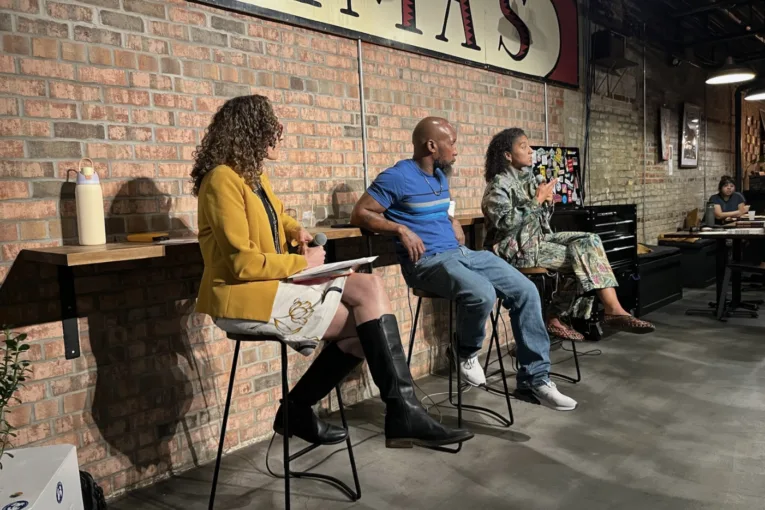

The American Prison Writing Archive (APWA), the country’s largest digital collection of writings by incarcerated people, recently published Harm and Punishment: Incarcerated Writers on Violence and the U.S. Prison (Haymarket, 2026), the debut anthology that kicks off a series of themed curations that reveal to readers what prisons work tirelessly to veil from public view. Edited by Elizabeth Hinton, class of 1954 Professor of History, Black Studies, and Law at Yale University and Yale Law School, and Elsa Julien Lora, Harm and Punishment deconstructs the logic of punishment, and presents the embodied observations of residents of the carceral state as a transcript of testimony that reveals violence as the prison’s primary organizing principle.
Describing the anthology as an answer to George Jackson’s call in 1970 for the public to investigate the myth “that incarceration could cure America’s violence problem,” Hinton and Lora draw upon fifty captive-authored essays to move readers “toward a deeper and more nuanced understanding of the prison’s role in producing and reproducing violence,” as an “essential” understanding for those committed to “the project of abolition.” As a key site of harm in our society, historicizing the thing we aim to rid ourselves of requires that scholars and publishers empower those whose first-person witness accounts reveal the prison’s techniques of harm. More than an anthology, this work archives the state-created harm committed upon captive bodies in your name; as taxpayers, you have paid for the structural violence that prisons generate.
Uhuru B. Rowe, whose essays “Different Prison, Same Old Abuse” (Part One), and “Deja Vu: Total Lockdown” (Part Two), document dehumanizing and racialized police actions deployed against “those prisoners who embrace certain religious and political views that are deemed radical, objectionable, and un-American,” acquired freedom in time to allow a 2026 promoted event convened by the APWA, Haymarket Books, and the Mellon Foundation. Rowe, Hinton, Lora, and the APWA’s executive staff Vesla Weaver, and Doran Larson, participated in a discussion about the importance of humanizing the archive by amplifying both the captive authors, and now-free contributors in ways that facilitate their participation in promotional publishing events in spite of their level of captivity.
Weaver, who coordinates the APWA’s forthcoming series of anthology titles, engages with prospective editors, and works directly with captive contributors, is determined to resist allowing prisons and the people they contain to become rendered “some abstraction we can tuck conveniently away.” By exposing harms the public cannot readily see, Weaver believes Harm and Punishment “speaks to the violence that is reproduced in the public’s name” taking place in spaces the public cannot access. Determined to stretch the format into a teaching tool, Weaver, along with the Justice For Everybody Movement at Yale University (J4EM), and the captive-founded Carceral Studies Journalism Guild (CSJG), are collaborating on horizontal projects of knowledge production and meaning-making that include captive community book reviews of Harm and Punishment, and a wrap-around anti-violence curriculum that captives can access via the EDOVO platform.

As the Executive Director of J4EM, Hinton’s work with CSJG has foregrounded a novel application of captive knowledge production that elevates incarcerated scholars as colleagues and subject matter experts.
“We valorize the unique contributions that only captives can make to these conversations, because they have the authority to steer them. The in-community spaces they occupy in order to do the critical emotional labor that prepares folks for parole suitability is where the most important abolition work is happening, because that work, when its done well, is what is nurturing the conditions that bring about the decarceration we all want to see moving forward. Excavating all the trauma and healing from the harm prisons create, is the first step in a long journey towards a life of service, safety, and solidarity. The same people whose testimonies populate this anthology, are authoring the horizontal modalities we will help make available to those who want to heal and move away from violence, but might not know how.”
In collaboration with scholars Erica R. Meiners and Rachel McMillian, the CSJG is coordinating a community review of Harm and Punishment that will invite captive scholars around the country to comment on the anthology, and make contributions to a curriculum that will onboard for confined learners subject matter expert-authored treatments designed to prepare violent offenders for parole suitability review, resentencing hearings, and commutation consideration. Centering trauma, emotional regulation, empathy, victim awareness, accountability, insight, relapse prevention planning, and making a living amends, The Violence Workshop: Confronting the Harm We Author will become available to more than 1M captives via J4EM’s forthcoming Inside Knowledge channel on the EDOVO platform in 2027.
Access Harm and Punishment here.

