
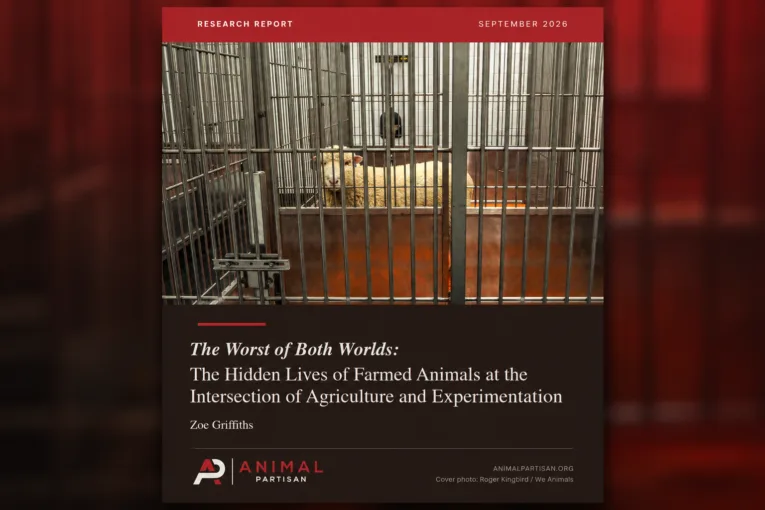
DAVIS, Calif. — Public records obtained by the animal advocacy organization Animal Partisan raise questions about the treatment, oversight and ultimate disposition of farm animals used in research and teaching at UC Davis, revealing a system in which animals can simultaneously serve scientific, educational and agricultural purposes.
The records show that livestock used by the university can retain economic value after participating in research or teaching and that UC Davis policies provide for the sale of surplus animals and animal products generated through university activities.
The documents also identify animal deaths and adverse events at university agricultural facilities, including two cows killed by a falling hay bale, a cow that died following an incident associated with Picnic Day and the death of a lamb.
Animal Partisan examined UC Davis as part of a broader investigation into agricultural animal research at 10 public universities. The organization obtained records through public records requests, including annual reports submitted to the Association for Assessment and Accreditation of Laboratory Animal Care International, or AAALAC, and reports submitted to the National Institutes of Health Office of Laboratory Animal Welfare, or OLAW.
Zoe Griffiths of Animal Partisan told the Vanguard that one of the most significant findings was the extent to which animals at agricultural research institutions can occupy roles that do not fit neatly into conventional distinctions between laboratory animals and livestock.
UC Davis publicly describes itself as a major agricultural research institution and says it houses production animals including cattle, pigs, sheep and chickens. The university also says all animal research must receive approval from its Institutional Animal Care and Use Committee, or IACUC.
The university says its IACUC reviews animal-use protocols and amendments, ensures compliance with federal and state regulations, inspects animal facilities and laboratories and oversees training programs.
But farm animals used for certain agricultural purposes are excluded from the definition of animals covered by the federal Animal Welfare Act.
UC Davis’ own Office of Research explains that the federal law excludes farm animals, including livestock and poultry used or intended for food or fiber and animals used to improve nutrition, breeding, management, production efficiency or the quality of food or fiber.
Griffiths said those animals nevertheless remain subject to UC Davis IACUC oversight.
“Protocols involving these animals still have to be approved by the UC Davis IACUC,” Griffiths said.
She said AAALAC oversight also applies because the university’s agricultural units are accredited by the organization.
UC Davis says its animal care program has been AAALAC accredited since 1966 and that it also operates under a Public Health Service animal assurance and USDA registration.
The records reviewed by Animal Partisan reveal another distinction involving what happens to research and teaching animals after their use by the university has ended.
Under UC Davis IACUC Policy 36, an animal that has participated in research or teaching can potentially be adopted as a companion animal if it is healthy, has an expectation of a normal quality of life and has a suitable temperament.
But the policy identifies categories of animals that cannot be adopted, including “livestock with a deemed value.”
Those animals are instead referenced to UC Davis Policy and Procedure Manual Section 340-30, governing the “Sale and Disposal of Agricultural By-Products.”
That policy defines an agricultural by-product as a saleable surplus agricultural commodity and expressly includes “surplus animals, and animal products.”
The policy applies to agricultural by-products generated through “teaching, research, or other University activities.”
UC Davis policy requires those agricultural by-products to be sold in a manner ensuring that the university does not incur a net loss and establishes procedures for public auctions, contracts, public sales and, under some circumstances, private sales.
Griffiths called the relationship between those two policies significant.
“It’s also significant that farmed animals ‘with a deemed value’ are excluded from the university’s animal adoption policy, and that the university requires these animals and/or their by-products to be sold in a manner that doesn’t incur a loss to the university,” Griffiths said.
She added, “Based on these documents, it seems clear that farmed animals would rarely be given the opportunity to be adopted or placed at a farm sanctuary upon the conclusion of their experimental protocols.”
The documents establish the policies governing adoption and disposition, but do not provide data establishing how frequently research livestock are adopted, sold, euthanized or placed with sanctuaries.
Questions also remain about the extent to which animals or products from animals participating in experiments subsequently enter the commercial food system.
UC Davis states publicly that milk produced by its Dairy Teaching and Research Facility is sold to Hilmar Cheese Company.
The university describes the facility as having a milking herd of approximately 105 cows, excluding dry cows, along with approximately 200 replacement heifers. The facility is explicitly used for both teaching and research.
UC Davis has described research conducted at the dairy in areas including nutrition, genetics and reproduction. An earlier university publication stated that milk from the herd was sold to Hilmar Cheese Company and turned into cheese.
Animal Partisan has requested additional documentation from the U.S. Food and Drug Administration to determine more precisely when products from animals involved in experiments can enter the food supply.
Griffiths acknowledged that the records currently available do not allow the organization to separate animals used for research from animals used for teaching and agricultural production within UC Davis’ AAALAC census numbers.
“Unfortunately, these animal-use purposes cannot be distinguished from one another in the census numbers provided to AAALAC,” Griffiths said.
The organization originally estimated that 97,448 farm animals at the 10 institutions examined appeared in AAALAC census figures but not USDA Animal and Plant Health Inspection Service reporting.
Animal Partisan calculated the estimate by comparing the numbers reported to AAALAC with those reported to USDA/APHIS, reasoning that the difference largely represented species or uses outside Animal Welfare Act coverage.
Griffiths said the organization subsequently discovered that 62 animals reported by West Virginia University to USDA had remained in the calculation.
The figure represents an estimate rather than a direct count of animals subjected to agricultural experiments because AAALAC census figures can include animals used for teaching, agricultural production and other purposes.
The UC Davis records also document adverse events involving farm animals.
According to Griffiths, a 2023 AAALAC annual report and an OLAW report document an incident in which a hay bale fell and killed two cows.
The incident was reported to AAALAC as a condition resulting in unexpected animal harm or death and was reported to OLAW as a noncompliance or adverse event, Griffiths said.
OLAW’s response noted corrective actions taken by UC Davis, including moving the hay bales, according to Griffiths.
At the same time, the university’s 2023 AAALAC annual report said the incident was “reported to applicable agencies who in turn determined situation to be within realm of standard agricultural practice and inherent dangers therefore not reportable.”
Griffiths said the university’s response to that incident was among the most significant findings in the UC Davis records.
“The response regarding the hay bale incident is incredibly telling,” Griffiths said.
She said UC Davis’ interim vice chancellor for research also referenced concern about human safety in explaining why the incident was reported to OLAW.
The records provided by Animal Partisan also identify a cow death associated with a Picnic Day incident.
According to Griffiths, UC Davis reported that death to AAALAC as a condition resulting in unexpected animal harm or death. A pathology report was prepared, although Animal Partisan said it does not currently have additional information concerning any investigation.
A separate OLAW report documents the death of a lamb, Griffiths said.
That incident was reported as a noncompliance, and OLAW said preventative measures had been implemented, including retrofitting catch pen gates.
Griffiths said OLAW ultimately wrote that it “concur[s] with the actions taken by the institution to comply with PHS policy.”
The records therefore document adverse events and corrective actions, but do not establish that OLAW ultimately found continuing violations in the hay bale or lamb incidents.
Animal Partisan’s national report also examines how research involving agricultural animals is funded, including support from government agencies, commodity organizations and agricultural industries.
For UC Davis, however, Griffiths acknowledged that Animal Partisan does not possess the underlying contracts or grant agreements necessary to determine whether private funders received authority over research design, data, publication or intellectual property.
The organization’s information concerning private industry funding primarily comes from published research and news reports.
Animal Partisan also said it cannot substantiate another potential concern specifically at UC Davis: whether researchers classify experiments in pain or distress categories that understate what animals experience.
“UC Davis was one of the three universities from which we did not receive AAALAC program descriptions (which contain detailed protocol information), we can’t apply that conclusion to UC Davis,” Griffiths said.
She added that Animal Partisan did not receive UC Davis’ definitions for its pain and distress categories through its records request.
UC Davis says its animal care program is designed to ensure humane treatment of research and teaching animals.
The university says IACUC is responsible for reviewing animal-use protocols, ensuring compliance with federal and state regulations and inspecting animal facilities and laboratories. UC Davis also says Campus Veterinary Services is responsible for providing adequate and humane veterinary care.
The records nevertheless illustrate a regulatory structure for agricultural research that differs in significant ways from the system many people associate with laboratory animal research.
For some farm animals, federal Animal Welfare Act protections do not apply because of the animals’ agricultural use. At the same time, UC Davis policies continue to require IACUC review and provide additional institutional and accreditation oversight.
And unlike many conventional research animals, livestock can retain an explicit commercial value.
For Griffiths, that overlap between scientific research and agricultural production is central to what Animal Partisan’s investigation uncovered.
“The scale and diversity of the farmed animals used by UC Davis was surprising,” Griffiths said. “When I was a student there, I was really only aware of the dairy cows because of their proximity to campus.”
“I, and I imagine many others, had no idea that pigs and chickens were also being raised in confinement facilities and subjected to experiments by UC Davis faculty just two miles away,” she added.
The underlying records establish that UC Davis uses livestock in research and teaching, operates agricultural production facilities, sells products generated through university agricultural activities and treats some livestock as assets with economic value.
But the records currently available do not establish how many animals in UC Davis’ agricultural census are actually experimental subjects, how frequently animals completing research protocols enter commercial channels or whether private industry funding gives sponsors control over the research itself.
Those questions remain central to determining the extent to which UC Davis’ agricultural research, teaching and commercial production systems overlap.
To comment please go to one of these social media platforms:
Facebook: https://www.facebook.com/DavisVanguard
LinkedIn: https://www.linkedin.com/company/peoples-vanguard-of-davis-inc/
Instagram: https://www.instagram.com/davisvanguard/
X: https://x.com/davisvanguard
Bluesky: https://bsky.app/profile/vanguardnewsgroup.bsky.social
Subscribe to the Vanguard News letters. To make a tax-deductible donation, please visit davisvanguard.org/donate or give directly through ActBlue. Your support will ensure that the vital work of the Vanguard continues.
