
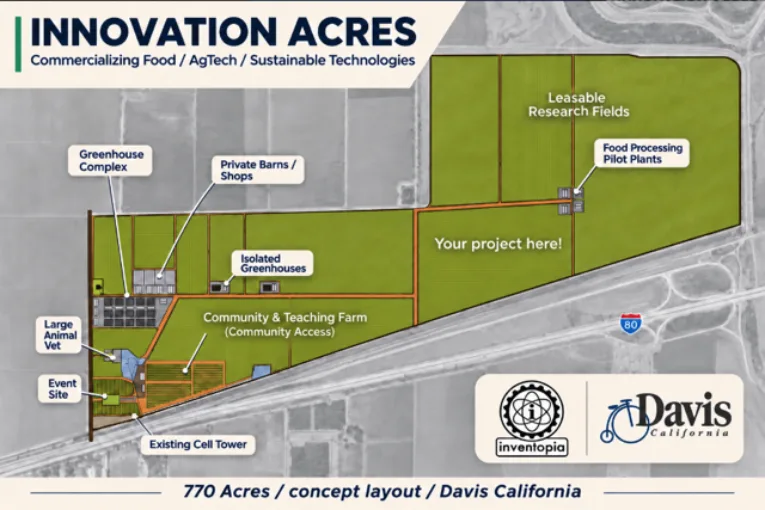
DAVIS, Calif. — The Davis City Council on Tuesday authorized a two-year exclusive negotiating agreement with Inventopia that could transform approximately 760 acres of city-owned farmland east of Davis into a regional center for agricultural technology research, development and commercialization, leveraging existing public assets without requiring an investment from the city’s general fund.
The proposal represents an emerging approach to economic development in Davis, focusing on cultivating a pipeline of emerging companies and commercializing university research rather than relying exclusively on the development of innovation parks to attract businesses.
Tim Keller, founder and executive director of the nonprofit business incubator Inventopia, said the effort builds directly on the Economic Development Strategic Plan adopted unanimously by the City Council’s framework for economic development on March 3.
In a March guest commentary published by the Vanguard, Keller argued that Davis needed to focus on cultivating emerging technologies and companies rather than simply creating physical space in the hopes that businesses would come.
“The goal here (and as I stated in the op-ed as well…) is that for the city, we need to focus on the pipeline of companies and technologies,” Keller told the Vanguard in an email explaining the proposal.
Keller worked with Davis Economic Development Director Katie Yancey during the preparation of the city’s strategic plan, helping identify opportunities to use city-owned properties to stimulate economic activity without requiring substantial municipal expenditures.
“This I think is especially clever because our city is not in a revenue position to be making large cash investments in our economy the same way that other municipalities might,” Keller explained.
The properties, known as Howat Ranch and Clayton Ranch, extend along the railroad tracks north of Interstate 80 toward the Yolo Bypass, beginning near the intersection of County Roads 32A and 105.
According to the Nov. 17 city staff report prepared by Yancey and Real Property Manager Tracie Reynolds, Davis owns more than 1,200 acres of farmland within its planning area, approximately 760 acres of which are encompassed by the proposed project.
The properties were originally purchased with stormwater funds for nonconservation purposes and have traditionally been leased to farmers to generate municipal revenue, maintain the land and minimize administrative costs.
“Over the years, the City has discussed converting some of this farmland to other public uses. Still, those discussions have never materialized into concrete projects,” the staff report states.
City staff identified the research farm as an opportunity to generate greater economic value from existing municipal assets while maintaining their agricultural character.
The council’s economic development plan identifies working lands as a regional industry cluster in which Davis possesses a competitive advantage, particularly in agriculture and food technology.
The proposed research farm aligns with four of the strategic plan’s primary objectives, according to city staff.
“If implemented, the concept would meet a regional need for flexible, affordable space for crop trials, plant breeding, agricultural robotics, sensor development, biological testing, food processing technologies, livestock applications, and other forms of agricultural commercialization,” the staff report states.
A central component of the proposal is addressing the gap between agricultural research conducted at UC Davis and the commercialization of discoveries emerging from the university.
While UC Davis has extensive research facilities, companies seeking to commercialize agricultural technologies often need access to specialized infrastructure outside the university.
“Without access to this type of infrastructure, these companies are often limited in how much they can grow locally,” city staff wrote.
Staff noted that existing opportunities to obtain dedicated greenhouse and field space are limited, particularly for smaller companies with fewer financial resources.
“This type of facility support would address the market shortfall, support the City’s targeted industry, and transform the local and regional ecosystem by creating jobs and improving collaboration with UC Davis,” the report states.
Potential uses include field-scale research into crop breeding, seed systems, soil health, crop protection, biological inputs and climate adaptation.
Other possibilities include irrigation and water management technologies, agricultural robotics, automation, renewable energy demonstrations, pilot food processing facilities and large-animal veterinary research.
“I’ve often said UC Davis is the Silicon Valley of agriculture technology. We need a farm incubator to help advance the world-class science coming out of the university,” Keller told the Sacramento Business Journal.
The scale of the property would allow researchers to conduct multiple agricultural trials while maintaining sufficient separation between experimental and control crops.
Keller also anticipates attracting established domestic and international companies seeking access to the region’s scientific expertise and highly educated workforce, even when their technologies originated outside Davis.
The effort would build on the existing Inventopia model, which since 2017 has provided entrepreneurs and emerging companies access to laboratory facilities, manufacturing equipment and other resources necessary to develop and test prototypes.
According to Keller, an economic impact study produced by the Greater Sacramento Economic Council found that Inventopia had already attracted millions of dollars into the community and generated measurable fiscal benefits for the city.
The city and Inventopia have been collaborating since 2020 to expand the local supply of specialized business incubation space.
In April 2025, the council authorized an additional $185,000 in loan funding for Inventopia, requiring the organization to develop a new five-year business plan addressing its future operations, growth and economic development activities.
The council received that business plan on June 16 and reconvened a subcommittee consisting of Councilmembers Linda Deos and Josh Chapman to explore the potential exclusive negotiating agreement.
The business plan identified three strategies for expanding and stabilizing Inventopia’s operations: expanding its existing facilities, introducing workforce development initiatives and pursuing the development of a research farm.
The $185,000 in loan funds will be used to expand Inventopia’s existing Peña Drive facility rather than finance the agricultural research project.
According to city staff, Inventopia recently received confirmation that adjacent space would become available, allowing it to add woodworking, painting and welding facilities as well as four private workshops that could be leased to individual companies.
The exclusive negotiating agreement establishes a separate process for evaluating the proposed research farm, beginning with a feasibility study.
The city and Inventopia have identified a potential funding opportunity through the U.S. Economic Development Administration’s Economic Adjustment Assistance program.
According to the staff report, preliminary federal guidance suggests that the program could cover between 60% and 80% of eligible project costs, with a potential federal grant of approximately $300,000.
City staff estimated that the required local contribution would range from $60,000 to $120,000, while Keller indicated that the combined funding effort could reach approximately $500,000.
Inventopia would be responsible for obtaining the local matching funds through noncity sources.
“The City is not responsible for funding the feasibility study,” the staff report states.
City staff also emphasized that existing revenue-generating activities on the properties could continue throughout the negotiating period.
The proposed agreement gives Inventopia the exclusive right to negotiate a lease or purchase of all or part of the properties for two years, with an automatic extension under specified circumstances if grant funding is secured.
During that period, the city would be prohibited from negotiating a sale or long-term lease of the property with another party, although existing agricultural leases could continue.
The city would retain the right to enter into temporary leases with other parties, provided those agreements could be terminated with no more than six months’ notice.
The city could also terminate the exclusive negotiating agreement for any reason by providing Inventopia with 30 days’ written notice.
The agreement does not obligate either party to complete a transaction, transfer ownership or approve any development project.
“Any transaction requires a separate written agreement signed by both Parties and all legally required approvals,” the proposed agreement states.
City staff outlined three possible outcomes from the negotiating process.
The first would be securing grant funding to complete a feasibility study, potentially leading to a subsequent property agreement establishing terms and community benefit objectives.
Alternatively, Inventopia could secure sufficient private investment to fund the feasibility study independently.
If neither funding approach succeeds, city staff said the process could still provide valuable information about private-sector interest, investment potential and the viability of the research farm concept.
Several practical and regulatory questions would need to be addressed before development could proceed.
The easternmost portion of the property is susceptible to seasonal flooding and is subject to a Williamson Act contract, which requires that the property remain in agricultural use or a use compatible with agriculture.
The feasibility study would also evaluate building, fire, grading and drainage requirements, along with potential infrastructure improvements involving wells, septic systems and other permitting requirements.
In August, Inventopia submitted an analysis of the compatibility of the proposed research farm with Yolo County’s Agriculture Intensive zoning designation and potential pathways for obtaining county approval.
City staff subsequently contacted the Greater Sacramento Economic Council and Valley Vision to evaluate regional demand for the proposed project.
Keller noted that Valley Vision has also identified working lands as an important regional economic resource.
Keller told the Sacramento Business Journal that he envisions using flood-prone portions of the property for rice cultivation.
Other possibilities include agrivoltaics, which combines solar energy production with agricultural activity, potentially allowing portions of the research farm to generate electricity while studying the relationship between energy production and agriculture.
City staff presented the research farm concept to the Open Space and Habitat Commission on Nov. 2, discussing how the proposal intersects with the city’s economic development strategy and ongoing General Plan update.
According to the staff report, the commission was generally supportive of the city’s efforts, with staff anticipating returning to the commission for further feedback as the feasibility study progresses.
“Staff acknowledged to the Open Space and Habitat Commission that the Site offers considerable open space and conservation value,” the report states.
Beyond its research and commercial applications, Keller wants the property to become a community destination.
“There will be a community farm, a teaching center, an event site for weddings / events, and I am very eager to plant trees and make a walking / biking path through it,” Keller told the Vanguard.
He said he wants to increase biodiversity on land currently dominated by conventional agricultural production.
“I want to make it a place that citizens are proud of, that they can visit and experience,” he said.
Any eventual development would remain subject to applicable environmental review, land use requirements and other legal obligations, including the California Surplus Land Act, where applicable.
City staff determined that approval of the negotiating agreement itself did not constitute a project requiring environmental review under the California Environmental Quality Act.
Implementation would occur over several years, with the immediate focus on identifying research partners, investors and prospective tenants.
Inventopia is seeking interest from startups, established agricultural companies, crop associations, research institutions and community organizations that could conduct research, establish facilities or operate educational programs on the property.
Keller said the opportunity extends beyond commercializing technologies developed at UC Davis to attracting international agricultural companies interested in employing scientists and agricultural technology specialists who already live in the region.
“All of this will take some time to put together, but it is directly in-line with the city’s economic plan which includes focusing on leveraging what we have for maximal impact and leaning into our strengths,” Keller said.
To comment please go to one of these social media platforms:
Facebook: https://www.facebook.com/DavisVanguard
LinkedIn: https://www.linkedin.com/company/peoples-vanguard-of-davis-inc/
Instagram: https://www.instagram.com/davisvanguard/
X: https://x.com/davisvanguard
Bluesky: https://bsky.app/profile/vanguardnewsgroup.bsky.social
Subscribe to the Vanguard News letters. To make a tax-deductible donation, please visit davisvanguard.org/donate or give directly through ActBlue. Your support will ensure that the vital work of the Vanguard continues.
