
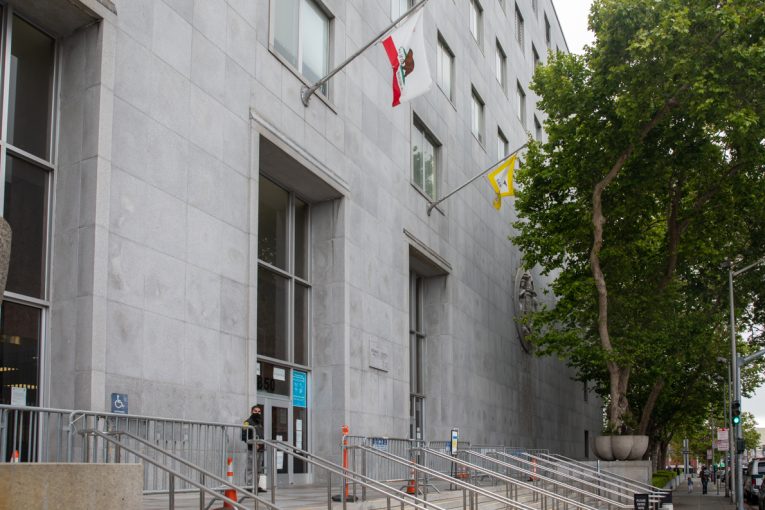
SAN FRANCISCO — A man accused of attempting to sell allegedly stolen property in San Francisco was held to answer on two felony counts following a two-day preliminary hearing marked by disputes over identification, the legality of a police search and whether prosecutors had established that the property was stolen.
San Francisco County Superior Court Judge Lianne M. Dumas ultimately dismissed a third felony count after finding prosecutors had not presented sufficient evidence connecting the accused to an alleged shoplifting incident in Corning, California.
The preliminary hearing was held Monday and Tuesday in Department 12. Deputy Public Defender Danielle Craig represented the accused, while Assistant District Attorney Shauna Kashyap appeared for the prosecution.
The case was beset with issues of identification and proof that the property was stolen.
The prosecution attempted to introduce new evidence involving an alleged shoplifting incident in Corning, arguing that the accused had been identified as the person who stole merchandise from a Safeway store there.
Craig objected and argued that the material constituted late discovery, moving to exclude the new testimony.
Kashyap argued that the evidence was necessary to establish Count 3.
Craig argued that the identification of her client as the person involved in the Corning incident was tenuous at best, noting that the evidence included a blurry still photograph. She characterized the prosecution’s attempt to litigate the Corning incident as essentially a case within a case.
The prosecution argued that the evidence was needed to establish the theft alleged in the third count and pointed to CALCRIM No. 1703 regarding the elements of the crime.
Dumas offered the defense a continuance, which Craig declined, and the judge allowed the evidence to be introduced.
Craig cross-examined Officer Mooney about his investigation.
Mooney acknowledged that a barcode could not establish whether an item was stolen or identify which store it came from.
Mooney did not view surveillance footage and only activated his body-worn camera after the accused was already in handcuffs.
According to the testimony, the accused had allegedly been attempting to resell items on the street.
Mooney testified that he went to a Safeway store and scanned the items. Some of the items were not from Safeway, and he could not determine whether the items had been stolen or, if they had, which specific items were stolen.
Officer Patrick Gerrans testified regarding the newly introduced evidence involving Corning.
Gerrans acknowledged that he never went to Corning and had only corresponded by telephone.
Gerrans, an organized retail theft investigator, testified that he reviewed a photograph, a report and body-worn camera footage and spoke with a person at Safeway.
According to Gerrans, the man involved in the Corning incident was seen putting merchandise into a bag and walking out of the store without paying.
Gerrans testified that when confronted by store employees, the man said, “Mind your own business or I’ll beat your face in.”
The man then left the store with the items.
Gerrans testified that the man “may have been shoplifting” and did not pay for any merchandise.
The individual was described as a Black male wearing a sweatsuit with a hoodie pulled over part of his face.
A store employee in Corning contacted authorities after seeing a photograph of the man involved in the San Francisco case and said that was the person the employee had seen in Corning.
Gerrans testified that the accused matched the description of the person involved in the Corning incident.
A photograph was admitted over the defense’s objection.
On cross-examination, Gerrans acknowledged that he was not present at the arrest, had never seen the accused in person and had never been in Corning.
Craig also pointed out that no one involved in the Corning identification referenced the prominent tattoos on the accused’s face.
The store employee nevertheless concluded that the people depicted in the two photographs were the same person.
On redirect examination, Gerrans testified that the hood was pulled over the person’s head. Kashyap later argued that this explained why the facial tattoos were not identified.
Dumas also denied Craig’s motion to suppress evidence.
Craig argued that the evidence available to the officer before the search was too vague to establish reasonable suspicion.
She noted that the officer relied on the presence of numerous items, the area’s reputation for the sale of stolen goods and the accused’s conduct, but argued that none of those circumstances independently established criminal activity.
Craig argued there was nothing sufficient to justify the detention and search, maintaining that neither the area nor the accused running from the officer was enough to establish reasonable suspicion.
Dumas denied the motion.
The judge said there was information beyond the accused allegedly running and the location’s reputation for the sale of stolen products. She pointed to testimony regarding the volume of merchandise and stickers on the items in finding sufficient grounds for the detention.
Craig then argued that a significant amount of evidence was missing to justify a holding order.
She argued that Count 1 required proof that the items had been obtained through shoplifting and maintained that prosecutors had failed to establish that the merchandise found with the accused was stolen.
Craig argued that the items allegedly taken in Corning did not match the items found in the accused’s possession in San Francisco.
She also attacked the Corning identification, arguing that prosecutors were attempting to identify a Black man without meaningful information about height, weight, stature, skin color or hair and relying heavily on the fact that the person was wearing a hoodie.
Craig pointed to the accused’s visible tattoos on his neck and face, which were not included in the description from Corning.
She further argued that even if the court accepted the Corning receipt as evidence of the items taken from that store, the number and types of items did not correspond with the merchandise found in San Francisco.
Craig emphasized that testimony established that scanning the barcodes on the merchandise could not determine whether the products had been purchased or stolen.
She asked Dumas to discharge all three counts, arguing that each required proof concerning stolen property that the prosecution had failed to provide.
Dumas questioned Craig about the distinction between Counts 1 and 3, noting that Count 1 did not require proof that the accused personally stole the property, while Count 3 presented a different issue.
Craig agreed with the distinction but maintained that Count 1 still required evidence that the property itself had been obtained through shoplifting.
Dumas also expressed concern about the prosecution’s identification evidence for Count 3.
The judge told Kashyap that People’s Exhibit 10 made it “almost impossible” for the court to identify the face or hoodie depicted and asked whether there was additional evidence connecting the accused to the Corning incident.
Dumas also questioned how the court could determine where the merchandise listed on the Corning receipt came from, noting that testimony established that the items were unaccounted for but appeared to go little further.
Kashyap responded that the receipts were prepared after thefts based on merchandise observed on surveillance footage or merchandise determined to be missing from the store.
She argued that many of the items on the Corning receipt were the same types of items depicted in photographs from the San Francisco investigation.
Kashyap also disputed Craig’s characterization of the identification as weak, pointing to what she described as a distinguishable pattern on the hoodie.
Dumas noted that there was not even evidence establishing the hoodie’s color, although she acknowledged the existence of a pattern.
Kashyap further argued that the hood was pulled up over the accused’s tattoos, explaining why the tattoos were not visible in the Corning images.
Dumas then turned to Craig’s jurisdictional objection to Count 3, which involved conduct allegedly occurring in Corning rather than San Francisco.
After hearing argument, Dumas found sufficient evidence to hold the accused to answer on Counts 1 and 2.
The judge explained that the standard at a preliminary hearing is whether the evidence would cause a person of ordinary prudence to strongly suspect the accused’s guilt, a standard analogous to probable cause and lower than the evidentiary burden required at trial.
Dumas found sufficient cause to believe the accused committed the offenses alleged in Count 1, a violation of California Penal Code section 496.6(a), and Count 2, an alleged violation of Penal Code section 496(a), along with the associated enhancement allegations.
But Dumas reached a different conclusion on Count 3, an alleged felony violation of Penal Code section 666.1(a).
“The People have not produced evidence establishing sufficient cause to believe that the defendant committed that offense,” Dumas ruled.
The judge dismissed Count 3.
Craig then asked the court under Penal Code section 17(b) to reduce Counts 1 and 2.
Craig argued that the accused had a misdemeanor theft conviction from 2017 but no other theft convictions and an unrelated felony conviction from 2022.
She argued that the accused, who is in his late 20s, had a relatively limited criminal history and noted that the property involved in the current case had been returned.
Craig asked Dumas to reduce the remaining counts based on the accused’s criminal history and the evidence presented during the two-day preliminary hearing.
Dumas denied the request.
The judge cited the relatively recent felony conviction, another misdemeanor conviction and a pretrial services report indicating that the accused was not in compliance with his release conditions.
The accused was ordered to appear in Department 22 on Oct. 6 at 9 a.m. for instructions and arraignment.
To comment please go to one of these social media platforms:
Facebook: https://www.facebook.com/DavisVanguard
LinkedIn: https://www.linkedin.com/company/peoples-vanguard-of-davis-inc/
Instagram: https://www.instagram.com/davisvanguard/
X: https://x.com/davisvanguard
Bluesky: https://bsky.app/profile/vanguardnewsgroup.bsky.social
Subscribe to the Vanguard News letters. To make a tax-deductible donation, please visit davisvanguard.org/donate or give directly through ActBlue. Your support will ensure that the vital work of the Vanguard continues.
