
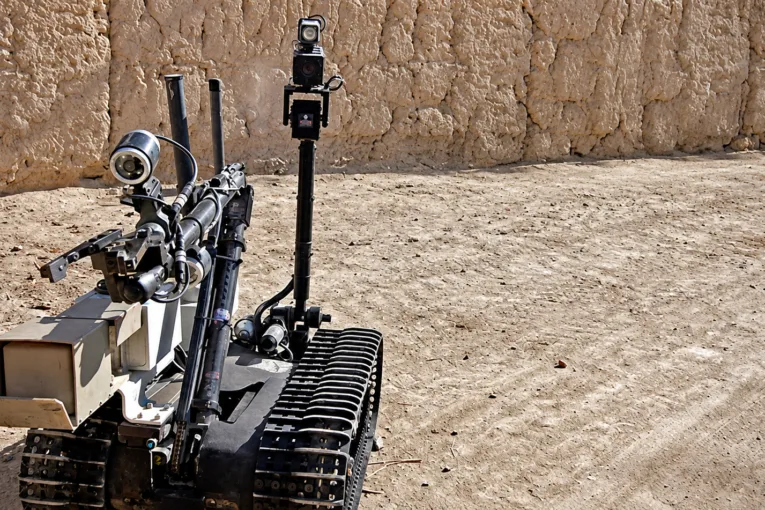
GENEVA — A growing number of countries are calling for international negotiations to regulate weapons capable of identifying and engaging targets with minimal or no human oversight, as recent United Nations discussions on lethal autonomous weapons systems concluded without a legally binding agreement, according to Human Rights Watch.
The talks concluded Sept. 4 after governments participating in the Convention on Certain Conventional Weapons (CCW) Group of Governmental Experts on Lethal Autonomous Weapons Systems worked on a proposed set of elements for a future international instrument.
Stop Killer Robots, as highlighted in the Human Rights Watch report, said 76 countries have now expressed support for moving toward negotiations, including 70 states that are parties to the CCW.
The proposed framework addresses weapons commonly referred to as “killer robots.” Human Rights Watch defines autonomous weapons systems as weapons that select and apply force to targets based on sensor processing rather than direct human input.
The technology differs from conventional remotely operated weapons because the system can perform portions of the targeting process independently.
The United Nations has been examining the development and use of autonomous weapons for more than a decade.
The discussions have focused on questions involving international humanitarian law, human control, accountability and the potential risks associated with allowing machines to make decisions involving the use of lethal force.
According to Human Rights Watch, the final report from the most recent group of experts includes several provisions that could provide a basis for future negotiations.
The report characterizes lethal autonomous weapons systems and states that human control and judgment are necessary to ensure that the use of such systems complies with international law. It also includes restrictions on systems that cannot comply with international humanitarian law.
However, the final document did not include all of the provisions supported during the negotiations. Human Rights Watch said the United States and Russia pushed for changes to language that had received broader support during the discussions.
Among the changes were the removal of references to the design and development of autonomous weapons and a narrower focus on international humanitarian law rather than international law more broadly.
Reuters reported before the conclusion of the talks that disagreements between countries had created uncertainty over whether governments would reach an agreement.
According to Reuters, the United States favored a nonbinding framework rather than a legally binding treaty and argued that existing international humanitarian law already provides a framework for regulating the conduct of warfare. Russia, India and Turkey supported a similar approach.
Other governments have advocated for a legally binding agreement. Reuters reported that countries including Brazil and Ireland, along with several African states, supported stronger international safeguards requiring meaningful human control over autonomous weapons.
The disagreement reflects a broader debate over how international law should address military technology that can operate with varying degrees of autonomy.
Supporters of stronger regulations have argued that humans should remain responsible for decisions involving the use of lethal force, while governments seeking less restrictive rules have emphasized the need to preserve flexibility for military applications.
The International Committee of the Red Cross (ICRC) has also called for international rules governing autonomous weapons.
The organization has warned that weapons capable of selecting and attacking targets without meaningful human intervention could create legal and humanitarian concerns because operators may not be able to adequately predict or control their effects.
The ICRC has previously called for new legally binding rules that would prohibit unpredictable autonomous weapons and weapons designed or used to target people without meaningful human control.
The organization has also supported restrictions on other autonomous weapons that create unacceptable risks to civilians or combatants.
The issue has gained additional attention as artificial intelligence and other technologies have become increasingly integrated into military systems.
Reuters reported that autonomous or semi-autonomous weapons have been used or developed in connection with conflicts, including those in Ukraine, Sudan and the Middle East.
Human Rights Watch and other organizations have argued that international rules should be established before technological developments make autonomous weapons more widespread.
Human Rights Watch previously cited a 2024 United Nations report in which Secretary-General António Guterres called for an international treaty addressing autonomous weapons by 2026.
The report recommended prohibiting weapons systems that operate without human control or oversight and cannot be used in compliance with international humanitarian law.
The recent talks did not establish a legally binding treaty. Instead, the conclusion of the expert discussions provides a basis for governments to consider whether to begin formal negotiations.
The next significant opportunity for countries to decide whether to advance negotiations will come during the CCW Review Conference in November.
The conference is expected to determine whether governments will establish a formal negotiating process for an international agreement on lethal autonomous weapons systems.
The outcome will depend on whether participating countries can reach consensus on the scope of potential restrictions and the level of human control required over autonomous weapons.
While most countries participating in the discussions have expressed support for moving toward negotiations, disagreements among major military powers could continue to affect the process.
For now, the conclusion of the expert talks represents another step in an international debate that has continued for more than a decade.
The growing number of countries supporting formal negotiations signals increased interest in establishing international rules, while differences over the scope and legal status of those rules remain unresolved.
To comment please go to one of these social media platforms:
Facebook: https://www.facebook.com/DavisVanguard
LinkedIn: https://www.linkedin.com/company/peoples-vanguard-of-davis-inc/
Instagram: https://www.instagram.com/davisvanguard/
X: https://x.com/davisvanguard
Bluesky: https://bsky.app/profile/vanguardnewsgroup.bsky.social
Subscribe to the Vanguard News letters. To make a tax-deductible donation, please visit davisvanguard.org/donate or give directly through ActBlue. Your support will ensure that the vital work of the Vanguard continues.
