
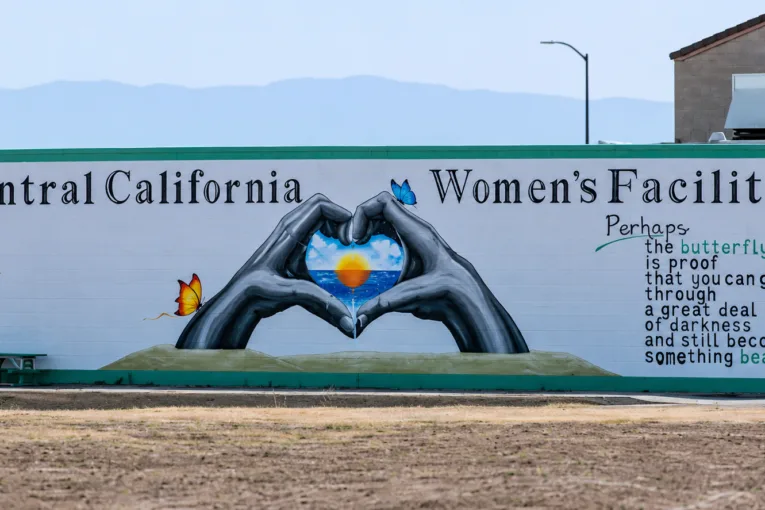
A new way to live in prisons across California was touted by CDCR. It was “the California Model.” It spoke across the board to many throughout Central California Women’s Facility (CCWF) as something wonderful. Bringing the implementation of programming that readies the population for freedom. Or so they said. There is a method to the madness and to understand the purpose is one thing, but to bring it to fruition is quite another.
The California Model professed itself to be the culmination of four pillars (Dynamic Security, Peer Mentorship, Normalization, and Trauma-Informed Organization) where such levels of rehabilitation could form and address the needs of residents full circle.
The pilot program as brought to Charlie (C) Yard. Building 511 was chosen as the “best” available building. It was said there would be overall access to more programming as well as safety and functionality of the Yard. The press came, interviews were given and then…crickets as to when the implementation would be accessible to all residents of CCWF.
There is more to come they said: “rushing into judging what has started takes away from the overall process,” also “it takes time to evaluate and shift when true change is happening,” and then there was, “there could be more access to positive programming once sponsors see that women need this ‘California Model’ perhaps even more so than men”, Oh, and let’s not forget the ever popular “there is a feeling that the women have been neglected and set to the side for so long which makes it hard to see that there is change happening.” That is what they said and more.
Can the change that sets CCWF apart from every other California prison evolve from this platform? Many hoped so.
This model was intended to bridge the gap between staff and residents. Helping the residents with their programming, rehabilitation, focusing on reentry and eventual integration back into society was the language heard throughout the CCWF grapevine. This chisme (gossip) many reverberated through the razor wires and beyond giving hope to a lot of people that we, the residents of CCWF, were to be accounted for and found worthy of TRUE programming efforts through CDCR.
Unfortunately, there was no depth in policy of how they wanted to integrate “California Model” standards into CCWF. For example, if an officer sits to play spades with residents and they are accused of touching someone’s hand, then this whole overfamiliarity policy comes into play. More clarification was needed from CDCR Sacramento. The Department Operations Manual (DOM) matrix for staff and standards for “California Model” contradicted one another. Looking to implement the four pillars (Dynamic Security, Normalization, Peer Mentorship, and becoming Trauma-Informed Organization) to encourage residents found no traction for most staff. Certainly, for some, this “California Model” remains an archetype, unfortunately for CCWF, one not yet ready to be realized except on paper…No, it is irrelevant.
While looking to our neighbors in the north bay, San Quentin Rehabilitation Center (SQRC), one can only imagine the possibilities making their way to CCWF. Their funding as massive. Their buildings revamped and colorful “rooms” were given space to allow single-celled incarcerated persons the ability to utilize their time wisely versus the overcrowded cells of CCWF, where time alone is unheard of. “These things take time” was said over and over, however, there was no concrete directives for the entirety of CCWF. Years passed and then, POOF, there is no longer a California Model to examine and behold. What happened? For this writer, this is just another example of how men will always have the upper hand…
To comment please go to one of these social media platforms:
Facebook: https://www.facebook.com/DavisVanguard
LinkedIn: https://www.linkedin.com/company/peoples-vanguard-of-davis-inc/
Instagram: https://www.instagram.com/davisvanguard/
X: https://x.com/davisvanguard
Bluesky: https://bsky.app/profile/vanguardnewsgroup.bsky.social
Subscribe to the Vanguard News letters. To make a tax-deductible donation, please visit davisvanguard.org/donate or give directly through ActBlue. Your support will ensure that the vital work of the Vanguard continues.
