
OAKLAND, Calif. — The Trump administration abandoned its lawsuit seeking to block the counting of thousands of California ballots after four consecutive court defeats and just days before a hearing that would have subjected its allegations of widespread noncitizen voting to judicial scrutiny, despite mounting evidence that its list of suspected ineligible voters included American citizens and thousands of names that could not even be matched to California’s voter rolls.
The Justice Department’s November 6 dismissal came after researchers at UCLA found that 42% of the 20,930 individuals identified by federal authorities as potentially ineligible voters did not appear on California’s current voter file, while dozens of others matched records belonging to confirmed U.S. citizens.
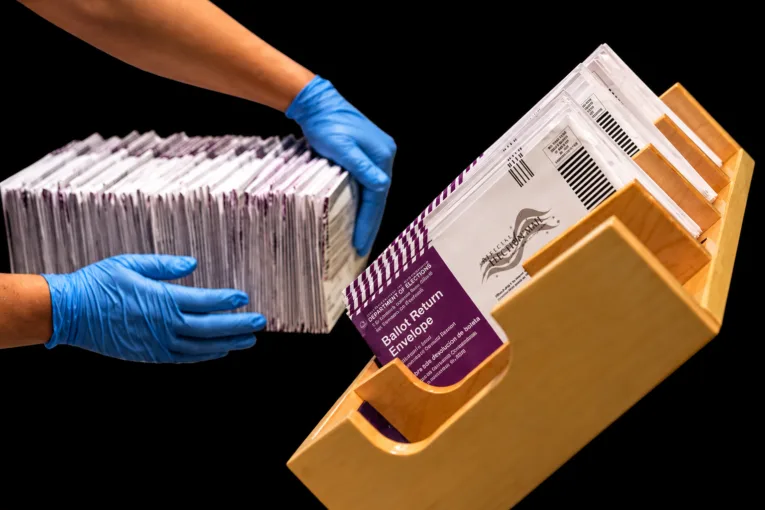
The findings raised questions about the reliability of the government’s allegations, which federal officials used to demand that California election officials segregate mail-in ballots during the November 3 election.
California Attorney General Rob Bonta accused the administration of dropping the case to avoid an evidentiary hearing scheduled for November 13 before U.S. District Judge David O. Carter.
“Next week, the Trump Administration would have faced tough questions in court about its list of suspected noncitizens. Rather than face that scrutiny, it chose to drop its case,” Bonta said in a November 6 statement.
“After four court defeats in just one week, including at the U.S. Supreme Court, the federal government has now thrown in the towel. California stood firm and prevailed, and the nationwide election results made clear that Americans overwhelmingly reject the Trump Administration’s anti-democratic agenda. California will always stand up for our democracy and the rule of law.”
The Justice Department’s notice of voluntary dismissal did not acknowledge inaccuracies in its evidence. Instead, federal prosecutors argued that the intervention they sought was no longer available because the disputed ballots would have been combined with other ballots before the scheduled hearing.
The filing stated that the government had exhausted its appeals through the Supreme Court but had been unable to secure an order requiring California to set aside the ballots before Election Day.
The administration maintained that separating the ballots was necessary to prevent potentially illegal votes from diluting those cast by eligible American citizens.
But the government’s claims had already encountered substantial challenges, including an independent analysis by researchers affiliated with UCLA’s Voting Rights Project.
In an October 31 federal court filing, UCLA researchers Matt Barreto and Michael Rios examined the 20,930 names supplied by federal authorities and found that 8,880, or approximately 42%, could not be located in California’s current voter registration database.
The researchers also identified at least 22 exact matches between the government’s suspected noncitizen list and records belonging to U.S. citizens associated with the Coalition for Humane Immigrant Rights, known as CHIRLA.
Another 66 citizen records were considered near-certain matches, while broader matching criteria identified hundreds of additional potential errors.
Using more expansive matching methods similar to those employed by federal investigators, the researchers identified 6,140 CHIRLA citizen records that could be flagged as probable matches to the government’s list.
The UCLA analysis also estimated that applying comparable matching methods to California’s approximately 3.8 million naturalized citizen voters could produce 3,743 certain incorrect matches and 7,486 highly likely incorrect matches, with considerably more potential errors under less stringent matching criteria.
Those statewide estimates were extrapolations rather than confirmed findings involving thousands of additional individuals on the original federal list.
Nevertheless, the analysis directly challenged the reliability of the methodology federal investigators used to identify supposedly ineligible voters.
The researchers’ findings also played a role in separate litigation brought by CHIRLA and California voter Pedro Trujillo against the Department of Homeland Security.
In a November 2 ruling, U.S. District Judge James E. Boasberg found that the administration’s lists were flawed and that the government’s demands threatened to interfere with eligible citizens’ voting rights.
Boasberg granted a preliminary injunction preventing federal officials from directing California election administrators to segregate ballots or depart from state election procedures based on the disputed lists.
The judge found that the plaintiffs had presented credible evidence that naturalized American citizens were being incorrectly identified as potentially ineligible voters.
The findings reinforced concerns raised by California election officials, who had questioned the federal government’s evidence from the beginning.
An earlier review conducted by the Los Angeles County Registrar-Recorder’s Office found that among a sample of 200 individuals flagged by federal authorities, 112 had canceled or inactive voter registrations.
Among individuals in that sample whose birthplaces were meaningfully recorded, 38.9% were identified as having been born in the United States, providing additional evidence that the government’s list contained potentially substantial errors.
Despite those problems, the Justice Department initially sought emergency court intervention requiring California to separate ballots associated with the individuals on its list.
The administration filed its lawsuit October 15, less than three weeks before Election Day, arguing that California officials had failed to cooperate with federal efforts to identify noncitizens who might be registered to vote.
Federal prosecutors claimed that approximately 20,000 individuals were highly likely to be noncitizens and that allowing their ballots to be counted without additional verification could undermine the integrity of the election.
California officials countered that the federal government had not established that the individuals were ineligible voters and that requiring election administrators to alter established procedures during an election risked disenfranchising lawful voters.
The federal government’s efforts were rejected repeatedly.
On October 26, the Ninth Circuit Court of Appeals dismissed the administration’s first emergency appeal after it attempted to bypass the district court.
On October 28, Carter denied the Justice Department’s request for a temporary restraining order.
Two days later, the Ninth Circuit rejected another emergency motion seeking an injunction pending appeal.
Finally, on November 2, the U.S. Supreme Court declined to intervene, leaving the lower court rulings in place.
The four defeats prevented the administration from forcing California election officials to separate ballots based on the government’s disputed list.
Carter subsequently scheduled a November 13 evidentiary hearing to examine the administration’s request for a preliminary injunction, including questions concerning the evidence supporting its allegations.
That proceeding would have offered an opportunity to scrutinize the methodology behind the list and evaluate the government’s claim that thousands of potentially ineligible voters had been identified.
Instead, the Justice Department filed a voluntary dismissal under Federal Rule of Civil Procedure 41(a)(1)(A)(i), ending the lawsuit without requiring a further ruling on the merits.
In its filing, the department argued that the requested relief had become unavailable because California would already have combined the challenged ballots with other ballots by the scheduled hearing.
The filing said the department was continuing to evaluate ways to address alleged noncitizen voting, but it did not provide additional evidence establishing the accuracy of the disputed list.
The dismissal does not constitute an admission by the Justice Department that its allegations were false. It does, however, leave the federal government’s central claims untested at the evidentiary hearing, following multiple judicial defeats and research documenting significant problems with its voter data.
Bonta characterized the lawsuit as an attempt to interfere with California’s election administration and prevent eligible voters from having their ballots counted.
The administration’s withdrawal also means that the scheduled November 13 hearing will not proceed in this case, leaving unresolved the federal government’s allegation that approximately 20,000 people on its list were potentially ineligible to vote.
To comment please go to one of these social media platforms:
Facebook: https://www.facebook.com/DavisVanguard
LinkedIn: https://www.linkedin.com/company/peoples-vanguard-of-davis-inc/
Instagram: https://www.instagram.com/davisvanguard/
X: https://x.com/davisvanguard
Bluesky: https://bsky.app/profile/vanguardnewsgroup.bsky.social
Subscribe to the Vanguard News letters. To make a tax-deductible donation, please visit davisvanguard.org/donate or give directly through ActBlue. Your support will ensure that the vital work of the Vanguard continues.
