
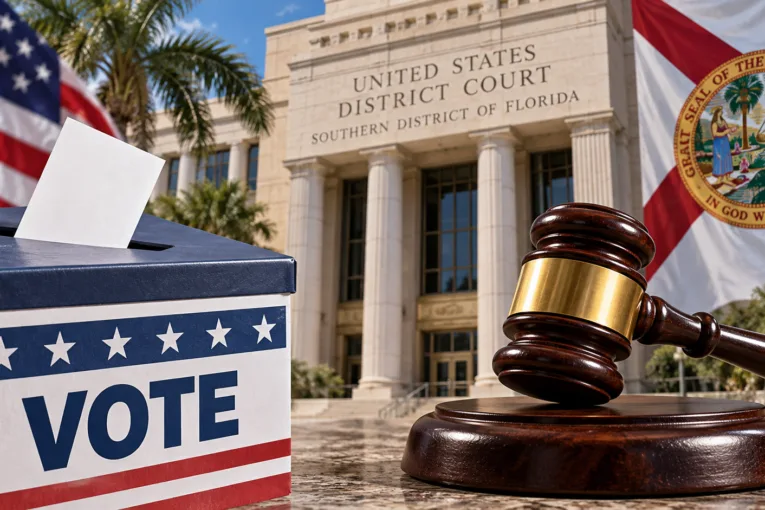
MIAMI, Fla. — A federal judge dismissed the prosecution of a Jamaican national accused of unlawfully voting in the 2020 presidential election, finding that the federal law used to prosecute her exceeded Congress’ constitutional authority to regulate elections.
Chelsea Cox, a Jamaican national residing in Florida, was charged in October 2025 with unlawfully voting in the 2020 presidential election. On Thursday, Oct. 1, U.S. District Judge David S. Leibowitz dismissed the federal case, finding that the law used to prosecute her exceeded Congress’ constitutional authority.
Cox was accused by prosecutors of casting an early ballot in Broward County on Oct. 29, 2020, according to Florida Politics. Cox was later charged Oct. 22, 2025, with a federal misdemeanor under 18 U.S.C. § 611 for voting as a noncitizen.
The case centered on whether Congress had the constitutional authority to criminalize noncitizen voting under federal law. U.S. District Judge Leibowitz ruled that Section 611 was unconstitutional as applied to her and dismissed the federal prosecution against Cox.
Leibowitz’s ruling did not establish a constitutional right for noncitizens to vote. Instead, the judge’s decision focused on the authority Congress has compared with the authority of states to determine voter qualifications.
Leibowitz characterized Section 611 as a voter qualification statute because the law determines who is eligible to vote in federal elections. He differentiated this from Congress’ authority to regulate the “Times, Places and Manner” of federal elections, as that power does not include independently deciding who may or may not vote.
Under the Constitution, Leibowitz reasoned that states have the primary authority to establish voter qualifications for congressional elections, subject to constitutional restrictions, including those established by the 14th, 15th, 19th, 24th and 26th Amendments.
The federal government argued that Congress could prohibit noncitizen voting through its authority to regulate federal elections. Leibowitz, however, concluded that Section 611 goes beyond regulating the administration of elections because it identifies a specific category of people who are not allowed to participate.
The difference between regulating elections and determining voter qualifications became central to the case.
Rather than establishing rules concerning how an election is conducted, Section 611 establishes who may participate based on citizenship status. Leibowitz therefore concluded that Congress exceeded its constitutional authority by enacting the statute.
This ruling does not prevent Florida from prohibiting noncitizens from voting under state law. Florida still retains the authority to establish its own voter qualifications and enforce its election laws.
The issue before the court and U.S. District Judge Leibowitz was instead whether Cox could be prosecuted by the federal government under Section 611. The judge concluded that the federal prosecution could not stand because the statute was unconstitutional as applied to Cox.
Florida Politics reported that the ruling was limited to Cox’s case. Leibowitz did not invalidate Section 611 in every possible application, meaning the decision does not necessarily prevent the federal government from relying on the statute in other circumstances.
The decision also comes from a federal district court, meaning it does not bind other district courts or the 11th U.S. Circuit Court of Appeals.
The ruling could have implications beyond Cox’s individual prosecution because it challenges the federal government’s authority to use Section 611 to prosecute noncitizens accused of voting in federal elections.
The decision does not prevent states from restricting noncitizen voting. However, it raises questions about whether the federal government can impose its own criminal penalties for conduct that states have the authority to regulate.
This case also highlights the division of power between the federal government and the states when it comes to elections.
Leibowitz’s reasoning differentiated Congress’ ability to regulate how federal elections are conducted from the states’ authority to determine who is qualified to vote.
This division of constitutional authority was central to the judge’s decision to dismiss the federal prosecution against Cox.
To comment please go to one of these social media platforms:
Facebook: https://www.facebook.com/DavisVanguard
LinkedIn: https://www.linkedin.com/company/peoples-vanguard-of-davis-inc/
Instagram: https://www.instagram.com/davisvanguard/
X: https://x.com/davisvanguard
Bluesky: https://bsky.app/profile/vanguardnewsgroup.bsky.social
Subscribe to the Vanguard News letters. To make a tax-deductible donation, please visit davisvanguard.org/donate or give directly through ActBlue. Your support will ensure that the vital work of the Vanguard continues.
