
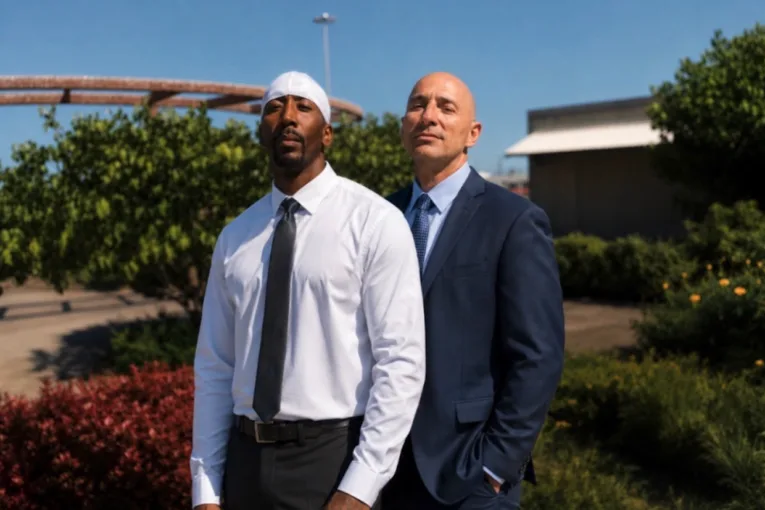
Advertised upon our housing unit wall as a “Day of Dignity” event, we had no idea what to expect when signing up to participate. Usually, events convened in prison espousing dignity center the plight of crime victims; thus, because the opportunity to make direct amends from confinement is so rare, we lean into any program that sounds like it might avail that opportunity. However, as soon as we entered our prison’s gymnasium for the first portion of the program, we could tell this was something altogether different.
I looked across the gym and made quick eye contact with Big Ant, a 300-pound dude from Watts with arms as thick as his thighs. He was grimacing uncomfortably as a thin man knelt before him and held a tape measure near his groin. Though he’d been to a dozen funerals before being expelled from middle school, Ant had never been measured for a suit.
“We wore hand me downs from the homies for church, weddings and funerals, so this was new for me. Took a minute to relax with dude’s hand being that close to me—I was low key tripping!”
We were greeted by formerly incarcerated people working for Preparing for Life Outside the Walls (PLOW)—the nonprofit organization running the event—who ushered into different lines according to our relative height, and asked about our two favorite colors. A pamphlet described how PLOW delivers curricula and services to long term residents of the carceral state which aim to prepare folks for societal reentry; the Day of Dignity event was framed as being something intended to celebrate our dignity.
Watching guys read the brochure, and then look around strangely—seemingly unsure of themselves—affirmed a sad truth that gargoyles the prison landscape: captives don’t reflexively relate to dignity.
“We spend so much time in prison demanding respect,” Ant noted, “we forget we was born with it.”
After moving through the tailor lines, we took our seats within discussion circles which on-boarded for us the teachings of the PLOW curriculum, a 16-week peer-facilitated program for long term residents introducing trauma reconciliation, empathy development, emotional intelligence, rigorous accountability and relapse prevention strategies. After spending the day learning how to facilitate the PLOW modality to prepare captives for parole suitability hearings, resentencing petitions and commutation filings, we were invited to become PLOW ambassadors, establish safe spaces around the curriculum where we are housed, and build out communities of care that allow us to teach each other how to become more accountable for the harms we author.
Our measurements were taken for a custom-tailored suit jacket, pants, collar shirt, and dress shoes combination, colorized to our specification, which PLOW presented to us a month later, when their team returned. On that day, we shed our state issue, climbed into our new wardrobes, spent the day dressed that way, took photos with each other and presented our respective PLOW modules in-the-round, demonstrating our facilitation skills before our peers.
“It felt like doing a TED Talk,” noted Matt Fletcher, a Peer Health Educator serving LWOP. “It was more than merely humanizing or just cool to embody fine clothes and move in space for several hours. It was actually profoundly liberating and nourishing, on an emotional level that is hard to convey, to no longer feel uniformed or othered by all that prison takes. It reminded me of who I can be—who I am. Human.”
Introduced within the PLOW curriculum as a necessary element of ethical, moral and social transformation, Freedom Dreaming—an abolitionist praxis rooted in the identification of social problems, the embodiment of relational possibility, and the mobilization of bottom-up community activism to solve those problems—is a solutions-oriented skill grounded in radical hope.
“There is no substitute for what comes from the in-the-room accountability PLOW will confront, deconstruct and nurture you with,” said Brian Porter, who was sentenced to LWOP for a Bakersfield carjacking at the age of 18, completed the pilot version of the PLOW curriculum at Valley State Prison, had his sentence commuted by Governor Newsom, and was recently found suitable by California’s parole authority. He described both Prepared (authored by Samir Mustapha Wahid & Keith Starks), and PLOW as the “critical ingredients” of his accountability process.
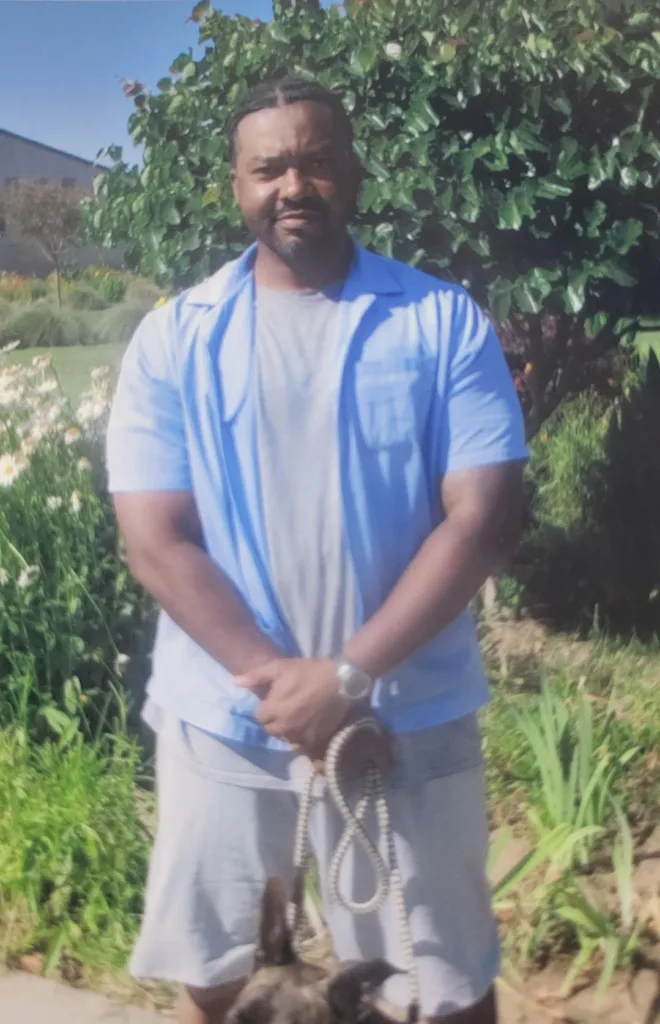
“The only other pen in California to permit residents to dress in street clothing—which permitted incarcerated fathers to dress out in order to celebrate an event with their daughters—has been San Quentin, a higher security facility than ours,” noted Leon, a lifer from Oakland. “But they make folks wear state issue on stage when the TED Talk cameras come around. They refuse to let us be seen as anything close to human, professional, or capable of societal integration. Forget normalization—there’s nothing normal about prison—I’m talking about being human. This was a revolutionary moment for people, and it needs to be done across the country, so folks inside can reclaim their futures, feel valued, and visualize what freedom offers.”
Dominick went for what some called a black-on-white Men In Black look, with black shoes. He described his look as “a salute to Malcolm X, period point blank.”
Ghost, who admitted that he chose what he “would want to wear on the daily if I could,” opted for a dark-light contrast of blue, anchored by brown shoes.
PLOW, which has been running its flagship curriculum at VSP in collaboration with the Carceral Studies Journalism Guild and the Justice For Everybody Movement at Yale University, intends to democratize its self-help suitability curriculum online and make it available to more than 1M captive Edovo app users as an on-demand digital PDF within the forthcoming Inside Knowledge channel.
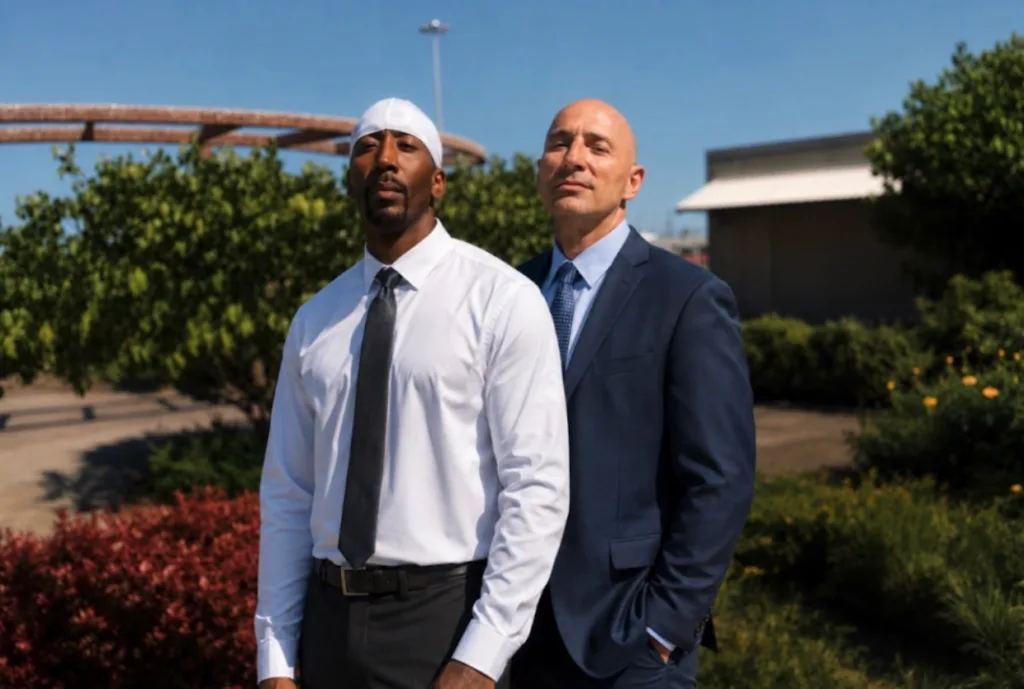
PLOW plans to travel formerly incarcerated PLOW ambassadors to prisons around the country to introduce the PLOW program and train residents to become in-community group facilitators. With more than 90% of the people we send to prison set to return to the community, prisons must be pushed to reinforce the reentry process with freedom-affirming opportunities that best prepare captives for the transition to freedom. PLOW is sure to position itself where those in the margin can access what it avails.
As for the hours spent amongst our peers wearing new threads, walking with new-found energy, and embodying a version of self some could never have imagined (or remembered), because the men in that gym got to observe each other in a different way—really see one another in that ‘as if’ mode of being—we each got to receive affirmation from those who saw us anew. Because uniforms flatten people into sameness, mute individuality and homogenize difference, moving through the space as if free was more than taking a seat within the theater of one’s mind, or a momentary catharsis; the biofeedback flooded our systems, imprinted upon us what we know we are destined for, and immortalized our futurity in photos they can never disappear from memory.
They called it a Day of Dignity, but what that experience taught us has endured. For six hours, while the captives were dressed with the liberatory individuality of a freedom otherwise denied, it was the violence workers who had become flattened, muted and homogenized by their custody uniforms. That hollow feeling born of seeing them the way they must see us—uniformed—has lingered. We think about our captive brothers and sisters in Connecticut who still cannot take a photo with their loved ones when they visit.
We shouldn’t have to virtually reunite captives with the families they can visit, but are prohibited from taking photos with, by resorting to the use of AI to insert their solo prison selfies into the free world family gatherings they cannot physically attend. The dignity proclaimed by one’s wardrobe, and preserved by photography, defies the logic of family separation and resists the dehumanizing statist aim of captive erasure. Preparing for a life beyond the wall requires the freedom to imagine, and embody the version of self prison is designed to thwart.

