
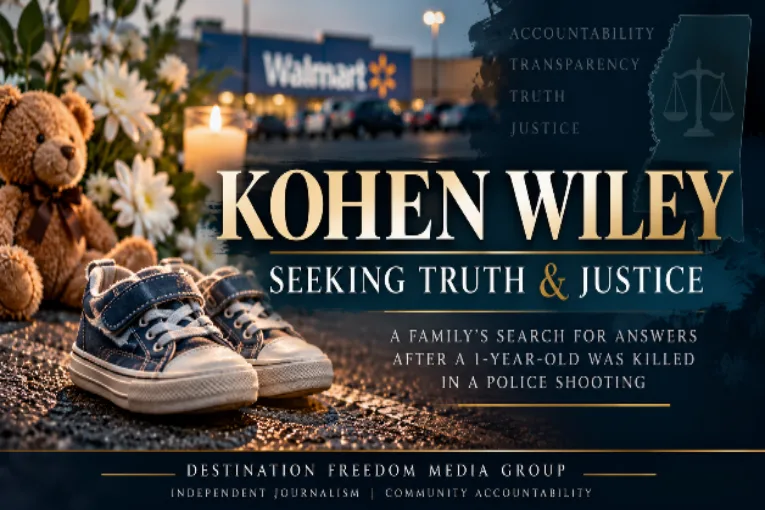
Destination Freedom Media Group Calls for Transparency and an Independent Examination of the Evidence
By: Destination Freedom Media Group | Malik & Gale Washington | October 27, 2026
On June 14, 2026, one-year-old Kohen Wiley was shot and killed by a police officer in a Walmart parking lot in Senatobia, Mississippi. An encounter involving allegations about diapers and baby clothing ended with a child dead, the driver wounded, and a family searching for answers.
On October 19, Mississippi Attorney General Lynn Fitch’s office announced that the officer’s use of force was justified. The state would not pursue criminal charges against the officer. That announcement came four months after Kohen’s death.
But the announcement leaves a fundamental question that deserves a complete, evidence-based answer: What circumstances made firing into an occupied vehicle necessary, and could the death of this one-year-old child have been prevented?
Destination Freedom Media Group calls for an independent, evidence-based examination of the investigative record, including the recordings and report released by the state after its charging announcement.
We intend to examine the facts before drawing conclusions.
What Happened on June 14?
The initial state account described a response to suspected shoplifting. Later reporting on the released MBI incident report establishes an important distinction: Senatobia officers and Tate County deputies were already at Walmart over an unrelated allegation that a man was sexually harassing customers. A store employee then alerted them to two women running from the store. The reported theft allegation involved diapers and baby clothing; it remains an allegation, not an adjudicated finding.
Kohen was in the front passenger seat in the arms of his mother, Vellesiya Wiley. Latoya Ferrell was driving. Officers pursued them into the parking lot and ordered the car to stop. Police said the vehicle moved toward officers; the released recordings show forward movement toward officers after the car reversed into another parked vehicle.
Senatobia Sgt. Hunter Foster opened fire. Kohen was fatally wounded, and Ferrell was injured.
Kohen’s mother has disputed aspects of the official account, including the circumstances surrounding the shooting. The family’s attorney, civil rights lawyer Ben Crump, has questioned whether the officer faced an immediate threat that justified firing into the vehicle.
The Associated Press reported on October 23 that neither woman had been charged, according to state and county court records. Action News 5 reported the next day that Tate County officials were considering whether to bring charges. A lack of charges does not establish whether theft occurred.
The suspected shoplifting allegation provides the context for the police encounter. It does not, by itself, establish a justification for deadly force. The state’s justification concerns the alleged danger posed by the vehicle.
That distinction is essential to understanding the case.
The Attorney General’s Decision
On October 19, the Attorney General’s Office announced that, after an MBI investigation, it had found “the use of force was justified.” The statement cited Mississippi Code Section 45-1-6.
The public announcement, as reproduced in contemporaneous reporting, did not provide a detailed reconstruction of the officer’s position, the sequence of shots, or the legal analysis supporting the decision. The subsequent release of video and a redacted incident report is significant progress, but it is not itself a shot-by-shot explanation of the finding.
The decision not to prosecute is significant. But it does not eliminate legitimate questions about the police response, departmental policy, the availability of alternatives, or the circumstances that led to Kohen’s death.
A criminal charging decision and a determination that police tactics were appropriate are not necessarily the same thing. Nor does a decision not to bring state criminal charges establish that no possible civil liability exists. Any civil claim would require its own legal and factual analysis, including applicable defenses; this article does not decide that question.
What Newly Reported Video Shows
On October 20, news organizations analyzed an initial compilation of body-camera and surveillance clips. That version did not include the shooting officer’s body-camera perspective. On October 22, the state released additional footage, including Foster’s body-camera recording, and a redacted incident report. The Fuller release broadens the evidence now available for examination.
The early video analysis showed the sedan reversing into a parked SUV as officers approached. Officers surrounded the car. It then accelerated forward and turned left, appearing to travel toward at least one officer before passing between officers. Later AP reporting describes Foster stepping toward the vehicle, appearing to put his hands on its hood, and moving out of the way as he fired. ABC News described shots toward the front of the car and its front passenger side.
Those observations support a serious examination of the danger posed by the moving car; they do not support implying that the vehicle never moved toward police. Foster’s attorney, Martin Zummach, maintains that his client faced the vehicle coming toward him and had no choice but to fire.
The footage is important because it provides evidence beyond the initial statements from law enforcement and witnesses. It must be examined carefully and in its full context.
The recordings also raise questions that a compilation or a single camera cannot settle. The public accounts differ in how they describe contact or near-contact with officers, and the footage does not by itself identify which projectile killed Kohen. Camera motion, viewing angle, occupant movement, and the location of other officers must be considered together.
That limitation matters.
The inquiry must consider the nature and immediacy of any danger when force was used, without artificially excluding relevant events leading to it. In Barnes v. Felix, the Supreme Court rejected a rule restricting Fourth Amendment review to the final “moment of threat.” Graham v. Connor also requires the perspective of a reasonable officer at the scene, allowing for tense, rapidly evolving circumstances rather than judging solely with hindsight.
The available footage should be evaluated alongside the complete recordings, forensic evidence, officer statements, and applicable use-of-force policies.
The autopsy adds evidence—not a complete reconstruction. Reporting on the family-commissioned preliminary review by forensic pathologist Dr. Roger Mitchell describes a bullet entering the right side of Kohen’s torso and exiting the left, with injuries interpreted as consistent with intervening glass. Crump argues this supports a shot through the passenger-side window. AP also reported that the pathologist lacked complete information. The wound path and vehicle damage should be tested against the full recordings and forensic record, not treated alone as proof of the officer’s position or of unlawfulness.
A shot from the side matters, but it is not automatically unlawful. A moving car can threaten another officer or bystander even after passing one officer. Conversely, an earlier danger cannot substitute for examining whether the threat continued during the firing sequence. In Plumhoff v. Rickard, a very different dangerous-pursuit case, the Supreme Court allowed continued justified fire until the threat ended. Neither that decision nor Barnes resolves what happened here.
The Questions That Must Be Answered
A thorough review should establish where each officer stood, how the vehicle moved, when the shots were fired, and what the involved officer could reasonably perceive.
It should also examine the complete Senatobia Police Department policy in force on June 14. FOX13 reported obtaining a city-supplied use-of-force policy warning that bullets may not stop a moving vehicle and could endanger others. That is a concrete reason to examine the response, not proof that Foster violated policy: the full text, exceptions, operative date and training records must be verified.
Other questions concern the investigative process itself.
Were all relevant witnesses interviewed? Were all available recordings reviewed? What did the ballistic and forensic evidence establish? What written analysis supports the attorney general’s conclusion? These are not abstract concerns: Mississippi Today reported on October 19 that Kohen’s mother and several witnesses said they had not been interviewed as recently as that month. Those statements warrant checking against interview logs and the investigative file; they do not establish what investigators ultimately did or did not consider.
The answers cannot be supplied by assumptions, social media commentary, or incomplete video excerpts.
They must come from evidence.
The Records Still Needed for a Full Accounting
The release of footage is an important step toward public scrutiny. The remaining task is to determine what the released material establishes and what additional releasable records are needed to evaluate the decision.
That examination should include the incident report; an inventory of recordings, their provenance and any redactions or gaps; dispatch communications; the final MBI findings; scene measurements; vehicle examination and ballistic records; relevant autopsy materials handled with the family’s dignity in mind; officer and witness statements; and the applicable policy and training records. Seeking these materials does not mean each has been confirmed to exist or is legally subject to disclosure.
Mississippi’s Public Records Act makes an important distinction: incident reports are public, while investigative reports held by law-enforcement agencies are generally exempt, although agencies may release them in their discretion. Where applicable, nonexempt portions must be separated from exempt material, and a written denial must identify the specific exemption relied upon. Closing an investigation does not automatically make every underlying record public.
We seek all nonexempt records and urge discretionary disclosure of additional material wherever lawful, with justified privacy and safety protections. A gap in public access is a reason to ask a precise question—not evidence, by itself, of a cover-up.
We will distinguish what the records establish from allegations, disputed accounts, and questions that remain unresolved.
Equal Justice Requires More Than an Announcement
Kohen Wiley was a Black child. Foster is white. Those facts do not independently establish racial motivation, but documented reporting makes questions about institutional impartiality more than an exercise in inference from race alone.
Mississippi Today reviewed an internal complaint alleging that Foster directed a racially offensive remark at a Black coworker two days before the shooting. A separate investigation by Mississippi Today, Verite News and The New York Times documented racist text messages attributed to then-chief Harold Vanderford. Subsequent reporting confirms Vanderford was fired in September.
A complaint establishes that an allegation was made; it is not an adjudicated finding. A chief’s messages are not proof of another officer’s motive. The records nonetheless justify scrutiny of complaint handling, supervision and impartiality. None of the reporting cited here establishes that racial animus caused the shooting.
Law enforcement has a responsibility to protect the public and to exercise its authority with restraint, professionalism, and impartiality.
No family should have to wonder whether their loved one’s death received less attention because of the color of their skin.
Foster’s departure does not answer those questions. Senatobia Mayor Greg Graves confirmed his resignation on October 23. Reuters reported that his lawyer described the resignation as being for the good of the city and department and to permit healing. Resignation is neither a finding of wrongdoing nor a substitute for review. The family’s lawyers have called for federal investigation and decertification; a request is not proof that either process has begun or reached a conclusion.
A Child’s Death Demands a Full Accounting
Nothing about this case should be reduced to a bag of diapers.
The suspected theft was the allegation that prompted the pursuit into the parking lot. The loss of Kohen’s life was the outcome of the encounter.
Those are profoundly different matters, and understanding how one led to the other is essential.
Destination Freedom Media Group is not declaring the officer criminally responsible, nor are we accepting the state’s justification without examining its evidentiary foundation.
We are asking for the complete record.
Kohen Wiley was one year old. His family deserves a clear accounting of the circumstances surrounding his death, and the public deserves sufficient transparency to evaluate the state’s decision.
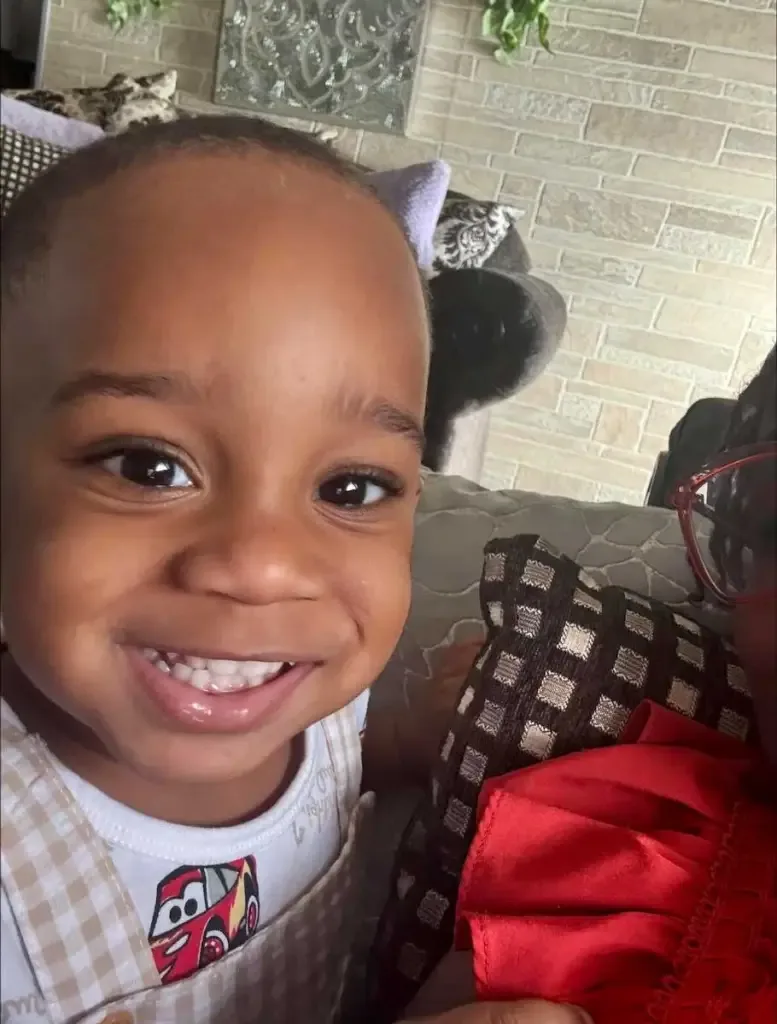
Community members plan to gather on June 16, 2026, to protest the June 14 killing of 1-year-old Kohen Wiley. Photo courtesy Kohen Wiley family
Seeking the truth is not prejudging the outcome. It is insisting that the outcome be supported by evidence.
Destination Freedom Media Group will continue examining available reporting, seeking original documents, and distinguishing official findings, corroborated facts, allegations and unresolved questions. Our position is that a child’s death requires a full accounting—not that the evidence can be selected to predetermine its outcome.
REMEMBER HIS NAME. SEEK THE TRUTH. DEMAND ACCOUNTABILITY.
In remembrance of Kohen Wiley, whose life ended before his second birthday, we share this song as a reflection on the immeasurable grief of losing a child.
Malik Washington is an investigative journalist, U.S. Army veteran, and CEO of Destination Freedom Media Group, which he co-founded with Gale Washington. Destination Freedom Media Group, an independent nonprofit newsroom dedicated to accountability reporting at the intersection of civil rights, public integrity, disability justice, structural accountability within American institutions, and community survival.
He previously served as Editor-in-Chief of the San Francisco Bay View National Black Newspaper (2020–2021) and has been a published journalist for over 14 years.
With journalist Maura Corkery, he is co-author of The Unquiet Resignation, an investigative series on the San Francisco Unified School District produced in partnership with The Davis Vanguard.
His “Price of Being Poor” series — also produced in partnership with The Davis Vanguard — is the most sustained recent accounting of privatized public housing in San Francisco documenting the conditions at Alice Griffith Apartments that culminated in San Francisco’s first-of-its-kind code-enforcement settlement of August 26, 2026.
His work focuses on government power, criminal justice, environmental justice, and the human consequences of policy decisions too often insulated from public scrutiny. Washington’s reporting amplifies the voices of impacted communities while insisting on documentary evidence, transparency, and the unvarnished truth—especially when institutions demand silence.
His work appears on platforms such as Muck Rack, examining the intersection of justice, governance, and community.
You can reach him via email: mwashington2059@gmail.com or call him at (719) 715-9592.
Suggestions or leads on stories are always welcome.
Please follow us on:
Facebook: https://www.facebook.com/destfreedom13
Instagram: https://www.instagram.com/destinationfreedom13/
X: https://x.com/dest_freedom
To comment please go to one of these social media platforms:
Facebook: https://www.facebook.com/DavisVanguard
LinkedIn: https://www.linkedin.com/company/peoples-vanguard-of-davis-inc/
Instagram: https://www.instagram.com/davisvanguard/
X: https://x.com/davisvanguard
Bluesky: https://bsky.app/profile/vanguardnewsgroup.bsky.social
Subscribe to the Vanguard News letters. To make a tax-deductible donation, please visit davisvanguard.org/donate or give directly through ActBlue. Your support will ensure that the vital work of the Vanguard continues.
