
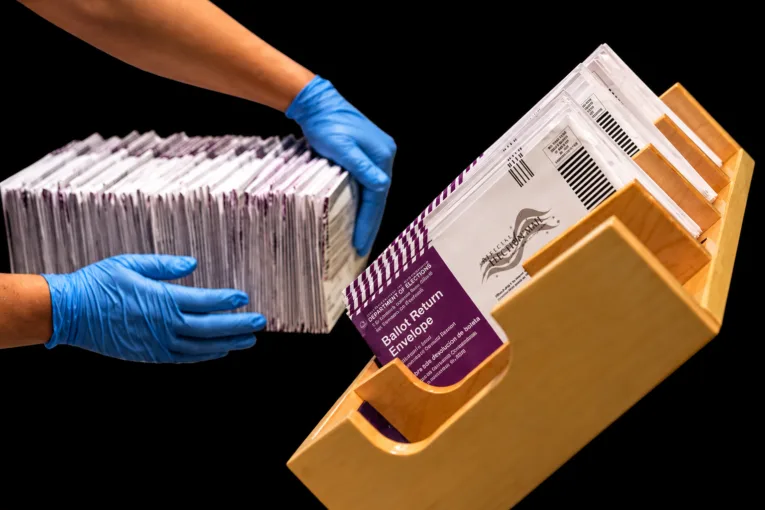
OAKLAND, Calif. — A federal appeals court on Monday dismissed the Trump administration’s emergency appeal seeking to prevent California from counting mail-in ballots associated with approximately 20,000 people federal officials identified as likely noncitizens, ruling that the administration had created much of its own emergency by delaying legal action and demanding an immediate judicial response.
In an Oct. 26 decision in United States v. California, the U.S. Court of Appeals for the Ninth Circuit ruled 2-1 that it lacked jurisdiction because the administration had not given the district court sufficient time to consider its request for a temporary restraining order.
The ruling leaves the underlying lawsuit unresolved, but two judges wrote separately to question the administration’s evidence and warn that the proposed intervention could disrupt an election already underway.
The federal government sought an injunction requiring California officials to set aside mail-in ballots associated with individuals it identified as likely noncitizens and verify their citizenship before counting their votes.
The administration argued that California’s refusal to take those steps violated federal laws prohibiting noncitizens from voting in federal elections.
According to the Ninth Circuit’s opinion, U.S. Citizenship and Immigration Services and Homeland Security Investigations began reviewing California voter registration records during the summer, cross-referencing voter information with immigration databases and third-party sources.
Federal officials initially contacted California in July, claiming that thousands of potentially ineligible individuals appeared on the state’s voter rolls.
California officials questioned the findings and requested additional information about the methods used to identify suspected noncitizens.
On Oct. 13, after California had begun mailing ballots for the November election, federal officials provided a list of more than 20,000 individuals they believed were likely noncitizens.
The administration demanded that California review the list within 48 hours and verify the individuals’ citizenship.
California declined, maintaining that existing state election laws prohibit noncitizen voting and establish procedures for determining voter eligibility.
The federal government filed suit Oct. 15, alleging that California officials were facilitating unlawful voting by refusing to act on the information provided.
California challenged both the government’s legal arguments and the reliability of its evidence.
In an Oct. 24 opposition filing, state attorneys argued that federal officials relied on an outdated voter registration database and an inadequately explained process for matching voter information with immigration records.
The state said the federal government’s review began with what appeared to be an August 2025 voter roster and incorporated information from an unspecified third-party analytical platform.
California also questioned how federal officials assigned confidence levels to potential matches and whether the process adequately distinguished citizens from noncitizens.
According to the state’s filing, only 7,035 of the approximately 20,000 names supplied by federal officials had Los Angeles County addresses.
A preliminary sample found that 42.9% had canceled registrations, while 38.9% had records indicating a U.S. birthplace.
The state argued that those discrepancies undermined the government’s assertion that its list reliably identified noncitizens registered to vote.
California also warned that requiring election officials to segregate ballots during an ongoing election could interfere with established procedures and potentially disenfranchise eligible voters.
The administration nevertheless sought emergency judicial intervention.
On Oct. 21, federal attorneys filed an application for a temporary restraining order in the U.S. District Court for the Central District of California.
Although the district court scheduled a hearing for Oct. 27, the administration demanded a ruling by noon Oct. 22.
When the district court did not rule within that period, the administration appealed to the Ninth Circuit, arguing that the delay amounted to a constructive denial of its request.
The appeals court rejected that argument, emphasizing that the district judge had been given approximately 15 hours, including only three business hours, to consider the government’s application.
“The United States’s claimed emergency, at least in part, is a self-constructed one,” the court stated.
The majority found that the administration had contributed to the urgency by waiting months after initially raising concerns about voter eligibility before filing suit.
The judges also noted that the district court had scheduled a hearing before Election Day and that ordinary appellate review would remain available after the lower court ruled.
The court dismissed the appeal for lack of jurisdiction and denied the administration’s emergency motion as moot.
Judge Mark Bennett, who joined the jurisdictional ruling, wrote separately that he would have denied the administration’s emergency request even if the appeals court had jurisdiction.
Bennett questioned the sufficiency of the government’s evidence and expressed concern about the potential consequences of interfering with California’s election procedures shortly before Election Day.
Judge Gabriel Sanchez also wrote separately, emphasizing the dangers of judicial intervention that could disrupt election administration and affect eligible voters.
Both judges raised concerns consistent with the principle established in Purcell v. Gonzalez, which cautions federal courts against changing election procedures close to an election because of the potential for voter confusion and administrative disruption.
Judge Patrick Bumatay dissented, arguing that the appeals court had jurisdiction to consider the administration’s emergency request.
Bumatay maintained that the federal government had a legitimate interest in preventing noncitizens from voting and that delaying intervention could make it impossible to identify and separate ballots once they were processed.
The disagreement highlighted the competing legal arguments concerning federal election enforcement authority, the protection of eligible voters and the limits of emergency judicial intervention.
California Attorney General Rob Bonta welcomed the decision, arguing that the administration had failed to establish a sufficient legal basis for overriding California’s election procedures.
“The U.S. Constitution gives states and Congress — not the President or the Executive Branch — the power to determine the time, place, and manner of elections,” Bonta said in an Oct. 26 statement.
Bonta said the ruling represented an important step toward protecting voting rights and California’s authority to administer elections.
The attorney general’s office also pointed to additional discrepancies identified in local reviews of the federal government’s voter lists.
According to the office, a preliminary review of 200 names by Los Angeles County election officials found that more than half involved canceled or inactive registrations, 38.9% of individuals with recorded birthplaces were born in the United States, and 71.2% had no voting history.
The office also reported that Mendocino County election officials found that every individual on a list supplied by the federal government lived outside the county.
Those findings raised additional questions about the reliability of the administration’s identification process, although the court did not resolve the factual dispute over voter eligibility.
The Ninth Circuit’s decision does not determine whether California violated federal election laws or whether the individuals identified by federal officials are eligible to vote.
Instead, the ruling establishes that the administration could not bypass the district court by demanding an immediate decision and treating the absence of a ruling as grounds for emergency appellate intervention.
The underlying lawsuit remains before U.S. District Judge David O. Carter, with a hearing scheduled for Oct. 27, one week before the November election.
To comment please go to one of these social media platforms:
Facebook: https://www.facebook.com/DavisVanguard
LinkedIn: https://www.linkedin.com/company/peoples-vanguard-of-davis-inc/
Instagram: https://www.instagram.com/davisvanguard/
X: https://x.com/davisvanguard
Bluesky: https://bsky.app/profile/vanguardnewsgroup.bsky.social
Subscribe to the Vanguard News letters. To make a tax-deductible donation, please visit davisvanguard.org/donate or give directly through ActBlue. Your support will ensure that the vital work of the Vanguard continues.
