
SANTA BARBARA, Calif. — As tens of thousands of young people prepare to disconnect from social media in November, the founder of a growing international movement says the goal is not simply to persuade people to put down their phones, but to challenge an industry built around capturing their attention and keeping them online.
Maddie Freeman, founder and executive director of the NoSo Connection Collective, told the Vanguard in an interview that the annual No Social Media November campaign offers participants an opportunity to reconsider their dependence on digital platforms while sending a message to technology companies about the consequences of addictive design.
The movement, which began as a local challenge in Colorado seven years ago, attracted approximately 30,000 participants last year. Freeman said organizers hope to match or exceed that number in 2026, with participation extending across 40 states and 33 countries.
The campaign encourages participants to temporarily leave social media for one day, one week or the entire month of November.
Freeman said the idea emerged from her own experiences growing up with social media and recognizing its effects on her mental health.
“When I got on social media, I was 12 years old and I spent pretty much six years, seven years straight just spending over 10 hours a day on my phone,” Freeman said.
She founded the movement at 19 after struggling to break her own attachment to platforms designed to encourage constant engagement.
“I’ve been addicted to nicotine before and I just feel like nothing compares to social media,” she said.
Freeman argues that the problem extends beyond individual habits to the economic incentives driving the technology industry.
“I think it’s really, we know that it’s designed to be addictive intentionally because that’s the profit model that big tech uses, is serving ads and trying to make your feed as addictive as possible so that you’ll spend as much time as possible to see those ads,” she said.
Features such as infinite scrolling, notifications and social rewards encourage users to repeatedly check their devices, she explained, often turning a few intended minutes online into hours.
The resulting behavior can be difficult to interrupt.
“Within the first few days I said it feels like a withdrawal and a lot of people tell us that,” Freeman said.
Participants frequently describe instinctively reaching for their phones or opening applications they have already deleted.
Freeman said those experiences reveal how deeply social media has become embedded in everyday routines.
The campaign attempts to make that transition easier by encouraging participants to arrange alternative ways of communicating, plan activities with friends and rediscover interests that do not involve screens.
Through NoSoNovember.org, participants can sign a free pledge and receive resources throughout the month.
The organization also works with schools that use its educational materials to encourage students to participate together.
Freeman said the goal is to prevent the isolation that can accompany abruptly abandoning platforms that have become central to social interaction.
The movement has also gathered information from participants suggesting that the effects of temporarily disconnecting can extend beyond November.
According to Freeman, approximately 60% of participants who respond to the organization’s surveys extend their break beyond the initial challenge.
Some ultimately abandon individual platforms altogether.
“Through this experience, like I shared before, I was really addicted to social media and it took a lot of tries for me to finally get to the point where I realized, okay, this just isn’t serving me and I’m going to get off of these platforms,” she said.
Freeman reported that the organization’s before-and-after surveys found a 32% decline in anxiety symptoms and a 25% decline in depressive symptoms among respondents.
Those figures are self-reported organizational findings, rather than results from a controlled clinical trial, but independent research provides some support for the potential mental health benefits of reducing social media use.
A 2025 study published in JAMA Network Open examined young adults ages 18 to 24 who participated in an optional one-week social media detox.
Researchers found that participants experienced a 16.1% reduction in anxiety symptoms, a 24.8% reduction in depression symptoms and a 14.5% reduction in insomnia symptoms.
The researchers cautioned that the study did not establish whether the improvements would persist over time and that more research was needed to understand the effects across different populations.
A separate randomized controlled trial published in 2022 also found improvements in well-being, depression and anxiety among participants who took a one-week break from social media.
Freeman acknowledged that the broader research on social media and mental health remains contested, particularly when attempting to distinguish the effects of platform use from other factors influencing young people’s well-being.
Nevertheless, she argued that the evidence increasingly raises questions about the responsibility of technology companies to protect vulnerable users.
She pointed to internal research disclosed by former Facebook employee Frances Haugen and other whistleblowers, which raised concerns about the effects of social media on teenagers, particularly girls.
Freeman said the disclosures revealed tensions between employees responsible for identifying safety problems and business teams focused on increasing engagement.
“I think that’s why a lot of the trust and safety people end up quitting because they don’t feel like the concerns that are raised and the proof that they have is being taken seriously by the company because there’s just this fundamental mismatch of incentives of profit versus designing the product to be safe, especially for kids,” she said.
But the movement’s implications extend beyond mental health.
The Vanguard asked Freeman about the relationship between social media, political engagement and the public’s dependence on digital platforms for news, particularly with the November election approaching.
Freeman said some critics question whether encouraging people to disconnect during an election risks leaving them less informed.
She rejected the assumption that social media is necessary for meaningful civic participation.
“I think we’re pushing back on this idea that the only place you can source information is from social media,” she said.
She suggested that participants could read news directly from publishers, attend public meetings, discuss political issues with friends and find other ways to remain engaged.
“Being informed, you can be very highly informed without using social media,” Freeman said.
Research on that question presents a more complicated picture.
A 2024 study published in the Proceedings of the National Academy of Sciences examined the effects of temporarily deactivating Facebook and Instagram during the 2020 presidential election.
The researchers found that deactivation reduced some forms of political participation, primarily online activity, while having little measurable effect on political polarization or voter turnout.
The study also found evidence that leaving Facebook could reduce general news knowledge, even as it potentially reduced exposure to misinformation.
Other research has similarly found that social media can simultaneously contribute to political knowledge and diminish subjective well-being.
Those findings suggest that disconnecting may produce benefits while also creating trade-offs for people who rely on social platforms to obtain information or participate in political discussions.
Freeman acknowledged a similar dilemma when asked how news organizations could reduce their dependence on platforms that remain important sources of readership.
“I think for a lot of folks, if your job almost requires it, that puts you in a harder place because sometimes it is kind of a necessary evil, right?” she said.
She said her organization has deliberately avoided paying social media companies for advertising, instead relying on grassroots organizing, posters, schools, partner organizations and traditional promotional methods.
“We have over 50 campaign partners like the Jed Foundation and the Center for Humane Technology who are sharing about it on their social media for free and sharing about it on their email newsletters,” Freeman said.
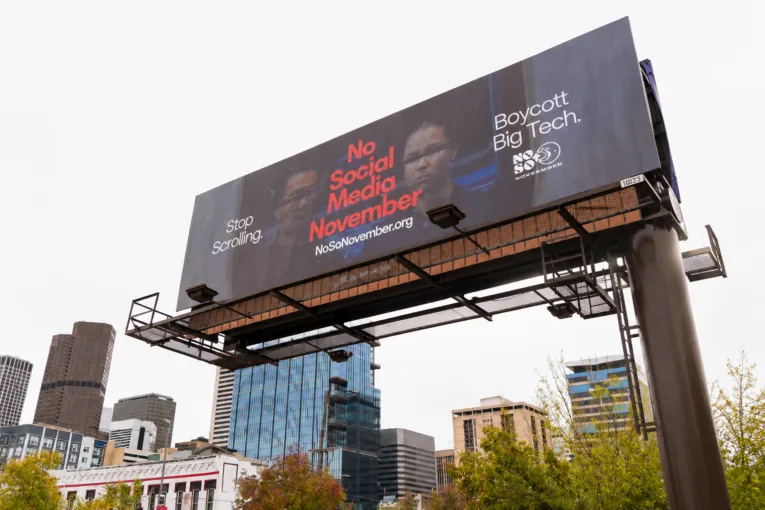
The organization has also used billboards in Colorado to promote the campaign.
Freeman acknowledged that such an approach may be more difficult for news organizations, whose audiences increasingly discover information through social platforms.
Still, she said the movement demonstrates that organizations can experiment with alternative ways of reaching people without relying exclusively on paid social media advertising.
The campaign also increasingly addresses artificial intelligence, reflecting concerns that emerging AI applications could adopt some of the same engagement-driven design practices associated with social media.
Freeman said the organization’s educational programs examine how both social media and AI systems are designed to influence behavior and command attention.
Ultimately, however, she emphasized that No Social Media November is not intended to force everyone to abandon social media permanently.
“The goal of our movement is not to be like, ‘Hey, get off social media forever. It’s horrible,'” she said.
Instead, she said participants should use the experience to evaluate whether social media serves their needs and whether they can establish healthier boundaries.
Some may return to their accounts with stricter limits, fewer notifications or different habits. Others may decide that leaving particular platforms is the best option.
“We believe in people making smart choices for themselves and building a healthy relationship to social media, and that is never going to be one size fits all,” Freeman said.
Her larger concern is the amount of time people surrender to digital platforms without fully recognizing it.
She offered a calculation intended to make that loss more tangible: Someone spending five hours a day on a phone could accumulate approximately 15 years of screen time over a lifetime.
For Freeman, the November campaign offers an opportunity to reconsider how that time might otherwise be spent.
“What we want, our real mission is for people to get that time back and to get their attention back so that it can improve their mental health and so that we can push back on these addictive platforms,” she said.
To comment please go to one of these social media platforms:
Facebook: https://www.facebook.com/DavisVanguard
LinkedIn: https://www.linkedin.com/company/peoples-vanguard-of-davis-inc/
Instagram: https://www.instagram.com/davisvanguard/
X: https://x.com/davisvanguard
Bluesky: https://bsky.app/profile/vanguardnewsgroup.bsky.social
Subscribe to the Vanguard News letters. To make a tax-deductible donation, please visit davisvanguard.org/donate or give directly through ActBlue. Your support will ensure that the vital work of the Vanguard continues.
