
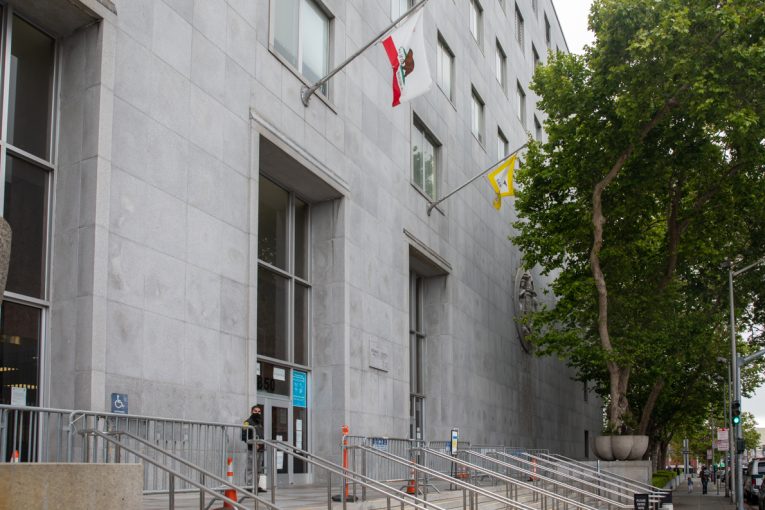
SAN FRANCISCO, Calif. — A San Francisco County Superior Court judge denied a defense motion Wednesday to reduce a felony charge to a misdemeanor in a case involving an accused man who allegedly threw a snow globe at another resident of a supportive housing facility, despite defense arguments that the 27-year-old had a documented history of mental health challenges and remained in custody without access to treatment.
Judge John D. Echeverria denied the motion under Penal Code section 17(b), finding that the alleged offense was “sufficiently violent in nature” to warrant felony treatment.
The accused faces charges stemming from allegations that he threw a snow globe, that struck another individual, while living at a supportive housing facility serving formerly unhoused residents and people with mental health needs.
During the preliminary hearing in Department 11, defense counsel characterized the charge as a “wobbler,” an offense that can be treated as either a felony or a misdemeanor, and argued that the circumstances raised questions about intent, mental health and whether felony prosecution was appropriate.
The prosecution called a San Francisco Police Department officer with 18 years of experience to testify about the investigation.
The officer testified that he spoke with the property manager of the accused’s residence and reviewed surveillance footage depicting the incident. According to his testimony, the footage showed an object later identified as a snow globe striking the alleged victim.
The officer described the facility as a hotel-style housing site with individual units that commonly serves residents with mental health needs.
During cross-examination, defense counsel established that the officer had no personal knowledge of several key facts and had obtained much of his information from other individuals involved in the investigation.
The officer acknowledged that he had not personally observed the alleged victim’s injuries. He testified that reports of a forehead laceration had been relayed by others and that, although he observed blood, he did not see the wound itself.
Defense counsel also questioned the officer about efforts to evaluate the accused’s mental state on the day of the incident. The officer testified that, to his knowledge, no such evaluation had been conducted despite the accused’s extensive mental health history.
When asked whether officers had sought mental health services for the accused following the incident, the officer said they had not.
Defense counsel also elicited testimony that the accused had no known ill will toward the alleged victim. The officer testified that there was no reported verbal exchange between the two before the incident.
Following the officer’s testimony, attorneys presented competing arguments about whether sufficient evidence existed to hold the accused to answer on the charges.
Defense counsel argued that uncertainty remained about why the snow globe was thrown and whether the accused intended to strike the alleged victim.
Counsel maintained that the evidence did not clearly establish the required criminal intent, emphasizing the accused’s mental health condition at the time of the incident and the absence of any prior relationship between the accused and the alleged victim.
Defense counsel also challenged the “characterization of the snow globe as a deadly weapon,” arguing that although the object was allegedly made of glass, it remained intact when it struck the alleged victim and broke only after hitting the ground.
Counsel noted that the snow globe itself had not been introduced into evidence, questioning whether the prosecution had sufficiently established its characteristics to support the deadly weapon allegation.
The prosecution countered that sufficient evidence identified the accused as the person responsible and supported the charges.
Defense counsel subsequently moved to reduce the felony charge to a misdemeanor under Penal Code section 17(b), citing the accused’s lack of prior convictions, history of mental health challenges, participation in therapy before the incident, attendance at City College of San Francisco and personal circumstances.
Counsel argued that unresolved questions about intent, the nature of the object and the circumstances surrounding the incident weighed in favor of misdemeanor treatment.
Addressing custody concerns, defense counsel described the accused as a 27-year-old man with no prior convictions who had been raised by a single mother and had already been attempting to address his mental health needs before the alleged offense.
Counsel maintained that these circumstances weighed against treating the accused as a public safety risk.
During arguments on the motion, Judge Echeverria asked whether the accused was currently receiving mental health treatment.
Defense counsel responded that the accused remained in custody and that no efforts had been made to provide him with mental health services while detained.
Treatment access became a central issue in the defense’s arguments, with counsel emphasizing that the accused had actively sought therapy before the alleged incident but remained incarcerated without receiving comparable services following his arrest.
While the court focused on the seriousness of the alleged conduct, defense counsel continued to question whether felony treatment was appropriate, particularly given the accused’s mental health history and lack of prior convictions.
Judge Echeverria ultimately denied the section 17(b) motion, concluding that the alleged offense was violent in nature. The judge also noted that although the accused had sought therapy before the incident, those efforts had not prevented the alleged conduct.
The court maintained the accused’s detention without bail pending further proceedings.
The case is scheduled to resume Nov. 12 at 9 a.m.
To comment please go to one of these social media platforms:
Facebook: https://www.facebook.com/DavisVanguard
LinkedIn: https://www.linkedin.com/company/peoples-vanguard-of-davis-inc/
Instagram: https://www.instagram.com/davisvanguard/
X: https://x.com/davisvanguard
Bluesky: https://bsky.app/profile/vanguardnewsgroup.bsky.social
Subscribe to the Vanguard News letters. To make a tax-deductible donation, please visit davisvanguard.org/donate or give directly through ActBlue. Your support will ensure that the vital work of the Vanguard continues.
