
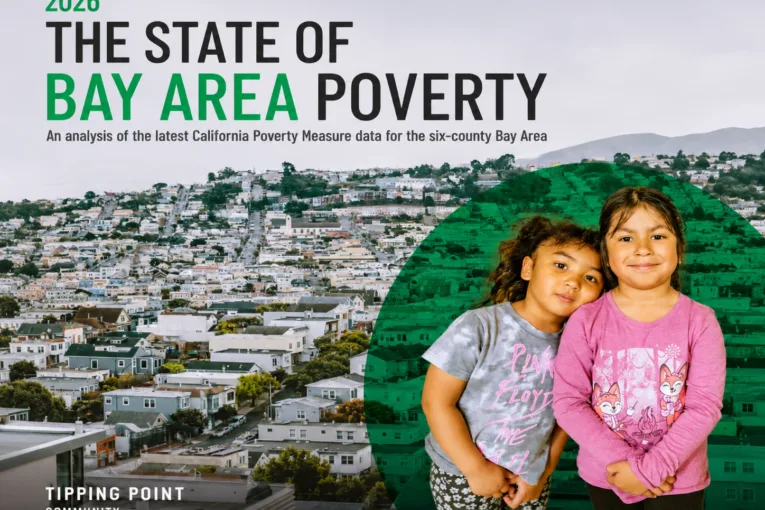
SAN FRANCISCO — Even as the Bay Area generates extraordinary wealth through the artificial intelligence boom, more than 1.8 million residents are living in or on the brink of poverty, according to a new report released by Tipping Point Community.
The report warns that expanded federal work requirements for food assistance could push as many as 145,000 Bay Area residents into poverty or deeper into poverty, reversing progress made through investments in social safety net programs.
Nearly three in 10 residents across the six counties studied are struggling to afford basic necessities, while more than 1 million residents live in or near poverty despite having at least one full-time worker in their household.
“The Bay Area can create opportunity at the same scale it creates wealth,” said Sam Cobbs, CEO of Tipping Point Community. “Our universities, talent and infrastructure have helped fuel extraordinary growth in AI. As these companies thrive and reshape our economy, they have an opportunity to invest in the communities that helped make their success possible, ensuring that more people across the region share in its prosperity.”
The report, The State of Bay Area Poverty, found that the region’s poverty rate stood at 15.5% in 2024, down from 16.3% in 2023. The decrease was not statistically significant, leaving poverty near a nine-year high for the second consecutive year.
Approximately 1 million residents lived below the poverty line, with another 820,000 living in near poverty. Nearly 300,000 residents experienced deep poverty, meaning they had less than half the resources necessary to meet basic needs.
The report relies on the California Poverty Measure, developed by the Public Policy Institute of California and the Stanford Center on Poverty and Inequality, which accounts for regional housing costs, child care and medical expenses, as well as the value of government assistance received by households.
The analysis covers Alameda, Contra Costa, Marin, San Francisco, San Mateo and Santa Clara counties.
Under the measure, the Bay Area’s poverty threshold in 2024 was $53,146 annually for a family of four, while families with resources of up to $79,719 were considered to be in or near poverty.
The cost of meeting basic needs has increased considerably over the past decade. In 2016, the poverty threshold for a family of four was $35,365, nearly $18,000 less than in 2024.
Housing tenure remains closely associated with economic hardship. The poverty rate among Bay Area renters was 25.6%, compared with 10.7% among homeowners with mortgages and 7.6% among homeowners without mortgages.
San Francisco recorded the highest poverty rate among the six counties at 19.2%, up from 17.5% in the previous report. Marin County experienced the largest increase, rising from 14.4% to 17.3%.
Alameda County’s poverty rate stood at 16.6%, followed by San Mateo County at 16.3%, Santa Clara County at 14.6% and Contra Costa County at 14.1%. Changes in those four counties were not statistically significant.
The findings also underscore the limitations of employment as a pathway out of poverty in one of the nation’s most expensive metropolitan regions.
Approximately 450,000 people living in poverty were in households with at least one full-time, year-round worker. Another 640,000 people in such households were living just above the poverty line.
Households primarily employed in the leisure and hospitality sector experienced a poverty rate of 30.3%, compared with 23.6% in construction and 6.4% in the information sector.
Among Latino residents working in food preparation and serving or building and grounds maintenance, the poverty rate reached 41.3%.
Significant racial disparities persist across the region. Nearly one in four Latino residents, or 24.6%, lived in poverty, compared with 19.8% of Black residents, 13.2% of Asian residents and 11.3% of white residents.
The poverty rate among foreign-born Latino residents reached 30.1%, compared with 21.1% among U.S.-born Latino residents.
Children and older adults were also particularly vulnerable. Approximately 16.4% of children and 18.4% of adults 65 and older lived in poverty, compared with 14.5% of working-age adults.
Government assistance programs kept more than 190,000 Bay Area residents out of poverty in 2024, according to the report. Without those programs, the regional poverty rate would have reached 18.5%.
CalFresh, California’s Supplemental Nutrition Assistance Program, had the largest individual impact, keeping more than 83,000 residents above the poverty line. Housing vouchers kept approximately 51,400 residents out of poverty.
Those gains are threatened by federal legislation expanding work requirements and reducing funding for social safety net programs.
Projections from Stanford researchers estimate that between 106,000 and 145,000 Bay Area residents could fall into poverty or deeper into poverty as a result of expanded CalFresh work requirements under H.R. 1.
Among residents at risk of losing food assistance, the deep poverty rate is projected to increase by 21%, from 14.1% to 17%, pushing approximately 9,000 additional residents into deep poverty.
Researchers also projected that more than 8,600 residents currently above the poverty line could fall below it.
Those estimates account only for expanded CalFresh work requirements and do not include the potential effects of other federal changes, including reductions in food assistance payments, new Medi-Cal work requirements and changes to tax credits.
“For more than a million of our neighbors, a full-time job doesn’t cover their basic needs,” said Ali Sutton, chief program officer of Tipping Point Community. “Now federal changes will make food assistance even harder to access for families already struggling to get by. Tipping Point is making investments that not only change the economic trajectory of tens of thousands of families but also transform the systems that are keeping people in poverty.”
Between 2011 and 2021, the Bay Area’s poverty rate declined from 18.7% to 10.8%, aided by expanded government assistance, including programs implemented during the COVID-19 pandemic.
By 2023, the poverty rate had climbed back to 16.3%.
Tipping Point said it is funding efforts to help county governments reduce administrative barriers to public assistance and equip community organizations to help residents navigate new eligibility requirements.
The organization is also investing in programs designed to reduce the financial hardship associated with having children, help young people transition into stable employment and connect low-wage workers with opportunities for career advancement.
In 2025, Tipping Point announced a commitment to accelerate regional philanthropic giving to $1 billion over the next decade in response to federal cuts to direct assistance.
According to the organization’s 2025 impact report, more than 101,000 people received support through its grantees, while 92% of clients who secured housing maintained it.
To comment please go to one of these social media platforms:
Facebook: https://www.facebook.com/DavisVanguard
LinkedIn: https://www.linkedin.com/company/peoples-vanguard-of-davis-inc/
Instagram: https://www.instagram.com/davisvanguard/
X: https://x.com/davisvanguard
Bluesky: https://bsky.app/profile/vanguardnewsgroup.bsky.social
Subscribe to the Vanguard News letters. To make a tax-deductible donation, please visit davisvanguard.org/donate or give directly through ActBlue. Your support will ensure that the vital work of the Vanguard continues.
