
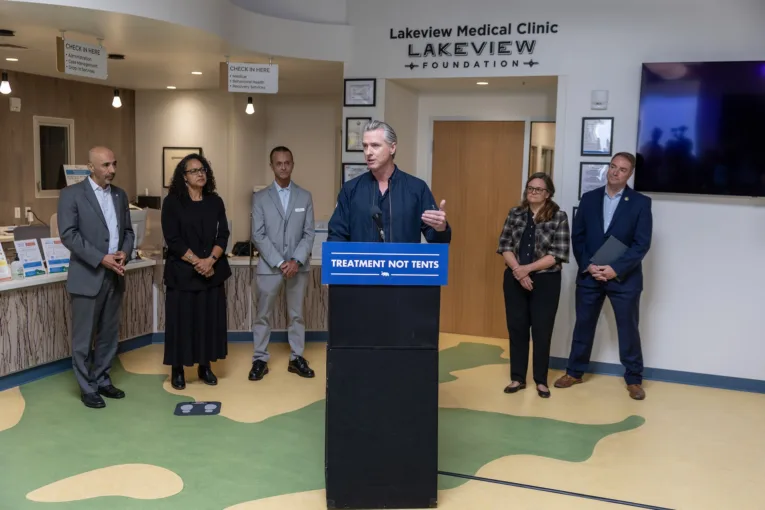
SACRAMENTO, Calif. — California has recorded a second consecutive annual decline in homelessness, according to preliminary figures released by Gov. Gavin Newsom’s administration, marking a significant reversal after years of rising numbers but leaving unresolved questions about the state’s overall progress and the effectiveness of its homelessness policies.
The administration announced that unsheltered homelessness declined approximately 12.8% between 2024 and 2026, while the total homeless population fell 6% during the same period.
However, an estimated 175,836 Californians remain homeless, approximately 24,600 more than when Newsom took office in 2019, according to an analysis by CalMatters.
The contrast underscores both the progress California has made over the past two years and the scale of the crisis that remains after nearly eight years of Newsom’s governorship.
In an Oct. 28 announcement, Newsom characterized the latest figures as evidence that California’s investments in housing, behavioral health treatment and homelessness services are producing results.
“California is proving that homelessness is not inevitable,” Newsom said. “We’re making progress because we’re building housing, expanding treatment and shelter, and holding ourselves and local governments accountable.”
The administration reported that unsheltered homelessness declined 6.5% statewide between 2025 and 2026, while total homelessness fell 3.4%.
The figures represent the first consecutive annual declines in both measures in more than a decade, according to the state.
California’s estimated unsheltered population is now slightly below its 2019 level, although the total number of people experiencing homelessness remains substantially higher.
The distinction is important because unsheltered homelessness measures people living outdoors, in vehicles or in other places not intended for habitation, while total homelessness also includes people staying in emergency shelters and transitional housing.
Moving someone from the street into a shelter can reduce unsheltered homelessness without reducing the overall number of people experiencing homelessness.
The preliminary figures are based on the annual point-in-time count, a federally mandated survey conducted by local communities to estimate how many people are experiencing homelessness on a particular night.
California has 44 regional Continuums of Care responsible for conducting these counts.
Of those, 37 conducted new unsheltered counts in 2026, representing nearly 90% of the state’s previously reported unsheltered population.
The remaining seven regions did not conduct new counts, requiring the state to carry forward their most recent available figures when calculating statewide estimates.
Among the 37 regions reporting new counts, unsheltered homelessness declined 7.3% compared with their most recent previous surveys.
The administration said the preliminary figures indicate that the state’s unsheltered population has declined for two consecutive years, following a nearly 7% reduction in 2025 confirmed by the U.S. Department of Housing and Urban Development.
The 2025 federal report counted 181,934 people experiencing homelessness in California, a 2.8% decline from 2024.
That decrease followed years of increases that had made California home to the nation’s largest population of people experiencing homelessness.
The latest statewide figures have not yet undergone the full federal review process.
Point-in-time counts also have limitations that complicate comparisons between years.
Volunteers and outreach workers conduct surveys over a limited period, often relying on visual observations, interviews and estimates to identify people experiencing homelessness.
Individuals sleeping in vehicles, secluded locations or other places that are difficult to access may not be counted.
Local jurisdictions can also change their counting methods, making year-to-year comparisons less reliable.
Those concerns were highlighted in an August CalMatters investigation, which found substantial differences in how California communities conducted their 2026 surveys.
In Fresno and Madera counties, for example, officials reported a 34% decline in homelessness, but the jurisdictions had changed their counting methodology.
Rather than counting everyone visibly living on the street, volunteers counted only individuals who confirmed they were homeless and agreed to participate in a survey.
Local officials acknowledged that the change complicated comparisons with previous years.
The investigation also found that homelessness trends varied significantly across California.
While some regions reported substantial reductions, Los Angeles County recorded a 1% increase in total homelessness, and Sacramento County reported a 13% increase compared with 2024.
Contra Costa County also experienced an increase after previously reporting a decline.
Other communities reported more encouraging results.
Alameda County recorded a 13% decline in homelessness compared with 2024, while increasing the share of unhoused residents staying in shelters.
County officials attributed some of their progress to state investments in housing and homelessness programs, including Homekey and the Homeless Housing, Assistance and Prevention program.
Jonathan Russell, director of Alameda County Health Housing and Homelessness Services, acknowledged the gains while warning about challenges to sustaining them.
“We’ve made progress,” Russell told CalMatters. “And there are real threats, real peril.”
The differences among communities illustrate the difficulty of attributing statewide changes to any single policy or funding initiative.
Newsom has highlighted the state’s investments in housing development, shelter expansion, behavioral health treatment and encampment removal as central components of his administration’s approach.
California has directed billions of dollars toward local homelessness programs, including funding for cities and counties to expand shelter capacity and permanent housing.
The state has also financed the conversion of hotels and other buildings into housing through Homekey, a program intended to move people experiencing homelessness into permanent residences.
Local officials in communities reporting declines have credited some of those investments with helping them expand services and move people into housing.
However, advocates have raised concerns that increasingly aggressive encampment enforcement may also affect the reliability of the counts.
When people are displaced from established encampments, they may move into less visible locations where survey workers have greater difficulty finding them.
A decline in the number of visible tents or encampments does not necessarily mean that the people previously living there have obtained housing.
CalMatters reported that research examining Los Angeles neighborhoods found a reduction in tent encampments accompanied by an increase in people sleeping without tents or other structures.
The findings suggest that changes in the visibility of homelessness can occur without corresponding reductions in the number of people living outside.
At the same time, the statewide decline is not solely an administration estimate.
Federal data confirmed California’s reduction in homelessness during 2025, and the preliminary 2026 figures indicate that the trend continued across much of the state.
The latest numbers therefore provide evidence of improvement, even as methodological limitations and substantial regional differences complicate assessments of its magnitude.
Newsom has also linked the reported progress to California’s expansion of behavioral health treatment.
In a separate announcement, the governor highlighted the opening of the first facility funded through Proposition 1, the behavioral health measure approved by voters in 2024.
The Ritter Center in San Rafael will provide outpatient mental health and substance use disorder treatment, with 1,412 treatment slots projected to serve more than 7,000 people annually.
The administration also reported that Proposition 1 bond funding has been awarded for projects expected to create 6,948 residential treatment beds and 27,868 outpatient treatment slots.
Those figures exceed the state’s original capacity targets, although most of the funded facilities have not yet opened.
The distinction limits what can be concluded about the measure’s contribution to the recent decline in homelessness.
While expanded treatment capacity may help address some of the conditions associated with homelessness, facilities that remain under construction cannot yet be credited with providing services to patients.
The state expects 13 additional Proposition 1-funded facilities to open by the end of 2026, with construction on the broader program scheduled for completion by 2028.
Meanwhile, California’s broader homelessness challenge remains closely connected to the availability and affordability of housing.
The state’s recent reductions have occurred alongside continued pressure on low-income renters and persistent shortages of affordable housing in many communities.
The latest estimates indicate that California is moving in a different direction from the increases that characterized much of the previous decade.
But the preliminary count also shows that roughly 176,000 people remain homeless statewide, with approximately 24,600 more people experiencing homelessness than in 2019, even as the number living without shelter has fallen slightly below its level when Newsom took office.
To comment please go to one of these social media platforms:
Facebook: https://www.facebook.com/DavisVanguard
LinkedIn: https://www.linkedin.com/company/peoples-vanguard-of-davis-inc/
Instagram: https://www.instagram.com/davisvanguard/
X: https://x.com/davisvanguard
Bluesky: https://bsky.app/profile/vanguardnewsgroup.bsky.social
Subscribe to the Vanguard News letters. To make a tax-deductible donation, please visit davisvanguard.org/donate or give directly through ActBlue. Your support will ensure that the vital work of the Vanguard continues.
