
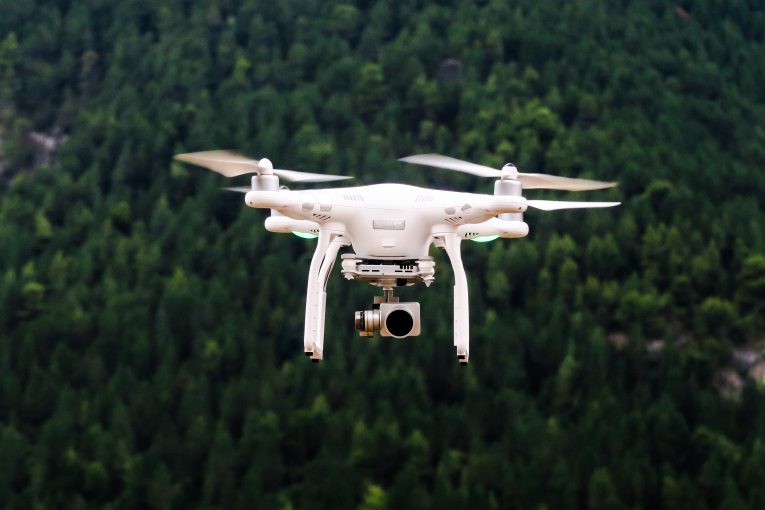
CALIFORNIA — The rapid expansion of police drone programs across California is generating opposition from privacy advocates and residents concerned about warrantless surveillance, government data collection and whether the technology delivers measurable public safety benefits.
As law enforcement agencies seek to deploy drones beyond emergency responses, critics are questioning whether existing policies adequately protect private property, limit the retention of surveillance footage and prevent government agencies from monitoring residents without judicial oversight.
An Oct. 27 CalMatters investigation documented disputes over police drone programs in San Francisco, Berkeley, Santa Ana and Stockton, where local governments are considering or expanding the use of drones as first responders.
According to the Los Angeles Police Department, nearly 60 law enforcement agencies across California operate drone programs.
In San Francisco, police proposed rules allowing drones to be deployed for public safety responses, active investigations, training and community outreach.
Although the proposed policy prohibits indiscriminate surveillance and monitoring of activities protected by the First Amendment, it allows footage unrelated to an active investigation to be retained for 30 days.
At an October meeting, the San Francisco Police Commission voted to advance the proposal to labor negotiations without adding a requirement that officers obtain a warrant before deploying drones.
Law enforcement officials argue that drones provide faster situational awareness, improve emergency response times and allow officers to assess potentially dangerous situations before entering them.
Anna Kearney, president of Stop Crime SF, argued that public safety and privacy protections should not be treated as competing priorities and urged commissioners to support responsible use of the technology.
Privacy advocates, however, warn that drones provide police with surveillance capabilities that can extend beyond traditional emergency response activities, particularly when equipped with thermal imaging, tracking systems and other advanced technology.
Katie Inman, a drone policy expert and attorney at Holland & Knight, told CalMatters that drones can operate at much lower altitudes than traditional aircraft, hover over specific locations and collect information that would otherwise be difficult to obtain.
Those capabilities have raised questions about when aerial monitoring constitutes a search under the Fourth Amendment and whether law enforcement agencies should be required to obtain warrants before conducting surveillance of private property.
The concerns are not limited to police departments.
In September, the American Civil Liberties Union of Northern California announced a settlement with Sonoma County over its use of drones to conduct residential code enforcement inspections.
The ACLU filed suit in June 2025, alleging that county inspectors had used low-flying drones to monitor private homes, fenced yards, swimming pools and other residential areas without warrants or residents’ knowledge.
Under the settlement, Sonoma County agreed to prohibit most warrantless drone inspections of homes and surrounding residential property unless an exception applies, such as an emergency or consent from the property owner.
The county also agreed to notify residents whose homes are surveilled, restrict the sharing of images with third parties and delete footage within 30 days unless it is connected to an investigation.
Sonoma County must also present a revised drone policy for public consideration and provide flight logs to the ACLU for two years.
The lawsuit involved residents who said drone surveillance had exposed private areas of their properties to government inspection without judicial authorization.
One plaintiff, Nichola Schmitz, who is deaf, learned that a county drone had hovered over her rural home only after someone else on the property alerted her.
According to the ACLU, county officials subsequently imposed thousands of dollars in fines for alleged code violations, relying in part on evidence obtained through the drone inspection.
The controversy has also raised questions about whether the claimed public safety benefits justify the financial costs and privacy risks associated with drone programs.
A February 2026 review by the UC Berkeley Criminal Law and Justice Center, prepared for Berkeley’s Police Accountability Board, examined the proposed acquisition of a drone-as-first-responder program.
The review found insufficient empirical support for claims that drone programs reduce officer-involved shootings, decrease overall uses of force or improve crime clearance rates.
Researchers examined publicly available crime statistics, drone deployment data, comparative jurisdictions and existing studies, while acknowledging that the available data could not establish causal relationships between drone deployment and crime outcomes.
The center recommended that Berkeley reject the proposed program in its current form, citing unresolved constitutional concerns, gaps in oversight and incomplete financial disclosures.
The review also identified potential costs not fully addressed in the department’s proposal, including data storage, communications infrastructure, equipment replacement and compliance with federal restrictions affecting certain foreign-produced drones.
The report recommended stronger restrictions on vendor access to surveillance information, independent cost-benefit analysis and safeguards against disproportionate deployment in low-income communities and communities of color.
Despite those concerns, California municipalities continue to make substantial investments in police drone technology.
Santa Ana approved $682,900 for a drone-as-first-responder initiative involving Skydio, while Stockton approved a $3.15 million expansion of its Flock Safety contract to integrate six drones with an existing network of approximately 120 automated license plate reader cameras, according to CalMatters.
San Francisco also received a $9.4 million donation in 2025 from cryptocurrency billionaire Chris Larsen to expand its drone program and surveillance systems.
The growing integration of drones with other surveillance technologies has prompted concerns about how law enforcement agencies collect, store and share personal information.
A June investigation by The San Francisco Standard reported that an audit uncovered 299 improper searches of the San Francisco Police Department’s automated license plate reader database over approximately one year.
The searches were conducted through a regional law enforcement intelligence network and involved access that violated California restrictions on sharing license plate reader information with federal and out-of-state agencies.
Police officials said the audit did not identify searches connected to immigration enforcement or reproductive rights investigations and that neither ICE nor the Department of Homeland Security was among the agencies accessing the database in those 299 searches.
However, earlier reporting by The Standard identified more than 1.6 million searches by outside agencies, including at least 19 associated with ICE-related inquiries.
The department subsequently suspended the regional intelligence center’s access and initiated an internal review.
Although automated license plate readers and drones are different technologies, privacy advocates argue that the documented misuse of surveillance databases demonstrates the importance of enforceable restrictions on data access and information sharing.
Jesus Gabriel Yanez, a recently retired San Francisco police commissioner, opposed the proposed drone policy and urged the department to limit deployments to incidents involving specific public safety needs.
Yanez argued that drones should not be authorized for general patrols or routine surveillance.
Manny, a member of the privacy advocacy organization DeFlock San Francisco, called for a warrant requirement during the Police Commission’s consideration of the proposed policy.
“If SFPD truly cared about operating these drones with any respect to privacy, the very least that can happen is one of you make an amendment to require a warrant,” Manny told commissioners, according to CalMatters.
The commission nevertheless advanced the policy without adopting the requested warrant provision, sending it to labor negotiations before further consideration.
To comment please go to one of these social media platforms:
Facebook: https://www.facebook.com/DavisVanguard
LinkedIn: https://www.linkedin.com/company/peoples-vanguard-of-davis-inc/
Instagram: https://www.instagram.com/davisvanguard/
X: https://x.com/davisvanguard
Bluesky: https://bsky.app/profile/vanguardnewsgroup.bsky.social
Subscribe to the Vanguard News letters. To make a tax-deductible donation, please visit davisvanguard.org/donate or give directly through ActBlue. Your support will ensure that the vital work of the Vanguard continues.
