
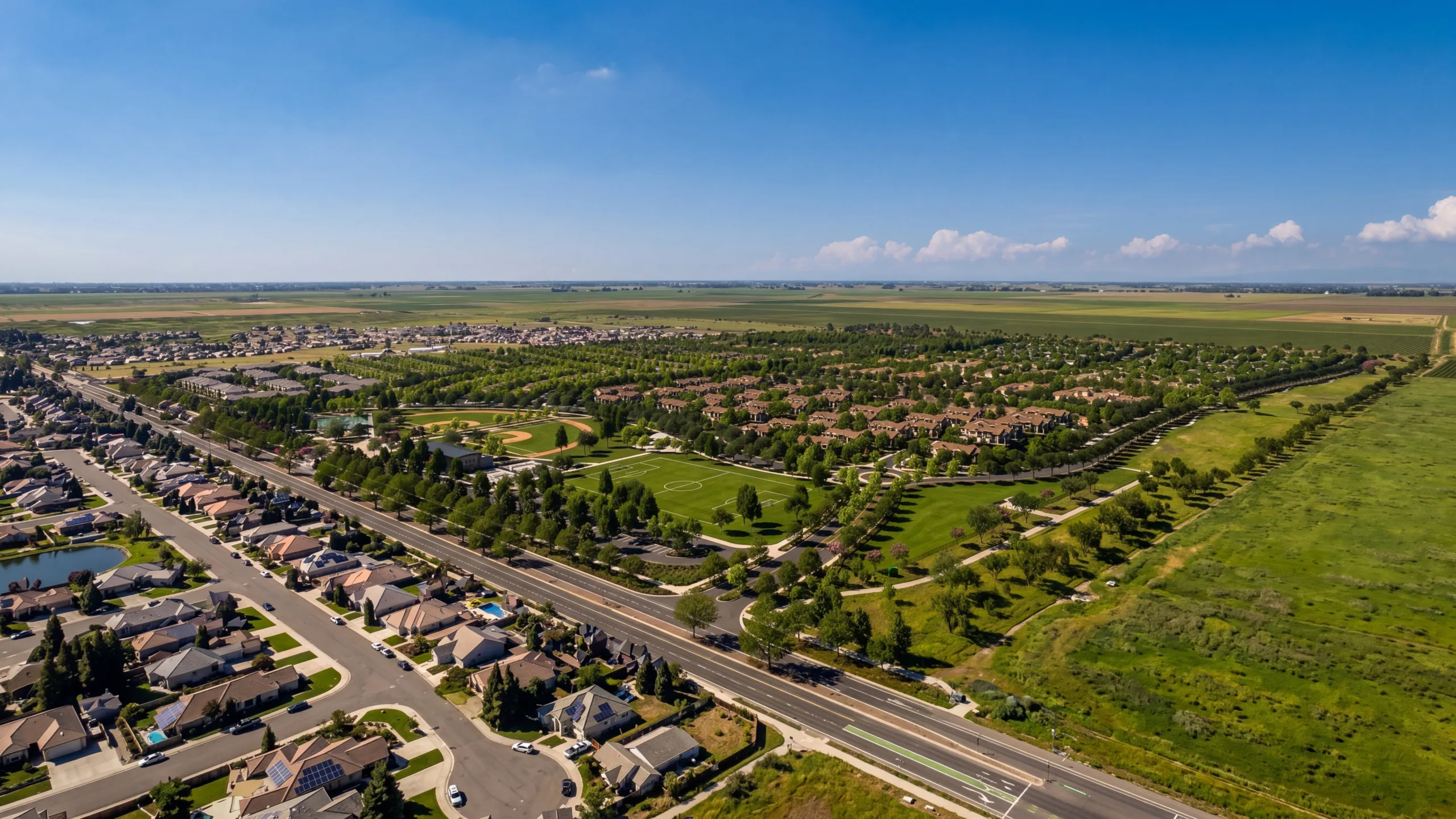
DAVIS, Calif. — Davis voters will decide Tuesday whether to approve the 1,250-home Willowgrove development, a decision that comes as the city faces questions about its ability to accommodate future population growth, meet state housing requirements and produce enough affordable housing within its existing boundaries.
Measure W would authorize the conversion of approximately 232 acres of agricultural land along East Covell Boulevard into a residential neighborhood containing at least 250 deed-restricted affordable homes, parks, trails and neighborhood retail space.
The proposal is the latest test of Measure J/R/D, the city’s longstanding requirement that voters approve certain conversions of agricultural and open-space land to urban development.
Since voters first adopted Measure J in 2000, the city’s record of approving peripheral housing projects has been limited. Most proposals brought before voters have failed, including Village Farms, which was rejected in June.
The election also comes as Davis prepares a new General Plan that will guide development through 2050, with preliminary planning discussions identifying the potential need to accommodate approximately 7,000 additional housing units over that period.
That long-term planning figure is separate from the city’s current state-mandated housing allocation, but it illustrates the scale of development Davis may need to accommodate over the coming decades.
The central planning question is how much of that growth can occur within the existing city limits, particularly given the limited availability of vacant land, the uncertainty surrounding redevelopment and the financial challenges associated with producing affordable housing.
Under the current Regional Housing Needs Allocation (RHNA) cycle, Davis must plan for approximately 2,100 housing units between 2021 and 2029, including hundreds of homes affordable to lower-income households.
The city’s housing production record shows that accommodating growth on paper and actually constructing housing are different challenges, particularly for households unable to afford market-rate development.
Measure W would not resolve all of those issues. Its approval would, however, add a substantial residential project to the city’s development pipeline, while its defeat would leave city officials to determine how much of the anticipated housing demand could be accommodated through other projects and future planning decisions.
The city’s latest planning figures provide a more detailed picture of the challenge.
At an Oct. 14 General Plan workshop, planners presented an estimate of at least 7,300 additional housing units needed through 2050, covering the current and two subsequent regional housing planning cycles.
The preliminary land-use framework identified capacity for approximately 3,000 units within existing city limits and another 18,000 in surrounding planning areas.
Those numbers represent potential capacity under proposed land-use designations, and many of the identified sites would require additional approvals, infrastructure investments and private development decisions.
Nevertheless, the comparison is significant: the estimated need for 7,300 homes is more than twice the 3,000-unit infill capacity identified within existing city limits in the preliminary framework.
Even that 3,000-unit estimate may prove optimistic. Much of the potential capacity depends on redevelopment of already-developed properties, increased densities and private investment in projects that may face substantial financial and logistical obstacles. The existence of theoretical development capacity does not guarantee that property owners will pursue projects or that those projects will be financially feasible.
Consequently, the gap between the city’s projected housing needs and the number of homes realistically achievable through infill could be considerably larger than the preliminary figures suggest.
The city is considering higher-density housing downtown, along transit corridors and in neighborhood commercial centers. The draft framework includes downtown mixed-use designations allowing densities of up to 220 units per acre.
Whether that capacity translates into actual housing will depend on property owners, redevelopment economics, financing and the ability to construct projects on sites that may already contain commercial buildings or other established uses.
The General Plan process remains underway, and its preliminary assumptions could change before the city adopts a final plan.
The challenge is especially pronounced for affordable housing.
According to the city’s annual housing progress data reviewed by the Vanguard earlier this year, Davis had permitted 963 of its 2,075-unit allocation through 2025, leaving 1,112 units to be permitted during the remainder of the current planning cycle.
The distribution of those units across income categories presents an additional challenge. Recent city reporting has identified a substantial shortfall in housing affordable to lower-income households.
Downtown redevelopment, accessory dwelling units and smaller infill projects can contribute to overall housing production, but their ability to provide deed-restricted affordable units depends on project economics, subsidy availability and the city’s inclusionary housing requirements.
Large developments can provide land and financial contributions for affordable housing that may be difficult to obtain through smaller projects.
Willowgrove’s approved development framework includes at least 250 deed-restricted affordable units, with at least 20 reserved for individuals with intellectual or developmental disabilities. The developer has also committed a minimum of $6.8 million to facilitate affordable housing.
The development agreement includes provisions for early infrastructure work and the commencement of construction on a portion of the affordable units before the project reaches specified market-rate occupancy milestones.
Those commitments would be subject to the development agreement and subsequent implementation if voters approve the measure.
The city’s history with Measure J adds another dimension to the election.
The voter-approval requirement was adopted in 2000 and subsequently renewed as Measures R and D. It requires a citywide election before certain agricultural or open-space properties can be redesignated for urban development.
Only two projects subject to the requirement, Nishi and Bretton Woods, have received voter approval. Other proposals have been rejected, including Village Farms in June 2026.
In a July 2021 review of Davis’ draft Housing Element, the California Department of Housing and Community Development specifically identified Measure J as a potential constraint on housing production.
The agency wrote, “As recognized in the housing element, Measure J poses a constraint to the development of housing by requiring voter approval of any land use designation change from agricultural, open space, or urban reserve land use to an urban use designation.”
At that time, HCD noted that four of six proposed rezonings had failed and directed the city to clarify whether sites identified to accommodate its housing needs would be subject to voter approval.
The agency’s concern was not that local voters lacked authority to decide individual land-use questions, but whether the city’s approval process could prevent housing sites identified in its Housing Element from being developed.
In August 2023, HCD issued Davis a notice of violation for failing to adopt a substantially compliant Housing Element, an enforcement action separate from the legality of Measure J itself.
The state has also demonstrated its willingness to enforce housing requirements against other California communities.
In July, Attorney General Rob Bonta and HCD announced enforcement actions against five local governments for failing to comply with California’s Housing Element Law.
The actions were part of a broader state effort to bring jurisdictions into compliance with requirements to plan for housing across income categories.
California law requires cities to adopt housing elements that identify adequate sites and programs to accommodate their assigned housing needs. The law also requires jurisdictions to analyze governmental constraints that may interfere with residential development.
The requirements are enforceable through administrative review and litigation. Depending on the circumstances, noncompliant jurisdictions can face court orders, penalties and restrictions on their authority to deny certain qualifying housing developments.
State law generally requires cities to provide legally adequate opportunities for housing development; it does not require municipal governments themselves to build every unit in their allocations.
At the same time, simply identifying theoretical capacity does not necessarily satisfy state requirements if the designated sites are unavailable, unsuitable or subject to constraints that make development unrealistic.
A city can therefore face scrutiny even when its planning documents identify sufficient housing capacity on paper.
Some residents have questioned whether state housing allocations will ultimately require additional peripheral development, particularly if the city continues to identify infill sites and maintains a state-compliant Housing Element.
The state’s enforcement record, however, establishes that housing element requirements are not merely advisory targets. Whether those requirements eventually lead to legal action involving Davis would depend on the city’s compliance status, its available housing sites and the application of state law to particular local decisions.
There has been no determination that rejection of Willowgrove would automatically violate state housing law or invalidate Measure J/R/D.
Nor has the state established that Davis must approve Willowgrove specifically to satisfy its housing obligations.
The unresolved issue is whether the city can continue demonstrating sufficient realistic housing capacity if large peripheral projects are repeatedly rejected and the amount of developable infill land remains limited.
That question has drawn attention from residents who have historically opposed peripheral development.
Former Davis Planning Commissioner Eileen Samitz, who opposed Village Farms, wrote recently that Willowgrove differs from earlier proposals because of its detailed planning, affordable housing commitments and opportunities for public involvement.
“Since our city is essentially out of adequate land to accommodate its RHNA housing requirements, we need to expand onto land adjacent to existing neighborhoods,” Samitz wrote.
She also raised concerns about possible state intervention if Davis fails to meet its housing obligations.
“If we do not meet these requirements, the city could be sued and/or sanctioned by the state, as some other cities have been,” she wrote.
Samitz’s support for Willowgrove reflects a calculus made by some longtime defenders of Measure J: retaining local voter approval does not necessarily mean rejecting every proposal for peripheral housing.
In another letter, Rena Nayyar, who also opposed Village Farms, argued that Willowgrove demonstrates how public involvement can shape a development proposal.
“Fortunately, Measure J/R/D gives us the opportunity to choose the best possible projects to meet this growth requirement,” Nayyar wrote. Davis Vanguard
Former Davis City Councilmember Dan Carson and community activist Elaine Roberts Musser raised a related concern in a September commentary, arguing that repeated rejection of housing proposals could eventually prompt state lawmakers to reconsider the authority of local initiatives and referenda that restrict residential development.
They pointed to AB 2676, legislation that advanced through the Assembly but did not become law, as an indication that state officials have considered additional limits on local land-use restrictions.
Their argument was that Measure J/R/D could be more defensible over the long term if Davis demonstrates that the process can accommodate needed housing rather than functioning primarily as a mechanism for rejecting development.
Willowgrove has also drawn support from residents who see its specific design and development commitments as critical to its planning success.
The project received unanimous approval from the Davis Planning Commission and City Council before being placed on the ballot.
Unlike the Village Farms campaign, Measure W has faced little organized public opposition. No formal argument against the measure was submitted for the county voter information guide by the deadline.
The absence of an organized opposition campaign does not mean concerns about the project have disappeared.
Peripheral development continues to raise questions about the conversion of agricultural land, transportation impacts, municipal service costs and whether the city should prioritize higher-density development within existing neighborhoods.
Willowgrove would convert agricultural land to urban uses, although its mitigation plan provides for permanent protection of 374 acres of farmland associated with Bullseye Farms.
The project would also require annexation approval from the Yolo County Local Agency Formation Commission before development could proceed.
For Davis, the election takes place during a broader transition in long-range planning.
The General Plan update is examining how to distribute thousands of additional housing units among downtown redevelopment, neighborhood infill and potential expansion areas outside the current city limits.
Its preliminary figures identify considerably more potential capacity outside the city than within it, while the current Housing Element shows continuing challenges in accommodating lower-income housing.
Measure W would authorize one specific development rather than settle those broader planning questions.
To comment please go to one of these social media platforms:
Facebook: https://www.facebook.com/DavisVanguard
LinkedIn: https://www.linkedin.com/company/peoples-vanguard-of-davis-inc/
Instagram: https://www.instagram.com/davisvanguard/
X: https://x.com/davisvanguard
Bluesky: https://bsky.app/profile/vanguardnewsgroup.bsky.social
Subscribe to the Vanguard News letters. To make a tax-deductible donation, please visit davisvanguard.org/donate or give directly through ActBlue. Your support will ensure that the vital work of the Vanguard continues.
