
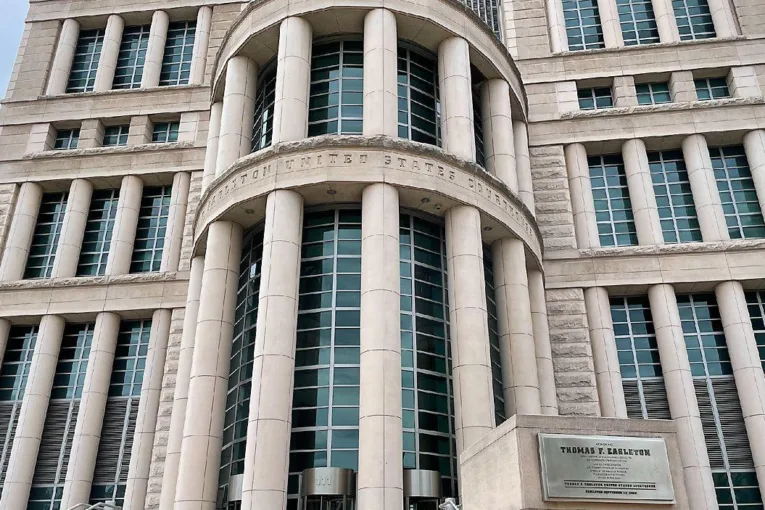
ST. LOUIS, Mo. — On Nov. 10, the U.S. Court of Appeals for the Eighth Circuit denied two petitions for review filed by Zoila Sucelly Saavedra-Villanueva, a Guatemalan lawful permanent resident convicted of child exploitation under Indiana law, leaving her removal order in place. The decision also marks the court’s adoption of a broad definition of “crime of child abuse” under the Immigration and Nationality Act (INA).
In Saavedra-Villanueva v. Blanche, Nos. 24-2918 and 25-1662, a three-judge panel ruled that the Indiana conviction qualified as a crime of child abuse under federal immigration law. Judge Jonathan Kobes authored the opinion, joined by Chief Judge Steven Colloton and Judge Raymond Gruender.
According to the court’s opinion, Saavedra-Villanueva discovered sexually explicit photographs and videos of her 16-year-old niece on her father’s phone, copied the images onto her own phone and sent them to the niece’s mother in Guatemala.
After her father was arrested for sex crimes and the niece moved in with her, the niece reported that Saavedra-Villanueva was using the images as leverage against her and to protect her father. Police later found the images on Saavedra-Villanueva’s phone, leading to her conviction under Indiana’s child exploitation statute.
The Department of Homeland Security subsequently initiated removal proceedings. An immigration judge ordered her removal, and the Board of Immigration Appeals (BIA) dismissed her appeal and later denied reconsideration.
The central legal question was whether the Indiana conviction categorically qualified as a crime of child abuse under 8 U.S.C. § 1227(a)(2)(E)(i). The Eighth Circuit concluded that the federal definition includes intentional, knowing, reckless or criminally negligent conduct that maltreats a child or impairs the child’s physical or mental well-being, including sexual exploitation.
The court adopted this interpretation through its own analysis of the federal statute rather than deferring to the immigration agency. The panel also noted that the Fourth, Fifth, Seventh and Ninth Circuits had reached similar conclusions, aligning the Eighth Circuit with those courts.
The decision applied the categorical approach, which requires courts to examine the elements of a criminal statute rather than relying exclusively on the specific facts of an individual’s case. Saavedra-Villanueva argued that Indiana’s statute could theoretically cover conduct outside the federal definition, including journalists collecting evidence of child sex trafficking or children sharing images with parents to seek assistance.
The panel rejected those hypothetical examples, explaining that the realistic-probability test requires more than speculation that a statute could be applied to conduct outside the federal definition. A challenger generally must demonstrate that the state has actually prosecuted such conduct. The court also reasoned that copying existing sexually exploitative images can compound the harm to a child.
The ruling does not establish that legitimate preservation of evidence of child exploitation automatically constitutes child abuse. Rather, the court determined that the Indiana offense at issue qualified under the federal immigration statute and that the hypothetical examples did not establish a sufficient basis for a different conclusion.
The panel separately rejected Saavedra-Villanueva’s challenge to the BIA’s finding that her conviction constituted a “particularly serious crime.” Under federal immigration law, that classification can make an individual ineligible for statutory withholding of removal and withholding of removal under the Convention Against Torture (CAT).
In reviewing that determination, the court considered the BIA’s assessment of the circumstances described in the opinion, including the use of the images as leverage against the niece and the finding that Saavedra-Villanueva acted to protect her father rather than contact law enforcement. The panel also rejected the argument that the BIA was required to conduct a separate assessment of future dangerousness.
The decision has broader implications for immigration cases involving state convictions for child exploitation and other offenses affecting minors. By independently adopting a broad definition of child abuse, the Eighth Circuit reinforced an interpretation that can make certain state convictions grounds for removal under federal immigration law.
The case also highlights the importance of the categorical approach and realistic-probability test when individuals challenge the immigration consequences of state criminal convictions. Although a statute may theoretically reach conduct outside a federal definition, courts may require evidence of actual prosecutions involving that conduct.
The Battered Women’s Justice Project, the National Immigrant Women’s Advocacy Project (NIWAP) and Yadira Baez-Lockard participated as amici curiae in support of Saavedra-Villanueva, bringing additional attention to the potential implications of the ruling.
The Eighth Circuit denied both petitions for review, leaving the removal order and the BIA’s particularly-serious-crime determination intact.
To comment please go to one of these social media platforms:
Facebook: https://www.facebook.com/DavisVanguard
LinkedIn: https://www.linkedin.com/company/peoples-vanguard-of-davis-inc/
Instagram: https://www.instagram.com/davisvanguard/
X: https://x.com/davisvanguard
Bluesky: https://bsky.app/profile/vanguardnewsgroup.bsky.social
Subscribe to the Vanguard News letters. To make a tax-deductible donation, please visit davisvanguard.org/donate or give directly through ActBlue. Your support will ensure that the vital work of the Vanguard continues.
