
MINNEAPOLIS — A Guatemalan immigrant was rearrested twice by U.S. Immigration and Customs Enforcement, each time immediately after separate court-ordered releases. His attorney argued that repeated transfers between detention facilities across multiple states have adversely affected his ability to receive legal representation, according to Minnesota Public Radio (MPR).
On Nov. 9, U.S. District Judge John R. Tunheim presided over a hearing involving the Guatemalan immigrant identified publicly as Ivan, who was rearrested a second time following a federal habeas ruling. Ivan F.M. v. Blanche raises questions about the lawfulness of the arrests and Ivan’s renewed detention, including whether federal immigration authorities can circumvent a court-ordered habeas release through an immediate rearrest and what legal safeguards apply when detention is reinstated.
Ivan, a 27-year-old Guatemalan citizen, entered the United States without inspection by immigration authorities in August 2019. On Sept. 11, ICE officers noticed Ivan’s truck at a gas station in Columbia Heights, Minnesota, while he was on his way to work. After reviewing the vehicle’s registration records, the officers determined that Ivan did not have lawful immigration status in the United States.
The officers subsequently carried out a warrantless arrest, citing the need to prevent Ivan from escaping before a warrant could be obtained or executed under 8 U.S.C. § 1357(a)(2), according to Tunheim’s Oct. 30 memorandum opinion and order.
Unlike a judicial warrant, an ICE Form I-200 administrative warrant does not require review or approval from a judge or neutral magistrate, according to the Immigrant Legal Resource Center. Consequently, it does not undergo the independent judicial review required for judicial warrants under the Fourth Amendment, which protects individuals against unreasonable government searches and seizures.
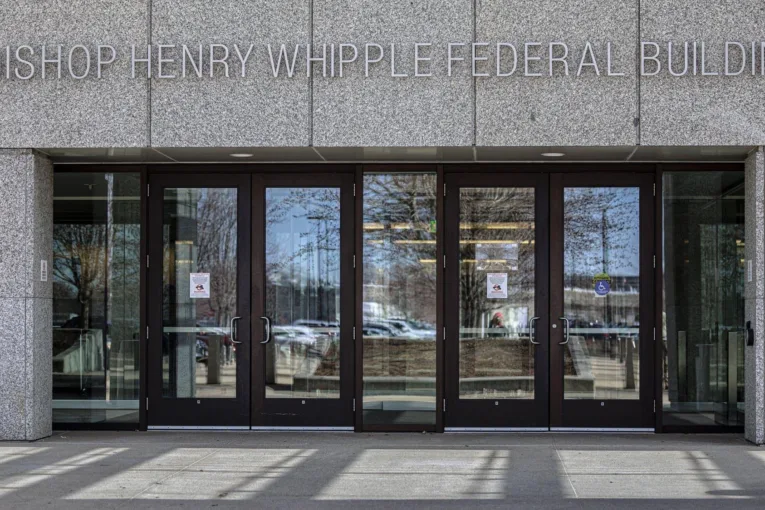
On Sept. 30, Ivan’s petition for a writ of habeas corpus was granted after the court concluded that ICE’s warrantless arrest was unlawful and ordered his release from detention. Ivan was escorted out of the Bishop Henry Whipple Building at 8:40 a.m. the following day. However, just one minute after his release, ICE officers arrested him again using an I-200 administrative warrant.
“A guy wearing body armor and a face mask jumped from behind a barrier or from the bushes,” said John Barham, Ivan’s lawyer. “There was a judge’s order specifically prohibiting you from [re-arresting him], and that’s when [the agent] waved the administrative warrant in my face.”
“Allowing an individual to step one foot outside a cell is not release in any sense of the term,” Tunheim wrote. “A court-ordered release for a habeas petitioner is not an opportunity to cure prior wrongs and certainly cannot be an opportunity to further flout legal and constitutional requirements.”
The court determined that Ivan had never been meaningfully released from custody, finding that ICE’s subsequent issuance of an I-200 administrative warrant neither remedied the initial unlawful arrest and detention nor established an independent legal basis for detaining him again.
The court granted a motion to enforce its release order and required ICE to provide notice and a pre-deprivation hearing before any subsequent arrest, rejecting “a process that allows Respondents to detain first and paper over their procedural failures later.”
Two federal judges, Eric Tostrud and Jerry Blackwell, have declined requests to authorize the rearrest of individuals who had been released, while Judges Jeffrey Bryan and Tunheim have ruled that rearrests violated their release orders.
The federal government’s justification for continuing Ivan’s detention and deportation rests on his agreement to voluntary departure before an immigration judge. However, Ivan’s attorney argues that he agreed under pressure, driven by desperation to secure his release from detention before Tunheim issued the order for his release.
“We believed we released him,” said Derek Ganzone, an ICE attorney acting as a special assistant U.S. attorney, describing the government’s position as a “mistaken belief.”
Since his initial detention in September, Ivan has been held in three Minnesota jails and facilities in Louisiana and Texas. His two lawyers have expressed concern that the transfers have disrupted his access to legal counsel and hindered their ability to represent him effectively.
“They have to dance around, have 20 gazillion forms of procedures to avoid producing the body,” said Steve Appelget, one of Ivan’s attorneys who filed a habeas corpus petition challenging his detention. “We have the great writ, they got shit.”
To comment please go to one of these social media platforms:
Facebook: https://www.facebook.com/DavisVanguard
LinkedIn: https://www.linkedin.com/company/peoples-vanguard-of-davis-inc/
Instagram: https://www.instagram.com/davisvanguard/
X: https://x.com/davisvanguard
Bluesky: https://bsky.app/profile/vanguardnewsgroup.bsky.social
Subscribe to the Vanguard News letters. To make a tax-deductible donation, please visit davisvanguard.org/donate or give directly through ActBlue. Your support will ensure that the vital work of the Vanguard continues.
