
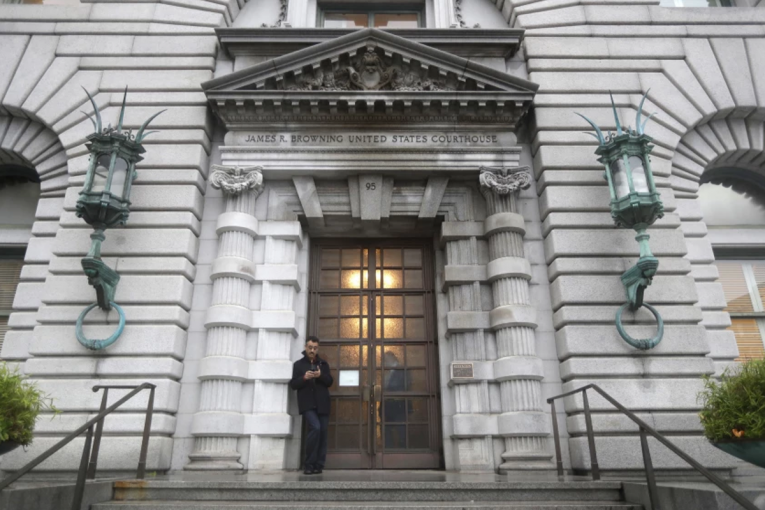
PASADENA, Calif. — On Nov. 19, the U.S. Court of Appeals for the Ninth Circuit heard oral arguments in Kidd v. Mullin, a case challenging the arrest practices of federal immigration officers in Southern California.
The federal government is seeking to restore its “knock and talk” immigration arrest practices after a district court determined that the challenged operations violated the Fourth Amendment.
Kidd v. Mullin was originally filed as a class-action lawsuit on April 16, 2020, on behalf of Osny Sorto-Vasquez Kidd, a Hacienda Heights resident and recipient of Deferred Action for Childhood Arrivals (DACA), and two community organizations: the Inland Coalition for Immigrant Justice (ICIJ) and the Coalition for Humane Immigrant Rights (CHIRLA).
The lawsuit was filed by the ACLU Foundation of Southern California, the UC Irvine School of Law Immigrant Rights Clinic and the law firm Munger, Tolles & Olson LLP in the U.S. District Court for the Central District of California.
The case concerns allegations that immigration officers in Southern California use deceptive tactics, including impersonating local police officers, to persuade community members to allow agents into their homes without judicial warrants.
According to the ACLU, these tactics undermine community trust in local law enforcement and violate the Fourth Amendment of the U.S. Constitution, which protects individuals against unreasonable searches and seizures.
Following a federal court order, the lawsuit gained class-action status covering two groups of Southern California residents who have been or are at risk of being subjected to the policies and practices challenged in the lawsuit.
The classes encompass residents of Los Angeles, Orange, Riverside, San Bernardino, San Luis Obispo, Santa Barbara and Ventura counties.
The district court determined that immigration officers cannot rely on the implied permission ordinarily granted to members of the public to approach a residence when their purpose is to conduct an arrest without a judicial warrant.
In its appeal brief, the federal government argued that the district court’s decision deprived U.S. Immigration and Customs Enforcement (ICE) of an “imperative immigration enforcement tool in a region of the United States in which illegal immigration is ‘especially pronounced.’”
The oral arguments were heard Nov. 19 by a three-judge panel consisting of Judges Milan D. Smith Jr., Danielle J. Forrest and Johnnie B. Rawlinson.
Deputy Assistant Attorney General Drew Ensign argued on behalf of the federal government.
According to Courthouse News Service, Smith questioned whether immigration officers could rely on the knock-and-talk method when their express intention in approaching a residence was to arrest someone.
Forrest similarly questioned whether immigration officers exceeded the implied permission ordinarily granted to members of the public to approach a home.
Ensign argued that administrative warrants, which are issued by government agencies rather than judges, provide lawful authority for immigration arrests and allow officers to seek consent to enter residential property without violating the Fourth Amendment.
The government’s opening brief, filed Feb. 19, 2026, challenges a May 15, 2024, ruling by U.S. District Judge Otis D. Wright II, as well as the plaintiffs’ standing to challenge ICE’s policy.
Ensign further pointed to the “overwhelming legislative propriety of the administrative arrest of deportable aliens,” citing language from Abel v. United States, a Supreme Court case involving searches and seizures following an arrest under an administrative immigration warrant.
Forrest questioned Ensign’s reliance on the case, pointing out that the language constituted “dicta,” or judicial commentary that does not establish binding precedent.
“From my understanding, the Supreme Court has not attempted to revisit that,” Forrest stated.
Ensign responded that “the signal from Abel has been so strong that no one has attempted to bring it back to them.”
Forrest continued to question the applicability of the decision, pointing to differences between the circumstances of Abel v. United States and the knock-and-talk practices employed by ICE agents.
Jeremy S. Kreisberg, arguing on behalf of the plaintiffs, stated that “the government has provided no reason to disturb the district court’s careful order.”
In their June 22 answering brief, the plaintiffs argued that established Fourth Amendment precedent prohibits officers from relying on an implied license to enter residential property when their purpose is to arrest an occupant.
The plaintiffs also argued that the federal government had previously agreed to forgo its legal argument concerning administrative warrants in exchange for avoiding certain discovery obligations during the district court proceedings.
The brief noted that the parties had reached a settlement concerning the separate allegations that ICE agents used deception to obtain consent to enter homes. The appeal concerns the district court’s decision to invalidate the knock-and-talk arrest policy.
The appellate panel also questioned attorneys about whether the plaintiffs had established standing, including whether individuals represented by the immigrant rights organizations faced an imminent threat of future harm.
According to Courthouse News Service, Ensign maintained that evidence of past injuries was insufficient to establish a likelihood of future harm. Kreisberg countered that immigration authorities already possessed the home addresses of individuals represented by the organizations.
Kreisberg further argued that the government had not established a legal basis for conducting the challenged home arrest operations.
“The Constitutional violation has occurred when the government repeatedly seeks to execute a knock and talk arrest operation,” Kreisberg stated.
He responded to the government’s arguments concerning administrative warrants by pointing out that such warrants are often “issued after an arrest takes place” and that “the idea that you could uphold the administrative warrants in a vacuum without a record would be a grave mistake.”
The three-judge panel took the matter under submission.
To comment please go to one of these social media platforms:
Facebook: https://www.facebook.com/DavisVanguard
LinkedIn: https://www.linkedin.com/company/peoples-vanguard-of-davis-inc/
Instagram: https://www.instagram.com/davisvanguard/
X: https://x.com/davisvanguard
Bluesky: https://bsky.app/profile/vanguardnewsgroup.bsky.social
Subscribe to the Vanguard News letters. To make a tax-deductible donation, please visit davisvanguard.org/donate or give directly through ActBlue. Your support will ensure that the vital work of the Vanguard continues.
