
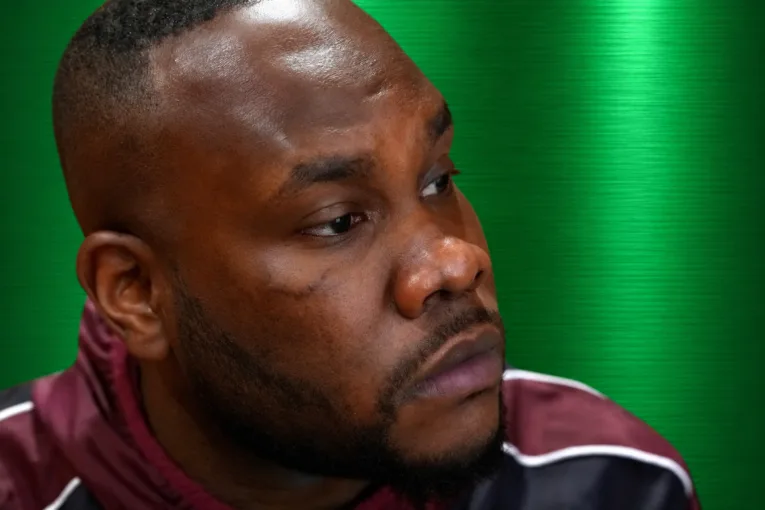
WASHINGTON — A federal judge Wednesday denied an emergency request from Moussa Diawara, a Malian man deported this summer, to compel the U.S. Department of Homeland Security (DHS) to remove social media posts revealing details from his confidential asylum application.
U.S. District Judge Jia M. Cobb of the District of Columbia denied the temporary restraining order in a 13-page memorandum opinion and order in Diawara v. Percival.
“Moussa Diawara is in danger,” Cobb wrote in the opening line of the order.
“In part, he is in danger because the Department of Homeland Security, its General Counsel, and Immigration and Customs Enforcement told millions on social media that Diawara sought asylum in the United States by falsely claiming to fear persecution on account of his sexual orientation,” she wrote.
Cobb added that the conduct “is hard to square with the DHS’s long-recognized commitment to safeguarding the confidentiality of asylum-related information.”
According to the order, Diawara lived in the United States for more than two decades and has a wife and two U.S. citizen children.
An immigration judge ordered him removed but granted him withholding of removal to Mali, “based on a finding that his ‘life or freedom would be threatened’ there,” Cobb wrote.
ICE arrested Diawara in July, according to CBS News’ “60 Minutes.”
His attorneys filed a federal habeas petition July 29 challenging the government’s “imminent attempt to remove [him] to Ghana, a third country,” according to a Sept. 1 recommendation by U.S. Magistrate Judge David L. Horan of the Northern District of Texas.
The government later submitted records showing Diawara was removed from the United States on July 30, the day after the petition was filed.
Horan wrote that a claim becomes moot when it is “impossible for the court to grant any effectual relief whatever to a prevailing party.”
“The court should dismiss this habeas action as moot,” Horan added.
Cobb’s order states that “within days, Ghanaian officials sent Diawara onward to Mali, where he was temporarily detained by Malian police.”
He later fled to another country, according to CBS, which did not identify the location at Diawara’s request because of concerns for his safety.
Diawara told CBS that a medical form and both of his DHS-issued tags listed Mali as his destination.
“So they know 100% I’m going to Mali,” Diawara told CBS.
DHS General Counsel James Percival told CBS that Diawara was flown to Ghana, not Mali, and said he could not explain the paperwork.
DHS told CBS that Ghana had provided diplomatic assurances for Diawara’s safety.
Ghana’s government declined to comment to CBS.
Diawara’s attorney, Reuben S. Kerben, has asked a federal judge to order Diawara’s return to the United States, according to CBS. That case remains pending before Cobb.
The new lawsuit concerns social media posts published after the “60 Minutes” segment aired Sunday, Oct. 25. The segment itself had not disclosed Diawara’s sexual orientation.
“I pulled [Diawara’s] file. His claimed reason for fearing Mali was that he is ‘gay,’ just in case you’re wondering how bad the immigration fraud problem is,” Percival wrote on X from his official account, according to the order.
ICE posted several times that Diawara “claimed he was a HOMOSEXUAL in order to try and dodge deportation to Mali.”
The next day, a Fox News correspondent posted pages from Diawara’s asylum application on X. ICE reposted the pages, commenting, “Fake & Gay!” DHS also reposted them, writing, “This is immigration fraud.”
Percival posted a meme with the text “I’m not gay no more!” and the comment “Illegal aliens after they lie to get asylum.”
According to the order, the posts had been viewed more than 11 million times.
When another X user suggested the posts might violate federal rules, Percival replied, “But of course I disclosed this consistent with regulation.”
Diawara filed suit Nov. 2 against Percival, Homeland Security Secretary Markwayne Mullin and acting ICE Director David Venturella.
He argued that the posts violated a federal regulation stating that asylum information “shall not be disclosed without the written consent of the applicant, except as permitted by this section or at the discretion of the Attorney General.”
His attorney stated in a declaration that Diawara had never consented to the disclosures.
His complaint further alleged that “neither the Attorney General nor the Secretary [of Homeland Security] authorized the disclosures.”
The government pointed to a November 2025 memorandum by then-Homeland Security Secretary Kristi Noem allowing officials to disclose asylum information “in cases with media significance, for purposes of promoting transparency, accountability, and public awareness.”
The memorandum included a handwritten addition reading, “with notification to me every time we exercise this authority.”
According to a DHS declaration, acting Assistant Secretary Katherine Currie determined that Diawara’s case “carried considerable media significance” and authorized disclosure.
Cobb found it plausible that the DHS and ICE posts were made with Currie’s authorization, although “perhaps they were not.”
“But at this early stage, Diawara has not established that a lack of authorization is ‘likely,’” the judge wrote, adding that “this is not to say that the record vindicates Defendants.”
She questioned the government’s suggestion that Currie could have approved the posts after the fact, as well as “the roughly three-week gap between Currie’s determination and the challenged disclosures.”
“On the record, there are more questions than answers,” Cobb concluded.
In a footnote, Cobb noted that Percival’s “own words” were “indicative of an independent decision to disclose Diawara’s records.”
She found, however, that an order against Percival alone would likely provide little relief while the DHS and ICE posts remained online.
Diawara’s second claim, that the disclosures were arbitrary and capricious, could not be resolved without reviewing the government’s administrative record.
Diawara’s attorneys argued in their reply that “the remedy is to order the record, not to deny relief.”
Cobb said she would order the administrative record if Diawara moves for a preliminary injunction.
The ruling does not determine whether the disclosures were lawful.
Cobb ordered both sides to file a joint status report by Friday, Nov. 13, indicating whether Diawara intends to seek a preliminary injunction.
To comment please go to one of these social media platforms:
Facebook: https://www.facebook.com/DavisVanguard
LinkedIn: https://www.linkedin.com/company/peoples-vanguard-of-davis-inc/
Instagram: https://www.instagram.com/davisvanguard/
X: https://x.com/davisvanguard
Bluesky: https://bsky.app/profile/vanguardnewsgroup.bsky.social
Subscribe to the Vanguard News letters. To make a tax-deductible donation, please visit davisvanguard.org/donate or give directly through ActBlue. Your support will ensure that the vital work of the Vanguard continues.
