
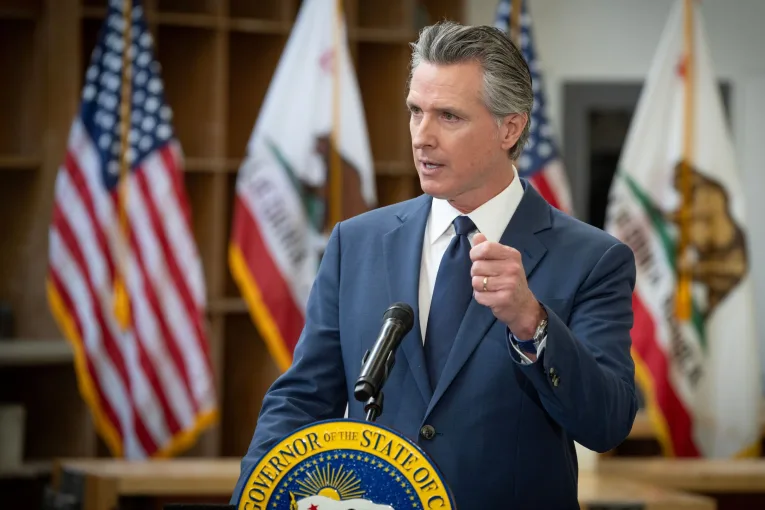
CALIFORNIA — UC Berkeley School of Law Dean Erwin Chemerinsky said Tuesday that he sees no legal basis for the challenge brought by California district attorneys seeking to block Gov. Gavin Newsom’s plan to commute all 548 death sentences to life without the possibility of parole.
Asked by the Vanguard during a virtual press conference whether the district attorneys had any legal grounds to challenge the governor’s commutation authority, Chemerinsky responded unequivocally.
“No, and it’s for the reasons that I said,” Chemerinsky said, explaining that the California Constitution expressly authorizes the governor to commute sentences and that Newsom has followed the procedures required for cases needing California Supreme Court approval.
“So I do not see a basis for legal challenge,” he continued. “Like Professor Semmel, I’ve read the filing and it doesn’t raise any legal issues that are an obstacle to this.”
The remarks came during a Nov. 17 press conference organized by Prosecutors Alliance Action in response to legal opposition from California district attorneys, including Orange County District Attorney Todd Spitzer and Los Angeles County District Attorney Nathan Hochman, who have challenged Newsom’s proposed commutations.
The event brought together current and former prosecutors and legal scholars who defended the governor’s constitutional authority, disputed the legal arguments advanced by opponents and explained why the commutations would not result in anyone being released from prison.
The confrontation comes after Newsom announced Nov. 5 that he intends to commute the death sentences of all 548 people currently on California’s death row. The governor has not yet issued the commutations, and the process remains subject to proceedings before the California Supreme Court.
Chemerinsky, one of the nation’s leading constitutional law scholars, described the arguments advanced against the governor’s action as legally unfounded.
“I have read the briefs that have been filed in opposition to this, and frankly, I think the arguments are frivolous,” Chemerinsky said.
He specifically rejected the contention that California voters’ decisions to retain capital punishment prevent the governor from exercising his clemency authority.
“That of course is so, but that doesn’t limit the governor’s authority under the constitution,” he said, referring to the fact that voters and lawmakers have authorized the death penalty.
Chemerinsky also rejected the argument that Newsom must make an individualized determination in each case rather than issuing commutations based on a broader policy judgment.
“Nothing in the California Constitution, nothing in the California Penal Code requires that it be an individualized determination,” he said.
He pointed to previous governors who had issued broad death penalty commutations, including Toney Anaya in New Mexico in 1986, George Ryan in Illinois in 2003 and Kate Brown in Oregon in 2022.
Chemerinsky emphasized that Article V, Section 8 of the California Constitution gives the governor broad clemency authority, subject to a requirement that four California Supreme Court justices recommend clemency for individuals convicted of more than one felony.
He cited a 2018 administrative order in which the California Supreme Court emphasized its limited role in reviewing gubernatorial clemency decisions.
Under that standard, the court does not independently determine whether each individual deserves clemency but instead evaluates whether the governor has acted within the boundaries of his constitutional authority.
The legal scholars’ response directly challenged the position of prosecutors who contend that Newsom’s proposal improperly circumvents jury verdicts, voter decisions and established procedures governing capital punishment.
Spitzer has argued that the governor’s action disregards victims’ families and the decisions of juries that imposed death sentences. Hochman has also opposed the sweeping commutations.
The press conference presented a sharply different interpretation of the governor’s authority and the practical consequences of replacing death sentences with life imprisonment.
UC Berkeley law professor Elisabeth Semel, co-director of the school’s Death Penalty Clinic, addressed another central argument advanced by opponents: that the governor failed to provide the legally required advance notice to prosecutors and victims.
Semel explained that California Penal Code Section 4805 requires advance notice when an incarcerated person individually applies for clemency, but that provision does not govern commutations initiated independently by the governor under his constitutional authority.
“This situation doesn’t trigger the notice requirement,” Semel said.
She emphasized that Newsom’s Nov. 5 announcement did not itself commute any sentence.
“The governor has not commuted a single death sentence,” she said.
According to Semel, the governor’s office nevertheless notified all 58 county district attorneys on Nov. 5, held briefings for law enforcement and prosecutors, contacted victim advocacy organizations and coordinated notification through the California Department of Corrections and Rehabilitation’s Office of Victim Services.
She said victims and their families currently have an opportunity to submit their views to the governor’s office.
Semel argued that the legal challenge rests on misunderstandings of both the governor’s actions and the applicable law.
“There are two problems here that I think it’s important to address, and one is a misstatement of the facts and the other is a misstatement of the law,” she said.
The legal process also differs depending on the criminal histories of the people whose sentences Newsom intends to commute.
For approximately 382 individuals with separate felony convictions, the California Constitution requires a recommendation supported by four justices of the California Supreme Court before the governor may act.
For approximately 166 others, the governor may issue commutations without that additional approval.
Semel said Newsom has indicated that he intends to wait for the Supreme Court proceedings to conclude before issuing commutations for either group.
The governor has requested that the court act before the end of the year.
Michael Romano, director of Stanford Law School’s Three Strikes Project and chair of the California Committee on Revision of the Penal Code, addressed concerns that commutations could eventually result in the release of people currently sentenced to death.
Romano said converting a death sentence to life without the possibility of parole does not create parole eligibility.
“Unlike ordinary murder cases where the parole board generally has authority to order defendant’s release after a period of time, the parole board has no power over the people who are receiving clemency from the governor,” Romano said.
He emphasized that the individuals would continue serving the most severe criminal sentence available other than execution.
The press conference also featured Santa Clara County District Attorney Jeff Rosen and former Los Angeles County District Attorney Gil Garcetti, both of whom previously supported capital punishment but have since changed their positions.
Rosen, who has spent three decades as a prosecutor, said he once personally handled death penalty cases and authorized his office to seek capital punishment in four cases early in his tenure as district attorney.
His views began changing after visiting the Legacy Museum and the National Memorial for Peace and Justice in Montgomery, Alabama, where he confronted the historical relationship between racial violence, lynching and capital punishment.
Rosen said he subsequently reviewed capital cases in his own county and identified racial disparities, inconsistencies in charging decisions and troubling conduct by prosecutors in some older cases.
Beginning in 2020, his office stopped seeking death sentences.
He later undertook a lengthy process of reviewing existing death sentences and meeting with victims’ families.
Rosen disputed the suggestion that victims’ families uniformly oppose commutations, explaining that most of the families he met either supported his decision, did not object or did not feel strongly about it.
“There were only two cases and a subset of families in those two cases where there was very strong disagreement to what I was doing,” Rosen said.
He acknowledged that many California district attorneys continue to support capital punishment.
Asked about the divide among elected prosecutors, Rosen estimated that perhaps five or six district attorneys no longer seek death sentences, although he said the number of capital prosecutions has declined substantially even among offices that continue to support the death penalty.
Former Los Angeles County District Attorney Gil Garcetti similarly described his shift away from capital punishment after leaving office in 2000.
Garcetti said he had supported the death penalty partly because he believed it could deter murders, but subsequent research convinced him that the evidence did not support that conclusion.
He also criticized the extraordinary costs and decades of litigation associated with capital cases.
Garcetti said those resources could instead support victims’ families and programs designed to prevent violence.
He further expressed concern about the possibility of executing innocent people.
“I am convinced that there are some inmates in California facing the death penalty that are factually innocent or in my mind do not deserve the death penalty,” Garcetti said.
The prosecutors’ support for Newsom’s proposal comes as opponents continue pressing their challenge before the California Supreme Court.
The California Justice Legal Foundation has sought a temporary restraining order to prevent the governor from granting clemency, while the court is also considering the governor’s request for approval of commutations involving individuals with multiple felony convictions.
The competing filings place the scope of the governor’s clemency authority, the limits of judicial review and the procedures governing mass commutations at the center of the dispute.
Chemerinsky maintained that the constitutional framework leaves little uncertainty about the governor’s authority.
“So if we just focus on the law, it’s clear that Governor Newsom has the authority to commute these sentences in this way should he choose to do so,” he said.
To comment please go to one of these social media platforms:
Facebook: https://www.facebook.com/DavisVanguard
LinkedIn: https://www.linkedin.com/company/peoples-vanguard-of-davis-inc/
Instagram: https://www.instagram.com/davisvanguard/
X: https://x.com/davisvanguard
Bluesky: https://bsky.app/profile/vanguardnewsgroup.bsky.social
Subscribe to the Vanguard News letters. To make a tax-deductible donation, please visit davisvanguard.org/donate or give directly through ActBlue. Your support will ensure that the vital work of the Vanguard continues.
