
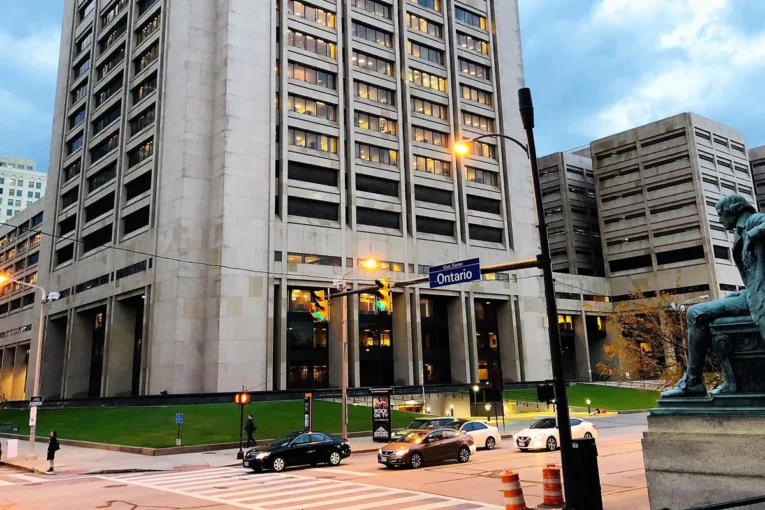
CLEVELAND, Ohio — A Cuyahoga County judge granted a new trial Tuesday, Nov. 10, to Roberto Wynn, who has spent approximately 18 years incarcerated for a murder he maintains he did not commit, following the recantation of testimony by a key prosecution witness.
Common Pleas Judge Jeffrey P. Saffold issued the ruling after an Oct. 27 evidentiary hearing at which Clifshell Stevenson, a central witness in the original prosecution, testified that she had falsely identified Wynn as the shooter.
The decision represents a significant development for the Ohio Innocence Project, which has represented Wynn in his efforts to challenge his 2009 murder conviction.
Although the ruling grants a new trial, it does not establish Wynn’s innocence or guarantee his immediate release. Prosecutors may pursue another trial or dismiss the charges.
According to Ohio Innocence Watch, a bond hearing was scheduled for Thursday, Nov. 12, at 9:30 a.m. The outcome had not been confirmed as of publication.
Wynn was convicted in connection with the April 25, 2008, fatal shooting of Christopher Basie on Cleveland’s East Side.
Stevenson, who was 12 at the time of the shooting and 13 when she testified in the original case, identified Wynn as the shooter during his prosecution.
However, she signed a statement recanting her testimony in 2022 and provided a different account during the Oct. 27 evidentiary hearing.
“I did not see him fire a gun,” Stevenson testified, according to News 5 Cleveland.
She instead described seeing Wynn running for cover.
Stevenson also alleged that Cleveland police and a family member pressured her to identify Wynn when she was a child.
In her 2022 statement, Stevenson acknowledged blaming Wynn for a shooting she said he did not commit. She also stated that she was certain Wynn did not have a gun.
Stevenson explained that she had been angry with Wynn at the time and had not understood the consequences her statements could have for his life.
During the October hearing, Stevenson said she had struggled with guilt over her original testimony.
“I just feel like my spirit been under attack since all this transpired,” she said, according to News 5 Cleveland.
Prosecutors disputed Stevenson’s credibility, arguing that three other witnesses had also identified Wynn as the shooter.
Donald Caster, Wynn’s former attorney with the Ohio Innocence Project, challenged the reliability of the remaining testimony.
“What’s left of the case is merely the testimony of wildly inconsistent witnesses,” Caster told News 5 Cleveland.
Caster argued that Stevenson’s original testimony had been central to securing Wynn’s conviction.
“Without the witness who recanted, there almost certainly wouldn’t have been a conviction in this case,” he said.
Wynn is now represented by Ohio Innocence Project attorney Lauren Staley.
The legal proceedings also exposed delays in Ohio’s post-conviction review process.
Wynn’s attorneys filed a motion in 2024 seeking permission to pursue a new trial, but the request remained unresolved for more than two years.
An investigation by News 5 Cleveland highlighted the delay. Following a July attorney conference held the same day the investigation aired, Saffold permitted Wynn to proceed with his motion.
News 5 identified 28 Cuyahoga County cases since 2014 in which motions for new trials remained unresolved beyond 120 days, the standard established by the Ohio Supreme Court.
Michael Donnelly, a former Ohio Supreme Court justice and founder of Ohio Court Watch, said prolonged delays reflect broader problems with post-conviction proceedings.
“Unfortunately, delays are very common,” Donnelly said. “It’s not because of an individual judge. It’s a systemic problem.”
A Nov. 9 investigation by The Marshall Project, published by WOSU Public Media, examined Ohio’s restrictive post-conviction procedures and recommendations made by a 2022 Ohio Supreme Court task force that remain unimplemented.
Proposed legislation, Ohio House Bill 177, would establish additional procedures for considering newly discovered evidence and require hearings on qualifying motions.
Introduced in March 2025, the legislation had not received a committee hearing as of the latest reporting.
For Wynn and his family, the ruling follows nearly two decades of efforts to challenge his conviction.
“My life is in the balance,” Wynn told News 5 before the evidentiary hearing. “I just want my freedom back.”
His father, Ronnie Wynn, described the emotional toll of his son’s incarceration.
“It’s not just him locked up. We been locked up too,” he said.
Wynn’s mother, Carla Butler, also expressed hope that her son would eventually return home.
“I look at it as my prayers has been answered,” Butler said.
The Nov. 10 ruling gives Wynn another opportunity to contest the murder charge, but prosecutors have not announced whether they intend to retry him.
The court’s next scheduled proceeding was the Nov. 12 bond hearing, which could determine whether Wynn remains incarcerated while the case moves forward.
To comment please go to one of these social media platforms:
Facebook: https://www.facebook.com/DavisVanguard
LinkedIn: https://www.linkedin.com/company/peoples-vanguard-of-davis-inc/
Instagram: https://www.instagram.com/davisvanguard/
X: https://x.com/davisvanguard
Bluesky: https://bsky.app/profile/vanguardnewsgroup.bsky.social
Subscribe to the Vanguard News letters. To make a tax-deductible donation, please visit davisvanguard.org/donate or give directly through ActBlue. Your support will ensure that the vital work of the Vanguard continues.
