
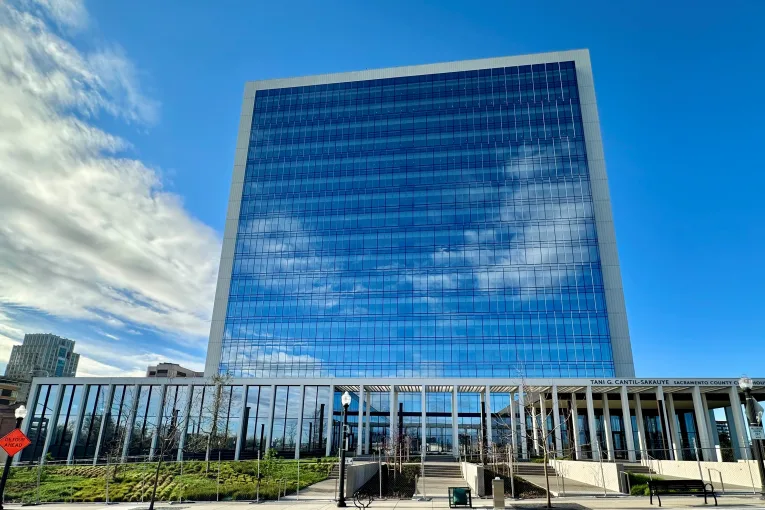
SACRAMENTO, Calif. — As approximately 450 Sacramento Superior Court employees continue a strike over wages and working conditions, court administrators are directing jurors and people with scheduled court appearances to report as usual, raising questions about whether the court is unnecessarily requiring members of the public to cross union picket lines to maintain normal operations.
The strike, which began Monday, Nov. 16, followed unsuccessful mediation between the court and United Public Employees (UPE), the union representing court clerks, court reporters, court attendants, paralegals and other employees responsible for the daily operation of Sacramento County’s judicial system.
On Tuesday, the second day of the strike, the Sacramento Superior Court announced that all court locations remained operational, even as some services were suspended because of the labor action.
In a statement, Court Executive Officer Kelly Sullivan defended the decision to keep courtrooms operating, emphasizing the court’s responsibility to protect vulnerable residents and comply with legally mandated deadlines.
“The doors of this court are open today because they have to be,” Sullivan said.
Sullivan cited domestic violence survivors seeking protective orders, children involved in dependency proceedings and crime victims preparing to testify as examples of people who cannot afford to wait for the labor dispute to be resolved.
“There are children in our community living in conditions no child should endure,” Sullivan said. “When a social worker brings their case to us, a judge must act, and must act quickly. The law sets deadlines for these children because their safety cannot be postponed.”
The court also noted the importance of continuing criminal proceedings, including felony arraignments that must occur within state-mandated deadlines.
However, the court’s operational instructions extend beyond emergency proceedings.
According to its announcement, all Sacramento Superior Court locations remain open, jurors are required to follow the reporting instructions for their assigned groups, and anyone with a scheduled court date must appear unless notified otherwise.
The court’s directive applies to all scheduled appearances, not just emergency proceedings. Jurors have been instructed to follow their assigned reporting schedules, while attorneys, litigants and others with scheduled court appearances must appear unless notified otherwise.
Jurors face particular pressure because jury service is a legal obligation rather than a voluntary activity.
Under California Code of Civil Procedure Section 209, prospective jurors who fail to respond to a summons or appear as directed can face court-imposed sanctions after receiving notice and an opportunity to be heard.
Consequently, a juror who does not wish to cross a union picket line may face a different set of considerations than an ordinary member of the public deciding whether to enter a struck workplace.
Attorneys, witnesses and litigants may also be subject to court orders, subpoenas or other legal obligations requiring their attendance.
California’s Trial Court Employment Protection and Governance Act establishes collective bargaining protections for trial court employees, including prohibitions against interference, restraint or coercion in the exercise of protected labor rights.
The Public Employment Relations Board has jurisdiction over labor relations involving trial court employees.
Those protections do not automatically excuse jurors, attorneys or litigants from complying with court orders. Nor does the court’s decision to remain open, by itself, establish a violation of labor law.
Nevertheless, the decision to maintain ordinary reporting requirements during a strike raises a broader question about whether court administrators could preserve essential judicial functions while limiting operations that require people to cross picket lines.
The court has not publicly clarified whether prospective jurors seeking postponements because of the strike will be accommodated or whether judges have been given guidance concerning strike-related requests for continuances.
The labor dispute follows months of unsuccessful negotiations over employee compensation and working conditions.
UPE has sought wage increases to address rising living costs, while also raising concerns about staffing shortages, increased workloads and employees’ ability to take time off.
According to union bargaining updates, employees have been working without a contract since September.
The union has also criticized compensation decisions involving court management, alleging that operations directors received raises of approximately 9.5% earlier this year while rank-and-file employees were offered substantially smaller increases.
In its Tuesday statement, the court said it presented two proposals to UPE on Oct. 20 following mediation.
Together with earlier proposals, the court said its offers included a one-time payment of $1,000 to all regular employees and salary increases of 2% to 3% for 131 positions.
The court has cited financial constraints in defending its bargaining position, including concerns about its funding allocation and the long-term sustainability of recurring compensation increases.
The union, meanwhile, has argued that its members are essential to the functioning of the judicial system and that their compensation and working conditions should reflect those responsibilities.
Sullivan acknowledged the employees’ contributions in her statement while defending the decision to continue operations.
“Our employees have spent their careers keeping that promise,” Sullivan said. “They know these victims, these families, these children, because they serve them every day. We respect their right to advocate for themselves, and we look forward to the day they are back with us.”
She added, “Nothing about keeping our doors open diminishes how much we value them.”
But Sullivan also made clear that the court intends to continue conducting proceedings throughout the labor dispute.
“But the people who depend on this court cannot pause their crises while we resolve our differences,” she said. “So, we will stay open. We will protect the vulnerable. And we will keep working, at the bargaining table and in every courtroom, toward the day we are whole again.”
Despite the announcement that all court locations remain open, the strike has already affected public services.
The Family Law and Probate Self-Help Center and Civil Self-Help Services are closed, although the Sacramento Law Library remains available to assist residents with accessing and completing court forms.
Meanwhile, the court continues to require jurors to follow their reporting instructions and people with scheduled court appearances to appear unless notified otherwise.
To comment please go to one of these social media platforms:
Facebook: https://www.facebook.com/DavisVanguard
LinkedIn: https://www.linkedin.com/company/peoples-vanguard-of-davis-inc/
Instagram: https://www.instagram.com/davisvanguard/
X: https://x.com/davisvanguard
Bluesky: https://bsky.app/profile/vanguardnewsgroup.bsky.social
Subscribe to the Vanguard News letters. To make a tax-deductible donation, please visit davisvanguard.org/donate or give directly through ActBlue. Your support will ensure that the vital work of the Vanguard continues.
